Continued pessimism in short term price as weakened demand outweighed production cutback
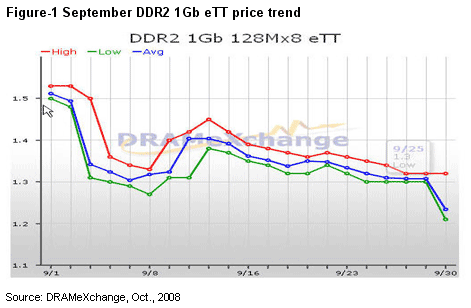
DRAM makers have announced cutbacks in production since September – PSC, Elpida, and Hynix have separately announced cutbacks on September 8th , 9th , and 18th. If the cutbacks proceed as scheduled, we expect to see a reduction in worldwide DRAM production by 5 to 6% around end of October to November. Spot market was encouraged - rose from 1.32 USD on September 8th to 1.4 USD on September 10th for an increase of 6% - initially when the first cutback was announced. However, the rebound was short-lived; by September 11th, price on spot market began to fall again. After the last announcement of cutback from Hynix, spot price failed to continue the rise with average price increasing slightly by 0.01 USD then weakened by the continued slow demand. Overall, spot market demand continued to weaken in September in spite of announcements of the production cutback.
Contract price fell precipitously in 2H September with average selling price of 1GB SO-DIMM 667MHz dropping by 15.6% - the biggest decline seen in the past 6 months. Economic recession has begun to spread from US to Europe and emerging markets in 3Q08. Branded PC makers with higher exposure in European market continued to lower their shipment target and reduced their DRAM purchase. In addition, previously accumulated DRAM inventory level at these branded PC makers continued to remain relatively high, which resulted in even lower demand in the contract market. Buyers now are with stronger bargaining power. Taken together, contract price continued to fall under these unfavorable conditions. In addition, given the economic condition, several branded PC makers have turned more conservative about the originally, much hoped for Christmas shopping season in Q4 which added even more downward pressure for the October and November DRAM contract price.
Given that the effects from the production cutbacks will not materialize for at roughly another month, short term contract and spot prices is unlikely to increase given the present weak demand. Although short term price is supported at current level given that cash cost of a single DDR2 1Gb die is roughly 1.3 to 1.5 USD, unless other DRAM makers follow suit and cut back production, DRAM price will continue to fall with the production cost improvement or the weakening demand. Supply reduction is the only way to see a recovery of DRAM price given the current DRAM market.
Creating new demand in flash memory card market - attention worthy, follow-up development of “slotMusic”
The global flash memory card leader - SanDisk - announced in a 9/22 press release the mid-October launch of the slotMusic memory card, which is basically a micro-SD card with preloaded music and no Digital Rights Management (DRM). The slotMusic combines musical contents from four main US record companies - EMI, Sony BMG, Universal, and Warner - and assistance from both dominant physical and online distribution channels such as Wal-Mart and BestBuy. With no DRM software installed, consumers are free to play the preloaded music on any cell phone with a micro-SD slot, MP3 music player, or PC and car stereo with an USB interface converter.
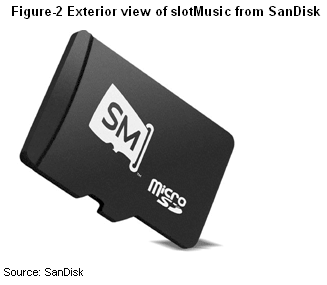
The launch of slotMusic from SanDisk, using 1GB micro-SD as a physical storage medium, introduced certain meaningful changes to the current music consumption model. First, slotMusic provides a convenient and portable alternative for consumers to purchase music legally. Currently, music is distributed either through traditional CD in a physical store or through online distribution softwares such as iTunes, which downloads singles or albums digitally then transfers the paid music content to MP3 music player via PC. Physical store that offers CD also offers more musical variety with the downside being that consumers need to go through the tedious and time consuming task of transferring music from CD to MP3 player via PC. Online music distribution softwares such as iTunes offer the convenience of direct download from internet but also often meant that consumers need to purchase certain software restricted hardwares - such as iPod or iPhone - in order to listen to the music content. In addition, certain consumer segments are still somewhat insecure about the online payment mechanism.
Motivated by the facts that, first, as many as half of all cell phones shipped annually are equipped memory card, second, a significant number of MP3 players comes with micro-SD slots, and third, slotMusic can also be used in PC through a converter, SanDisk expects huge business opportunity to open up once consumers experience the convenience of this new consumption model. slotMusic also provides a new source of demand in a over-supplied global NAND Flash market. Although the number of applications that use NAND Flash as storage medium continues to grow, it is still unable to consume all of the NAND Flash dies produced. Thus, creating new sources of demand is the most urgent issue facing NAND Flash suppliers. Combining resources with several known record companies and distribution channels, SanDisk launched slotMusic as an easy to purchase and highly portable medium to carry music. If this new product is well received at the market, not only will it help to reduce current over-supply in the NAND Flash market, but it will also motivate other primary memory card makers to join forces with other media companies and distribution channels and to create similar products.
Finally, success or failure of music products such as slotMusic ultimately depends on whether its price is acceptable to consumers. Currently, the press media expects slotMusic to sell for 10-15 USD based on the traditional price for a CD. We will not know the actually selling price until after slotMusic is on-rack at each distribution channel. We expect the launch of slotMusic to bring more excitements into a weakened NAND Flash market and to establish a feasible and profitable business model for memory cards with preloaded content.
Netbook – the double edged sword
The concept of Low Price PC has been in existence since MIT originally proposed the OLPC concept. But the first Low Price PC to open up the market is the Asus EeePC in terms of both technology and volume. From the production spec, EeePC is relatively simple compared to mainstream NB. However, thanks to the advances in both technology and process, NB performance and spec has way exceeded the needs of average consumers. Thus, as a product that satisfies the basic needs and a product that offers a price tag much closer to the average wallet size, EeePC successfully leveraged off a joint effort with telecom providers to offer an important channel to be in touch with the average consumers and opened up the Low Price PC market for other PC makers to compete in.
With the concept of Netbook coming to maturity, many NB makers have entered this market, and we begin to see a replacement effect of Notebook by Netbook. With the shaky global economy, a depressing Q3 NB market is now a given with a less than average quarterly growth. Asus, the most prominent Netbook maker, has also stated that it will not be able to meet its shipping target of 7M NB, announced earlier this year. However, Netbook as a category continues its rapid growth with new products launches. Overall, 5M Netbooks are expected to ship this year – a clear indication that for NB, as a mature product category, low price has become an important factor to stimulate demand.
It is now obvious that demand for a usable and cheap Netbook has replaced demand for certain NB models. Even Acer, which emphasizes on its low price as its strategy, has also felt the Netbook market surge as more customer inquired about the even cheaper Netbook. Along with the changing product mix, NB makers have also experienced a change in expected revenue growth for the year. Take Quanta for example, Quanta saw a reduction in shipping for high priced NB and an increase in low priced Netbook in August which resulted in a reduction in both ASP and revenue. Although Quanta still expects a positive growth in overall Q4 NB shipment, its revenue performance become more uncertain as more Netbooks are shipped.
How PC makers view the operating contribution from Netbook and how they view the interaction between market forces because of Netbook will determine the future growth of Netbook as a product category with the later being an important factor for the continued existence of Netbook. Netbook products have already successfully broken into consumer niche market and have proven the existence of this market niche. Thus, as long as one NB maker continues to introduce new Netbook models, other NB makers will not allow this market to be left untapped either. Market growth will, therefore, depend on how fast can NB makers adjust its operation efficiency to counter the increase in amount of low price NB made.
Thus, in terms of the future NB market, mainstream NB will continue to occupy an important part in the commercial market. However, in the consumer market, we expect to see a polarized market with more high end and low end products (included Netbook). We further expect a faster growth in the low end product lines than the high end.


