DRAM spot price enjoys a temporal boost amid supply cut
PSC and Elpida have announced respective DRAM output cut recently. Amid the reduction, global DRAM output is estimated to be reduced by 2-2.5% accordingly. Of which, PSC will cut output by 10-15% and Elpida will cut its Hiroshima, Japan fab output by 10%. PSC and Elpida house a respective output of 130k and 115k, respectively, representing a global market share of 20%.
Buoy from the supply reduction news, price of DDR2 1Gb eTT appreciated from US$1.32 to US$1.39 with price once hit US$1.40 mark. Over the week Sep 9-15, a sequential growth of 5.3% is seen. Price of DDR2 512Mb eTT has also appreciated by 5.7% in the same period. But prices for the DDR2 667 1Gb and 512Mb DDR2 were maintained static without being spurred by the news.
Although spot pricing did enjoy a temporal catalyst last week, the entire market is back to basic – oversupply. Given that the supply volume will take two months to see the impact, and that present inventory at the spot market is still high, impact from the output reduction has failed expectation. Demand is also encountering bottleneck as the acute price plummet as seen in early 2008 has spurred memory content per box to 2GB. The weaker-than-expected boost from Vista SP1 for memory upgrade thus slows down memory growth in 2H08.
DRAM spot price has dropped by an approximate of 20% since the Beijing Olympics ended. Despite price of 1Gb eTT once hit US$1.39 mark last week, the present pricing is still lower than makers' variable cost of US$1.30-1.50. Since DRAM makers have been bleeding in red for seven straight quarters from 2Q07, they are teetering on the brink of eroding operation fund, rising debt ratio and more difficulties on fund raising (probably last through 2009). Output trim, thus, being the only way to resume the industry to normality. The Elpida-PSC camp’s10-15% output cut is not powerful enough to drive the swing. Korean makers, who have a combined market share of almost 50%, will be a critical indicator. Without any of them cutting output nor quitting from the market, time for a recovery will be postponed.

New Launch of iPod nano by Apple to Promote Customers' Demand
Apple has introduced a 32GB iPod Touch and reduced price of 1GB iPod Shuffle to US$49 and replaced the original US$79 model with 2GB memory in February. Seven months later, after releasing these new products, Apple has officially introduced a new iPod nano in September.
Apple doubles memory in the 4th generation iPod nano to 16GB (at US$199) and prices the 8GB model at US$149. Built on an accelerometer, the new iPod nano will switch to Cover Flow (music library) when rotated and goes to Shuffle (music) mode when shaken. The new 8GB iPod nano holds up to 2,000 songs or eight hours of video and the 16GB model doubles the volume and time of the 8GB one.
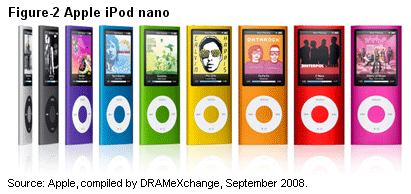
Launch of the new iPod lineup is in fact a marketing strategy to draw more sales amid an earlier launch of a 3G iPhone. The innovative designs and features that iPhone brings have prompted Apple to cut price of iPod Touch to spur those existing iPod customers to replace their models with more density ones. It also encouraged Apple to reduce price of iPod Shuffle to draw sales from potential iPod customers.
The launch of new iPod nano, on one hand, is a strategy to strengthen existing iPod customers. The launch has justified that Apple maintains as the leader in the MP3/PMPmarket. Apple also tries to resume its sales model as introduced during the launch of iPod Shuffle, aiming to boost sales via cutting prices with more density.
According to Apple, it shipped a total of 11mn units in 2Q08, representing a 3% sequential increase. But ASPs have also declined by 11% in the same period. This implies that the price cut of iPod nano may also drag down overall ASP in the following quarter. For other first-tier rivals in the industry, Apple's price cut and new product launch will leave them with no alternatives but to follow. It is an inevitable trend to see MP3/PMP to come with higher memory density with even lower price.
NAND Flash demand remains weak in 1HSep, resulting in 0-15% drop in corresponding contract pricing. Price of a 16Gb MLC chip has dropped by 20% in a month's time to US$2.60, down from US$3.24 in 1HAug. This is because most downstream players are still holding conservative outlook with inventory clearance ongoing. Due to a low demand visibility in 4Q08, industry players are conservative about seasonal demand surge. It is expected that NAND Flash price will only stabilize when demand amid seasonality starts emerging.


