Spot price hits new lows; Contract price to continue head south in September
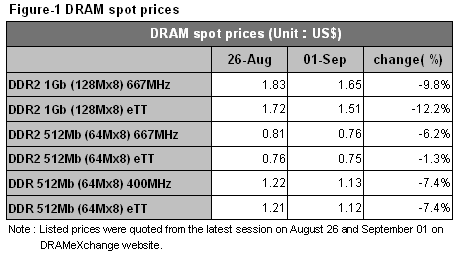
Demand for DRAM does not recover after the Beijing Olympics. By seeing their expectations being failed, some memory module makers thus started initiating price cut at China. Therefore, price of DDR2 1Gb eTT has dropped by an approximate of 7% within single day to US$1.51, marking a new record low since Nov 27 (at US$1.57). Price of DDR2 1Gb eTT has declined by 20% throughout August. And that price of branded DDR2 667 1Gb has also dropped to new low at US$1.65 in the same period.
Some industry players explained the 10% sequential DRAM contract price drop in 2HAug to a noticeable drop in PC OEM demand. Amid a weak economy trend and unclear demand visibility for Christmas, PC OEMs have started trimming their inventory from a 6-8-week amount. Some orders were even said to be cancelled. DRAM makers thus have no alternative but to lower their price further. Given that the downward price trend is solid, price should hit bottom in October.
After seeing a price plummet in early 2007, DRAM makers still fail to see their ASP rises above cost, despite pricing has shown some temporal rebound or stability. Thanks to pre-stock procurement among PC OEMs and traders, price appreciated by more than 20% in 2Q08. Some DRAM makers thus expected to swing from loss to profit under an anticipation that the upward price trend would sustain.
However, spot price later posted a sharp fall in early July, followed by a weakening contract price trend in late July. While price seems having no upside catalyst in 3Q08, inventory clearance pressure is intensifying on an eroding demand. When more industry players expect a supply trim to drive price upward, DRAM makers have no way back but to continue expanding and shrinking design geometry. Therefore, pace of DRAM cost down lags behind ASP erosion.
In addition to additional output from 50nm generation migration, new camps are also expected to fill the market with fresh capacity. Nanya, which has forged partnership with Micron, is expected to add an extra capacity of 30k per month at its Fab 3 during the second phase production. Fab 2, which is scheduled to remodel as 12-inch fab, will also contribute another 45k of capacity. Rexchip also has plans to expand capacity at its R2 to 30k in 2009. And Elpida will also tie up with UMC and Suzhou Venture Group (SVG) for a 12-inch wafer fab in China. The aggressive expansion plans imply that oversupply will continue weighing on DRAM makers' profitability in near term. Under such an industry trough, a market mechanism will edge out those players with poor cost structure.
Soft NAND Flash pricing; Industry players strongly anticipate a mass adoption of SSD
NAND Flash contract prices continue trending downward in 2HAug. Price of 8Gb and 16Gb MLC averaged at US$1.90 and US$2.96, respectively, representing a sequential decline of 10% and 8%.
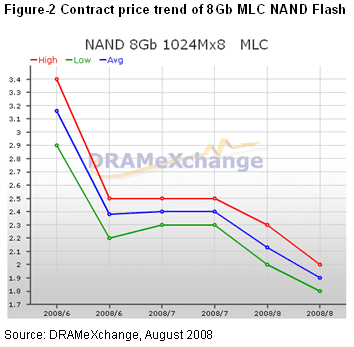
Consistent overage of NAND Flash is the key factor of the price erosion. In near term, downstream players are still looking for potential demand recovery from the white-box applications market in China after the Beijing Olympics. They also anticipate a possible rebound when Europe- and US-based vendors make pre-stock procurement for Christmas after summer holidays. In a word, they are hoping possible demand recovery to stabilize a volatile price trend as seen recently.
However, a true killer application will be a fundamental strength to stabilize price in the mid- to long-term. Among all applications, SSD (solid-state disk) is widely expected to be a possible demand driver as its high density is likely to consume a considerable amount of NAND Flash within a short period of time.
Despite demand for SSD grows mildly from 2Q08, a relatively high retail price still constrains it as a niche applications. Yet, as many leading chipmakers all regard SSD as a killer application, their continual efforts in SSD deployment help drawing more upstream and system makers to join.
Some vendors even claimed their SSD production has entered into volume stage. Besides a consistent technology development, a stronger integration with end products and a well-established standard are vital for ongoing SSD penetration.
SSD standardization is one of the most important issues that has to be addressed. Among all the leading players, Samsung, SanDisk, Intel, Micron and Toshiba have all reveal their respective SSD standards, highlighting the fact that every player wants to take a lead in SSD standardization.
Toshiba has tied up with memory module and controller designers in Taiwan on the SSD Alliance establishment. Given that the alliance has a strong anticipation over SSD position in PC space, they are also soliciting PC vendors to join the alliance.
Intel, on the other hand, has already set an ONFi standard before the SSD Alliance was established. It has recently announced to partner with JEDEC to develop ONFi 2.0 standard, aiming to simplify NAND Flash applications in different segments.
Samsung has chosen to partner with software giant Microsoft to enhance SSD compatibility with Vista, primarily because it believes potential should stem from an integrated Vista and SSD environment.
For SanDisk, it has designed specialized endurance and Bapco usage models for specialized applications. It has also introduced a LDE (Long-term data endurance) concept. Under the LDE concept, endurance of a SSD will be defined by LDE (total amount of data writes allowed in SSD lifespan).
A quick review of SSD standardization among the aforementioned players shows that it is hard to have a well-defined SSD standard prior to a meaningful adoption of SSD. But this does not necessary mean that a SSD standardization could be held. When industry players are having a strong anticipation about SSD penetration, having related standards well established is also critical and urgent.


