Contract price remains firm, but gap between spot and contract still remains
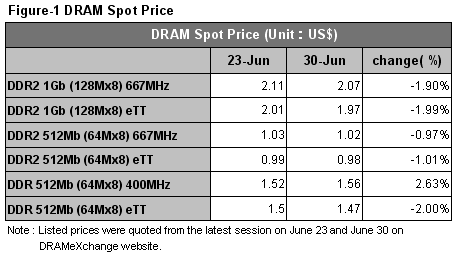
A low transaction volume during seasonal downturn is normal, but a divergent price trend in two market places is indeed rare. spot price of eTT 1Gb dropped by 8.4% in two weeks’ time, down from the high-level US$2.15 in mid June to US$1.97 on June 30. A divergent price trend is observed in DRAM contract and spot market. While DRAM contract price is trending up steadily amid tight supply, the downward spot price trend only reverse to a flat trend last week after experienced consecutive drops since mid June.
The performance of spot market can be explained from supply and demand. On the supply side, Rexchip was ramping up in the 1H08 and create excess supply to the spot market. On the demand side, Since the China government enacts a stricter policy on customs checks prior to the Beijing Olympics, distributors who found some difficulties of their shipments. The pending parts which couldn't enter China partially end up in the spot market else where and created pressure to the DRAM spot price. Some industry players were even skeptical about a fundamental demand weakness. Buyers, on the other hand, turned reluctant as they worried that the increased volume may stem from quarter end inventory clearance at upstream. These factors slow the buy side down.
DRAMeXchange believes that amid the aforementioned reasons, Rexchip had ramped up most rapidly during Q1~Q208 and reached full capacity in Q208. The upside of Rexchip output in Q3 is limited. On the China issue, as long as the real demand doesn't become weak, the situation mentioned above will be solved by market mechanism after the Olympics. Quarter end clearance had also been done now. Given that the price gap between contract and spot prices encourage OEMs to increase their procurement proportion to the DRAM makers who mostly used to do spot and module house business. If the vendors passed the certification and once the procurement volume increased sufficiently, this would become another consumption path of the spot market supply. Unless the demand of DRAM is far below expectation, the spot price should consolidate and go up again. There should be 10~20% upside of 1Gb eTT.
NAND Flash June Price Trend Recap –- Downhill Trend Amid Quarterly Financials Pressure and Seasonal Downturn
NAND Flash pricings in both contract and spot market are lulled by gloomy economy in June. Amid a high crude oil price trend and intensifying inflation pressure, consumption incentive of consumer electronics have been whittled down globally.
In the spot market, spot price of the benchmark 8Gb MLC has been dropped by early June’s US$2.74 to June 9’s US$2.68 and finally June 30's US$2.28. Whereas in the contract market, a mild upward price trend as seen in April has came to an end in May. A stronger price-drop magnitude was seen in June, with price of 8Gb MLC dropped from US$3.26 in late May to US$3.16 in mid June and finally US$2.38 in late June.
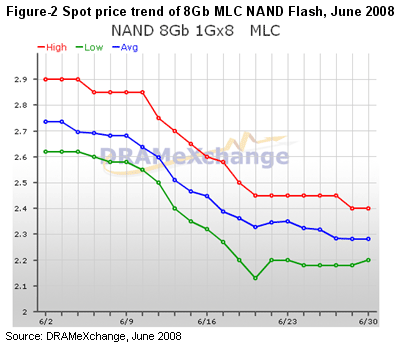
Key factors behind the consistent price decline are:
1, Seasonal downturn: Buyers are in lack of a strong incentive to make their procurement under a mixed market outlook where downstream players are also reluctant to grow their inventory level.
2, High crude oil price: Consumers are being discouraged under inflation pressure amid high crude oil price. Not only shopping incentive for new products has been discouraged, but also replacement demand.
3. Quarterly-end financial pressure: Vendors are more flexible over price bargaining amid inventory pressure concern.
4. Weak demand for memory cards;
5. Pessimistic economic outlook that implies an absence of a powerful catalyst to consumer electronics sales.
A stabilizing price trend is expected in mid 3Q08 because:
1. Upcoming seasonality upturn for consumer electronics;
2. Apple 3G iPhone shipments are expected to hit 12mn units as global telecom service carries will bundle sales in a more favorable package;
3. Low-cost PC market is expected to materialize with shipments to hit 8mn units.
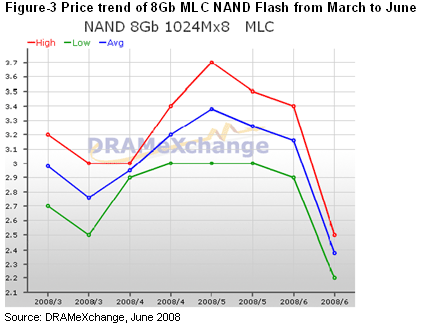
2H June Contract Price Recap
Average NAND Flash contract price of 2H June dropped at the range between 5 to 25% due to the quarter-end factor. Market suppliers take strategic price-cut policy to lower their stock and stimulate the weaker NAND Flash market demand. NAND Flash price is likely to gradually stabilize after Mid-July pushing by lower price, new demand from 3G iPhone, smart phones and Low-cost PCs. Price is expected to rebound and stabilize as the traditional 2H hot season demand gradually recovers.


