The last winter for DRAM module makers
After DRAM module OEM Lih Duo forced to suspend production after reporting bounce checks, TwinMOS is also said to shutter business on April 15. While some DRAM module makers are being expelled from the industry, leading players such as Kingston and Transcend, shift to enhance profit and try their best to reduce inventory level.
Prior to seasonal upturn, operation and cash utilization strategy will be the judging criteria for survival. If the industry trough about to last for a while, more DRAM makers are expected to quit the market. Since DRAM module makers also play a vital role to tune inventory level between upstream and downstream, a considerable number of players quitting the market are not necessarily good news for the industry in our view.
DRAM spot price stabilize
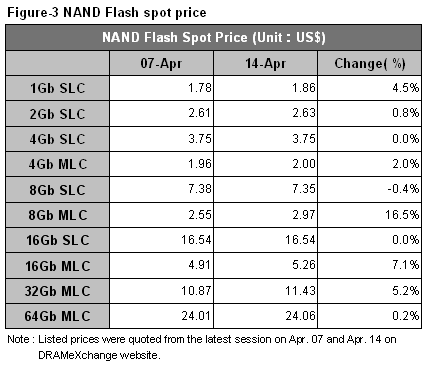
DRAM spot prices corrected in the high range as expected last week. Transaction was weak, especially after March 9, when marketers stopped chasing for a higher price. Supply of eTT was relatively low last week, implying a weakening selling pressure.
DRAMeXchange records that price fluctuation of DDR2 1Gb 128x8 and 512Mb 64x8 eTT stays in the range of 4-5% from late March, with the 128x8 part once hit its record-high price range since 2HFeb at US$1.82. This marks a relatively strong pricing during traditional seasonal downturn.
Where for the contract market, prices are generally flat or post mild growth as of today. Sell side has not revised up their quotes as reported by media. Most chipmakers, who are already selling at losses, are insisting strong on their quotes, though OEMs are still looking for price cuts.
We think 2GB module is the only item that is likely to see price adjustment as PC OEMs are growing their demand and consumers also prefer to install one 2GB module instead of two 1GB modules under future upgrade concern.
Price of a 2GB module averages at US$40, whereas price of two 1GB modules is US$35. As demand for 2GB module ramp up, the observed price gap implies a room for further price cut in the future.
A consistent NAND Flash price rebound depends on NAND Flash related end product demand
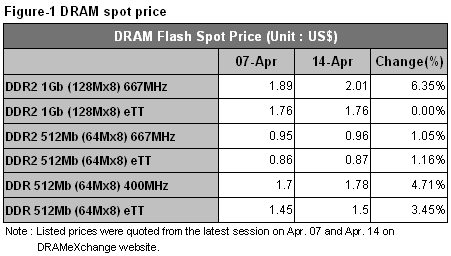
Prices of the mainstream 8Gb MLC started to show signs of a rebound signs last week, after experiencing a weak price trend for more than six months. Whether the upward price trend is sustainable remains uncertain.
The contract price of the 8Gb MLC weakened from mid August. Price did not trend upwards during the traditional hot season in 4Q07, as the subprime crisis dampened the NAND Flash demand at the end market (see Fig 2).
Persistent expansion at chipmakers’12-inch fabs also prevented prices from increasing. As chipmakers saw their yields on 5x nm achieve the standard benchmark in 4Q07, and that all key players were aggressively increasing their respective capacity, a glut arose. In light of the oversupply, downstream players became more conservative about their procurement in 1Q08, resulting in the price of the 8Gb MLC to lack any catalyst in trending upwards.
News about the NAND Flash output cut by major players has spurred price up recently. Hynix recently announced to trim its output at its 8-inch fab (M9) and delay production at another 12-inch fab (M11). IMFT, at the meantime, also announced that it would delay the volume production schedule at its Singapore 12-inch fab. The volume production was originally slated for 2H08. Whether the observed price rebound implies a sign of an improved outlook still depends on the existence of a meaningful demand recovery in the near term.
1H April Contract price comment
The NAND Flash average contract price for 1H April, 2008 fluctuated, ranging between -3% to 7%. Due to Hynix’s reduction announcement for its 8-inch M9 fab from 2Q08 to 3Q08 and the postponement of new 12-inch M11 fab, certain contract prices showed a sign in trending upwards. However, some contract price still fell due to the low season effect. We assume Hynix’s reduction will reduce about 6 % of total 1Q08 global NAND Flash wafer capacity. Market will remain in an oversupply in 2Q08 but will gradually become more balanced in 3Q08. We expect to see price stabilize for the short term due to the supply reduction effect. However, the contract price will gradually rebound, as long as traditional 2H hot season demand increases.
NAND Flash spot price recap, Apr 7-14
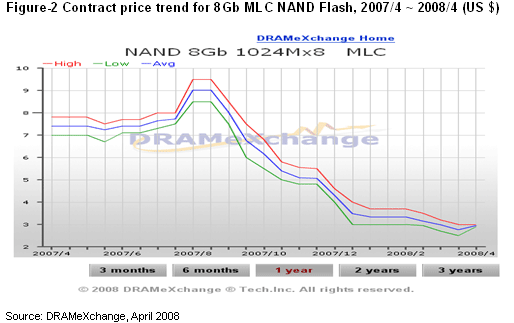
In the SLC segment, price of 1Gb up 4.5% to US$1.86; 2Gb up 0.8% to US$2.63; 4Gb flat at US$3.75; 8Gb dropped 0.4% at US$7.35 and 16Gb flat at US$16.54. In the MLC segment, price of 4Gb up 2% to US$2; 8Gb up 16.5% to US$2.97; 16Gb up 7.1% to US$5.26; 32Gb up 5.2% to US$11.43 and 64Gb up 0.2% to US$24.06.