Short term correction in spot, contract remains firmly up
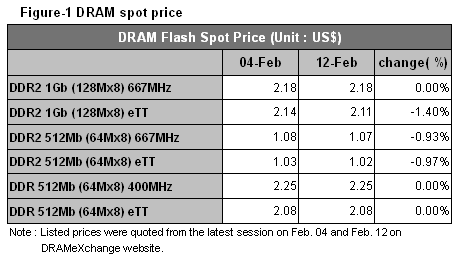
It was Chinese New Year Holidays last week and most Asian spot markets were closed. Taiwan spot market started trading again on Tuesday, where a higher trading volume began to appear in the afternoon, but was still considered relatively low. In the China spot market, players are still in their way back to work, thus the trading momentum was even lower. Last week (2/4-2/12), DDR2 512Mb eTT and DDR2 1Gb eTT dropped 0.97% and 1.4%, average spot price closed at US$ 1.02 and US$ 2.11 respectively. The difference between DDR2 1Gb chip price and DDR2 512Mb is converging.
In the contract market, not too many OEMs settled their contract price since the CNY holidays started at the beginning of Feb. During the holidays, some settled their DDR2 1GB module price mainly around US$ 17 to 18, but other OEMs plan to negotiate the price in 2H Feb with larger quantity of buying. The recent settled contract price is pretty close to the price settled at the beginning of Feb. which was about US$ 0.5 higher than in 2H Jan.
After the recent rally where the DDR2 512Mb eTT chip price reached US$ 1.2, the spot price is now approaching resistance. On the other hand, the nature of the contract price is that the surging price momentum is always not as strong as the spot price. Even the recent rebound of the contract price remains steady, until 2H Feb, there already exists quite a big price gap between contract and spot. Calculating a 1 GB module made of eight DDR2 1Gb 128Mx8 667MHz spot chips, the module might approximately cost US$ 20.4 which is already more than 10% higher if the US$ 18 contract price is considered. Under the normal DRAM demand and supply situation, the chance of strong 2H Feb contract price rally is relatively low. It will be normal if the already strong surged spot price pulls back. The range of US$ 0.95 to 1 can be considered the first correction supporting area of spot DDR2 512Mb eTT. If the support is firmly provided, the spot price might form another higher bottom.
4Q07 revenue ranking of branded NAND Flash makers
Impacted by the sharp decline of NAND Flash price in 4Q07, branded NAND Flash makers saw a revenue decrease to US$ 3.9bn in 4Q07, or a 2.9% decrease QoQ. Because of, one, the continued impact of the mid-3Q07 Sub-Prime Mortgage woes lasting into 4Q07, which led to a disappointing traditional shopping season result, two, the smooth transition to 5Xnm process, which led to about 45% QoQ increase of bit shipment for all branded NAND Flash makers and subsequently led to a reversal from under-supply in 3Q07 to over-supply in NAND Flash market, and three, the expectation of a global economic slowdown in 1Q08, average NAND Flash price fell precipitously about 33% QoQ in 4Q07.
Ranked by 4Q07 revenues, Samsung continued to be in the lead position with Toshiba and Hynix in second and third place. However, Toshiba and Hynix market share have fell slightly given the rise on Intel and Micron’s market shares. Top 4 NAND Flash camps in 4Q07 – Samsung, Toshiba, Hynix/STMicro and IM Flash revenue make up nearly 98.7% of entire branded NAND Flash revenues. The 4 camps thus will become the major players in NAND Flash market in 2008. The 2007 NAND Flash market revenue for branded manufacturers was US$ 13.37bn while the 2007 top 5 vendors by revenue is again Samsung, Toshiba, Hnyix, Micron and Intel – same as the 4Q07 ranking.

Samsung NAND Flash market share by revenue was 41% in 4Q07, a slight increase than 3Q07, and continued to lead in the market. While Samsung was able to increase its bit shipment by 44% QoQ with the gradual migrating to 51nm process, impacted by the large price decline, Samsung’s QoQ sales growth stayed flat with revenue of US$ 1.58bn in 4Q07.
Toshiba NAND Flash market share by revenue was 22.3% in 4Q07, a slight decrease QoQ, and continued to be in second place in the market. Although the new 56nm process production has obvious impact on the bit volume shipped, the large scale decline in NAND Flash price made the revenue fell 11.4% QoQ. Toshiba’s 4Q07 revenue was US$ 858M.
Hynix NAND Flash revenue market share was 20.8% in 4Q07, a small decline over 3Q07 but continued to remain in third place among all NAND Flash producers. Although Hynix was able to grow its bit shipment QoQ by 43% with upgrading its 200mm facility from 60nm process technologyto 57nm, ASP QoQ fell roughly 34%; therefore, 4Q07 still showed a QoQ decline in revenue of 7.9% or a revenue of US$ 802M.
Intel and Micron bit shipment largely increased given both the 50nm process production ramp up and mass production from the new 300mm Fab Lehi in 4Q07. This growth was able to absorb part of the impact from a deep price decline in 4Q07 and resulted in a beyond 8% growth in revenue QoQ. Subsequently, Intel and Micron 4Q07 revenue reached US$ 187M and US$ 283M respectively while Intel and Micron 4Q07 market share increased to 4.9% and 7.3% respectively.
Although STMicro had the demand for cell phone related NAND Flash applications and the Hynix capacity to support a continued growing bit shipment volume in 4Q07, the large scale decline in price has made 4Q07 revenue QoQ to remain flat with a 4Q07 market share of 2.4%. Renesas continued to reduce its owned AG-AND Flash production in 4Q07; although its alliance partner, PSC, has already begun 70nm MLC NAND Flash production, the large scale price decrease has left Renesas/PSC camp with a 33.3% decline in revenue QoQ and a market share of 1.3%.


