DRAM Spot Price remained stable, DDR2 512Mb Avg. Price Stands strong above 1 USD
After the strong spot price rally in the first half of January, the Pre-Chinese New Year buying activities had come to an end, DDR2 512Mb eTT had surged up from 0.8 to a high of 1.22 USD. The spot price remained stable in previously (Jan. 22nd to Jan. 28th) and slightly dropped this week (Jan 29th to Feb. 4th) with DDR2 512Mb eTT and 1Gb eTT daily average spot price dropping 1.9% and 1.38% respectively, but still standing above 1 and 2.1 USD level. The market transaction momentum has slowed down already with less volume. Some explained the short term sluggishness was caused by the heavy snow storm in China, but actually it‘s caused by the end of Pre-Chinese New Year inventory preparation.
The price gap between DDR2 1Gb eTT and twice of the DDR2 512Mb eTT price is shrinking and driving market demand to 1Gb chip, which is becoming the main stream item in DRAM spot market. This week 1Gb spot chip price dropped less than 512 Mb in percentage. We did see some players start to sell 512Mb chips and buy 1Gb instead for their longer term holding position. In addition, DRAM vendors are migrating to 70nm process for 1Gb chip making. Buying 1Gb chip has more advantages, such as having more options while assembling chips into modules, and easier to sell in the future which is more attractive speculating buyers.
In the contract price market, the 1H Feb. contract prices are still in negotiation than being settled so far. Some OEM buyers even planned to negotiate the price after the holidays end. Since the DRAM spot price has more price premium over the contract price after the January rally, plus certain DRAM vendor was having annual maintenance, although the DRAM demand remained stable, the vendors are not interested in price slashing and even want to raise the contract price up 3~5% in 1H Feb.

USB 3.0 Standard Kicks off in 2008; Earliest Impact to USB Flash Drive Market in 2009
USB drive and standard memory card both belongs to matured market product. Most USB drives are purchased by PC users to transfer or backup files. Thus it's shipment volume is related to sale volume of desktop and notebook computers. Many vendors of SD memory card over 1GB in capacity often include an USB adapter, allowing SD card to double as USB drive.
With world wide sale of notebook computer grew by 30% in 2007, USB drive sale volume grew in accordance to over 30%, reaching 140 million. Believing that notebook will continue in 2008, USB drive shipment volume is anticipated to grow by 24%, reaching 173 million. NAND Flash consumption by USB drive this year will reach 4799.2M Gb, a growth percentile of 106% comparing to 2332M Gb the prior year.
Leading semiconductor manufacturer Intel is currently working with other large IT equipment manufacturers in creating USB 3.0 specification, and it is anticipated that final specification to be unveiled before the end of first half 2008. According to information revealed by Intel, transmission speed of USB 3.0 can reached up to 4.8Gb/s, a ten fold increase over the transmission speed of existing USB 2.0 specification. This high speed technology can be used to transmit high quality image files, such as DVD, Full HD video, or over 10 megapixel photo images.
Although USB 3.0 is not limited to USB drives, it can be predicted that once USB 3.0 specification is finalized, USB drive usage can expect to expand from PC to other home electronics such as digital television. This anticipated market expansion is a worthy prospect for the USB drive manufacturers, However we believe the anticipated benefit from application of USB drive to home electronics is not expected to be apparent until after 2009.
1HFeb NAND Flash contract price recap.
NAND Flash contract price roughly stayed flat in 1H Feb due to better demand in 2H Jan . In light of sharp price cuts of NAND Flash in 4Q07, some NAND Flash downstream makers started to build up on their inventories ahead of the Chinese Lunar New Year holiday sales in 2HJan. We expect the NAND Flash price to become more stable in the near term. However, NAND Flash makers will need to monitor the future demand in deciding their 2HFeb contract price.
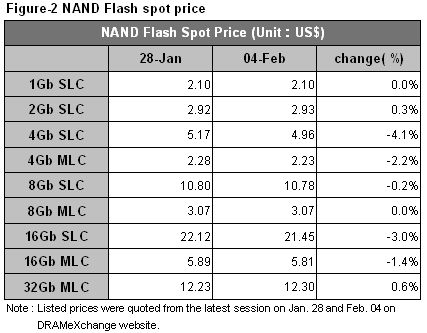
NAND Flash spot price recap, Jan 28-Feb 4.
In the SLC segment, 1Gb part stayed flat and closed at US$2.1; 2Gb up 0.3% to US$2.93; 4Gb dropped 4.1% to US$4.96; 8Gb dropped 0.2% to US$10.78 and 16Gb dropped 3% to US$21.45. In the MLC segment, 4Gb dropped 2.2% to US$2.23; 8Gb stayed flat and closed at US$3.07; 16Gb dropped 1.4% to US$5.81 and 32Gb up 0.6% to US$12.3.