Price of 512Mb DDR2 stabilizing, hitting US$1 mark soon
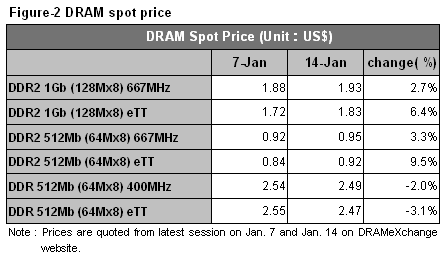
DRAM spot price trend recap, Jan 7-14
Upward price trend was across the board in the DRAM spot market last week, with prices of both eTT and branded chips posting sequential gains. Price trend of DDR2 512Mb and 1Gb highlights the importance of migrating production to higher density, not only because of the mainstream role that 1Gb plays, but also the corresponding cost reduction. By witnessing a perfect W-shape price trend in the spot market and a stable contract price trend in 1HJan, DRAMeXchange also see stabilizing signs for 512 Mb components.
Prices of DDR2 512Mb eTT was hovered around US$0.84-0.85 in the first week of 2008, but saw rebounded from Jan 8. Price was up 6% and closed at US$0.89 during Jan 7-14. The higher-density 1Gb parts, in the meantime, only posted a sequential gain of 2.3% to US$1.76. In the branded chips segment, prices of 512Mb were up 2.1% to US$0.94 and 1Gb up 1.1% to US$1.90.
The price trend highlights that the price of one DDR2 1Gb die has dropped slightly lower than two 512Mb components with less than 1% difference only, justifying that demand for 1Gb is considerable in the marketplace, along with marking the mainstream role of 1Gb parts. Reviewing the price premium of 1Gb over 2x512Mb, the gap was 37% in Oct 2007 and shrank to 5.1% in Dec 2007.
Driven by price pressure, some chipmakers have already migrated their production from 512Mb to 1Gb component. DRAMeXchange estimates that some leading DRAM makers’ bit output for 1Gb should have already exceeded 512Mb’s.
Since producing 1Gb part could save a minimum of US$0.30-0.50 from backend testing and assembling than producing two 512Mb parts, speeding up migration to higher-density chip thus being the most effective way to shrink cost.
By reviewing the historical price trend, the W-shape we saw foretells stabilizing price trend for DDR2 512Mb component, implying that price is likely to head towards US$1 again. Starting from Jan 2, 2007, spot price of branded DDR2 512Mb nose dived by 73% to US$1.70 in May 22, 2007.
The price later rebounded by 40% to US$2.40 on June 22, 2007 but again posted a consecutive drop of 62% to US$0.92 on November 28. As of December 5, price appreciated 4.3% to US$0.96 and hit record-low again to US$0.91 on December 11. By witnessing the spot pricing portraying a complete W-shape, price hit bottom at US$0.92-0.95 over the following three weeks and stabilized thereafter.

DRAMeXchange estimates that the variable cost for DDR2 512Mb is about US$0.80, accounting for 30% of the total cost. History shows us that whenever DRAM spot price edges to similar level as variable cost, DRAM makers are forced to adjust their strategy under cost concern. Besides aggressively easing 8-inch production capacity, some DRAM makers are now preparing for fab annual maintenance during late Jan and some are planning to postpone equipment move-in schedules at new fabs. It usually takes about two quarters’ time to complete these adjustments, meaning that DRAM price will require some time to have its price stabilize in meeting the cost.
DDR2 price likely to see a 30% rebound in 2H08
DRAM contract price in 1HJan highlights that the downward trend finally came to an end. By breaking the module into component quote, the price is indeed close to that of DDR2 eTT in the spot market, and is about 8% cheaper than the branded one in the spot market also. Marketers interpret the price trend as a signal showing that DRAM contract price should have bottomed. They believe price may either stay flat or post mild growth in 2HJan.
Besides the catalyst that stemmed from a stable DRAM contract price in 1HJan, spot price of DDR2 512Mb is believed to resume to US$1 mark in late Jan, as some marketers tend to be more cautious over transaction while some pile stocks in an attempt to make a fortune later, as well as the general consensus about a swell in procurement prior to the upcoming Lunar New Year (in early Feb). If demand is not secure enough to drive price resuming back to US$1 mark, we believe the range will be US$0.80-0.95.
During 2HJan and early Feb, DRAMeXchange estimates that price of DDR2 is very likely to hit US$1-1.20 mark as some DRAM makers that are planning for fab annual maintenance implies an output reduction in March, and that demand for PC is expected to post mild growth in March. Of the major DRAM makers in Taiwan, ProMOS is planning for a two-week-long fab maintenance starting from next week.
Price may even surpass US$2.50 mark, representing a 35% appreciation over current quotes, if some DRAM makers announce cutting capex or holding production prior to 2Q. For those DRAM makers, who are delivering relatively competitive cost structure, the anticipated price trend will mark a farewell to losses.
What UMPC and MID bring to future NAND Flash market in the wireless broadband era
In the recent 2008 CES (Consumer Electronics Show) in Las Vegas, electronics suppliers introduced a lot of new products to lure attention. Ultra-Mobile PC (UMPC) and Mobile Internet Device (MID) were the most popular concepts.In fact, Intel already talked about these two devices in IDF (Intel’s Developer Forum) 2007. Intel plans to develop platforms, codename Menlow and Moorestown, for both devices. Built on Microsoft Windows OS, UMPC’s functions and user interface are more geared to the commercial users, according to Intel. MID, on the other hand, is built on Linux OS and is designed for consumers to surf the Internet when outdoors, and therefore the functionality focuses on mobility, fast boot-up time and multimedia playback.
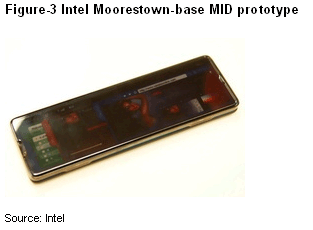
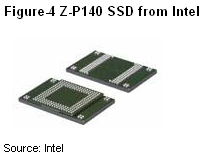
Since mobility is the core concept behind UMPC and MID, and as both devices are built under principles of light, small and energy- efficient, NAND Flash-based SSD therefore will be a more ideal choice for storage. Intel’s Z-U130 and Z-P140 SSDs have already hit product shelves in paving the way for UMPC and MID. These two products will also play key roles to help digest the NAND Flash capacity. Yet, for UMPC and MID to be successful, it is important to develop a faster Internet environment as shown by Intel during IDF.
Most commercial users now use WLAN and 3G networks to go online when outdoors. Consumers will better enjoy a seamless broadband Internet environment when infrastructure deployment for WiMAX and 3.5-4G matures. As of today, WLAN is faster in terms of data transmission, but the effective distance is relatively short. 3G coverage is broad, but its data transmission performance is not fast enough to meet requirement of some high-definition multimedia content applications.
MID and UMPC may become a key driver for NAND Flash demand, as the wireless broadband network infrastructure for WiMax & 3.5-4G mobile phone system can get more popular in the near future. In general MIDs will install 4-16GB SSD, and UMPC will install more than 32GB of SSD. When production cost of both devices shrink further alongside with the adoption of power-efficient chips & long-life portable batteries, the better performance/price ratio will prompt it to become an emerging application for NAND Flash.
1HJan NAND Flash contract price recap
MLC NAND Flash contract price trend has stabilized since 1HJan. 2008. As the NAND Flash suppliers largely cut the MLC NAND Flash contract price during the year-end holiday promotion events last December, the MLC price merely declined by 0-6% in 1HJan 08. However, SLC NAND Flash contract price roughly declined by 10-20% after the year-end holidays, due to limited price drop last December. In light of the new purchase demand for the Chinese Lunar New Year holidays after mid-January, we expect the NAND Flash contract price to relatively stabilize in the near term.
NAND Flash spot price recap, Jan 7-14
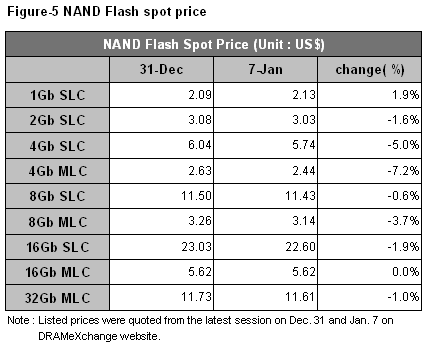
In the SLG segment, price of 1Gb up 1.9% and closed at US$2.13; 2Gb down 1.6% at US$3.03; 4Gb down 5% at US$5.74; 8Gb down 0.6% at US$11.43 and 16Gb down 1.9% at US$22.60. In the MLC segment, price of 4Gb down 7.2% at US$2.44; 8Gb down 3.7% at US$3.14; 16Gb flat at US$5.62 and 32Gb down 1% at US$11.61.