DDR2 eTT prices has fallen to the variable cost level; may be the starting point for future price increases
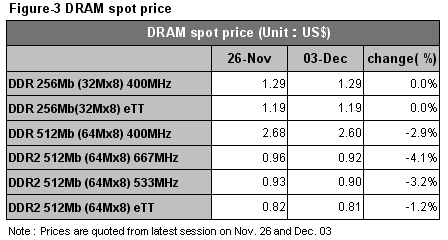
Last week, the DRAM spot price continued with its weak market trend. Although the DDR2 price declined slightly, a stronger market demand appears to be emerging in underpinning the recent price level. The DDR2 512Mb eTT price dropped 1.2% from US$0.82 on Nov.26 to US$0.81 on Dec.03. DDR2 1Gb eTT price slipped 1.8% from US$1.64 on Nov.26 to US$1.61 on Dec.03. Branded DRAM DDR2 1Gb price dropped 2.41% from US$2.01 to US$1.96 on Dec. 03. It should be noted that the DDR2 512Mb eTT price last week had fell below the US$0.80 level reaching US$0.77 for a while, but subsequently returned to its current price level. According to the current market development, it is expected that the DDR2 512Mb eTT chip price will stay flat or slightly trend upwards to US$0.80.
In the contract market, the DDR2 667 1GB module contract prices are currently being negotiated in 1HDec. There is no official price at the moment. As Dec. is a traditional slow season, OEM manufacturers have a low incentive to re-stock, thus prolonging the price weakness. For the module houses, due to strong-than-expected sales in western countries, module houses in Taiwan have received an additional amount of orders, allowing them to take advantage of the last Christmas business opportunities.
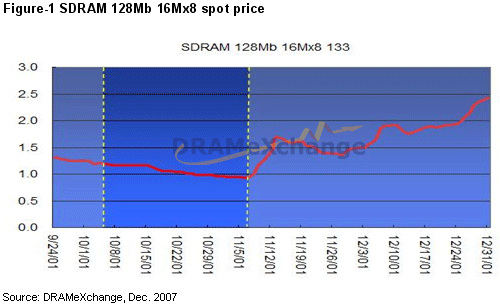
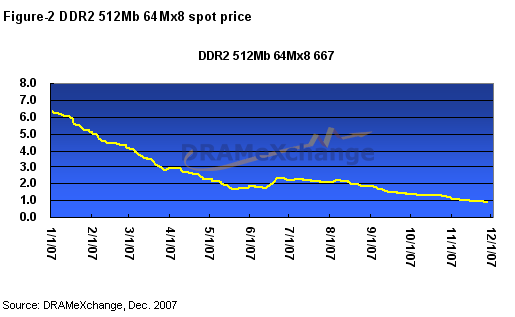
Amid the persisting DRAM spot price declines, a probable price rebound has finally appeared. In 1998, 8” wafer factories expanded too quickly, causing a market oversupply. In 2001, because of the 911 event and bubble economy, it also caused a huge drop in demand. During this year, the Vista effect wasn’t as hot as expected, resulting in the DRAM demand to continuously grow weaker. Moreover, 12” wafer factory manufactured excessive volumes of DRAM chips, causing DRAM prices to keep dropping. According to DRAMeXchange, the price drop can be attributed to many reasons. Nevertheless, a probable price rebound may occur as the DRAM prices slip below the variable costs. This comes in the wake of manufacturers adjusting their production plans based on the changing market conditions. For example, the DRAM price dropped to US$0.8 in 1998 Q2, and then surged back to the US$2.0 level during the next quarter. For Nov01, it dropped to US$0.8, but eventually rebounded back to average of US$2.42. Based on these two events, it can be seen that the price changes were spurred by major international DRAM makers scaling back on their production volume in an attempt to bring the market demand and supply to a more balanced state. Beginning from 2006, the DDR2 price has already dropped from US$7.0 to US$0.77. However, it has returned to the US$0.82 level. By looking at the current market dynamics, market observers believe it has already reached the variable cost level, prompting major DRAM manufacturers to reduce their production volume in spurring prices to rise in the not-too-distant future. If prices do indeed begin climb upwards, a strong price rebound may be seen.
Vendors to speed up improving the technical bottleneck of NAND Flash applications
Recently, those Data Flash related vendors expressed that they are going to put more attention and resources on Research and Design field at 2008 to speed up improving those existing technical bottleneck related to NAND Flash applications. For example, some Data Flash makers are developing CTF/NROM/XNOS architectures to improve some physical limits on Floating-gate NAND Flash with sub-40 nm process technologies. Or, they are going to develop 3-bit/cell & 4-bit/cell MLC architectures or 3D-cell architectures to increase the storage density per cell for Data Flash.
Moreover, those IC equipment vendors are also assisting Data Flash makers to collaboratively develop new generation fabrication technologies, such as 3X nm & 2X nm process technologies as well as 3D-cell architectures related lithography technologies for Data Flash. In addition, SSD makers will also work with those Data Flash controller vendors to improve the data transfer rate and endurance of the NAND Flash-based storage devices. This action will make SSD application has better performance on both NB and Desktop PC, and make SSD become the next killer application product faster with NAND Flash-based technologies. In the meantime, some electronic Associations/Organizations are accelerating to collaboratively develop next-generation NAND Flash-related standards/interfaces with different characters hoping that NAND Flash can be more widely used on more electronic products. We also anticipate those aggressive actions will help NAND Flash with better performance/price ratio to raise its penetration rate on 3C electronic applications starting from 2008.
Some memory makers also declare recently that they will nimbly adjust their 2008 capex budget according to up-to-date NAND Flash market trend. Or, they may dispose their 8” wafer equipments or switch it to other production purpose. If some of these plans get realised, it will help slow the increase of NAND Flash production. This action will also help ease the oversupply situation at slack season, 1H08.
For the timing being, we are facing traditional year-end holiday which is also a hot season of electronic products. NAND Flash downstream makers are also planning series of hot promotions for this year-end holiday. It’s expected that it gets warmed up from US Thanksgiving and continuously sustains to Christmas, even new-year holiday at other countries including Chinese lunar new-year holiday. After seeing those great selling result on Black-Friday at US, we also find out not only those retail channels are having great selling accomplishments, but also does vendors have great selling achievement through the Internet. Because those electronics makers are aggressively planning worldwide promotions on year-end holiday, we believe this action will help reduce NAND Flash downstream makers’ inventory effectively. Furthermore, it will help motivate NAND Flash downstream makers’ willing of purchasing more NAND Flash chips in the near future. At the same time, it can also help lower part of the impact from the sub-prime mortgage aftereffect to 1Q08 NAND flash market.
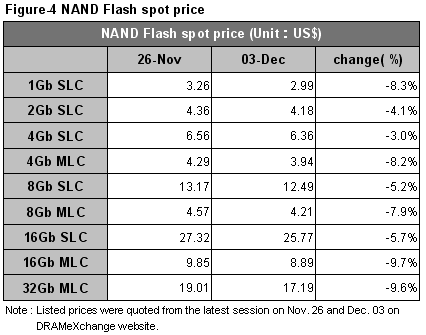
At the end, DRAMeXchange does a comparison on spot price of NAND Flash chips by each density on Nov.26 and Dec.3, 2007. In the SLC segment, prices of 1Gb dropped by 8.3% from US$3.26 to US$2.99; 2Gb 4.1% from US$4.36 to US$4.18, 4Gb 8.2% from US$4.29 to US$3.94, 8Gb dropped 5.2% from US$13.17 to US$12.49, and 16Gb dropped 5.7% from US$27.32 to US$25.77. In the MLC segment, all of them keep dropping trend just like SLC segment. 4Gb dropped 8.2% to US$3.94, 8Gb dropped 7.9% to US$4.21, 16Gb dropped 9.7% to US$8.89, and 32Gb dropped 9.6% to US$17.19.