DDR2 1Gb eTT spot price slips past US$2 and may drop further; DDR2 1Gb eTT starting to replace DDR2 512Mb eTT as new standard
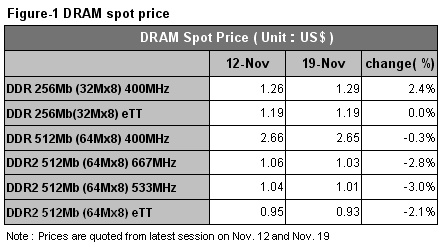
Similar to last week, the DDR2 price level continued to trend downwards. The DDR2 512Mb eTT slipped from US$0.95 on Nov 12 to US$0.93 on Nov 19, down by roughly 2.1%. A point worthy of paying attention to is the price of the DDR2 1Gb eTT, where it dropped from US$2.10 on Nov 12 to USD1.91 on Nov 19, down by roughly 9.0%. It can evidently be seen that the DDR2 1Gb ett spot price has slipped past the US$2.0 level. In terms of the market trend, although the DDR2 512Mb eTT price levels appears to have grown more stable, amid the sluggish demand and rapid price declines in the DDR2 1Gb eTT, the DDR2 512Mb eTT chip price may fall below the US$0.9 level.
In the contract market, in 1H Nov, the average price of the DDR2 667 1GB module closed at US$22. With the spot price continuing to drop, and shipments already peaking during October, OEMs have not been placing too many orders, rendering the contract market to be even more sluggish in 2H Nov. By looking at both the spot price and contract price, there is still a 10% price gap. Thus, DRAM makers are facing mounting pressures in the contract price negotiations for 2H Nov.
In terms of the DDR2 eTT chip price, the price of one DDR2 1Gb eTT chip is roughly equivalent to two DDR2 512Mb eTT chips. Thus, a growing trend will be seen where the DDR2 1Gb eTT gradually replaces the DDR2 512 eTT. Meanwhile, the 2GB module will also become increasingly mainstream. From a DDR2 1 GB module standpoint, the chips need to be mounted only on one side, which can shorten the manufacturing time and save costs as well. With roughly 8% of the manufacturing costs saved, module houses would be more than willing in seeing the DDR2 1GB being increasingly adopted by the market.
In addition, with the scheduled release of Windows VISTA SP1 in 2008, it should further help drive up the overall demand for PC upgrades. Consumer NBs and PCs that carry roughly 2GB of memory are expected to account for roughly 60%~70% of the market share by the end of 2007. As NBs have less room for relevant memory upgrades, the use of a single 2GB memory module would be viable, as it can better meet Vista’s memory requirements. Amid the continued migration to the 70nm process and production ramp up of the DDR2 1Gb, DRAMeXchange projects it to become the new mainstream memory size in 2Q08.

Introduction of ONFi 2.0 spec marks NAND Flash performance leap in PC
The Open NAND Flash Interface (ONFi) Working Group announced on November 14 the availability of the 0.9 draft of the ONFi 2.0 specification to 71 member companies. This signals the imminent release of the ONFI 2.0 specification in January 2008. Following the introduction of the 1.0 specification on December 28, 2006, ONFi took less than one year to complete the drafting of 2.0 specification, marking the fast pace that the Group has made on working on standardizing an infrastructure for NAND electrical parameters and protocol interfaces.
By having the 2.0 specification set, ONFi marks the leap in terms of interface performance. The latest specification defines a high-speed NAND interface that delivers up to 133 MB/s, breaking the precious maximum speed of 50 MB/s. The high-speed NAND definition is forward looking, with infrastructure in place to reach 400 MB/s in the third generation that is scheduled to be completed in 2009.
The fundamental orientation of ONFi is to provide a simplified and standardized infrastructure for NAND Flash applications in 3C products. In the PC segment, standardization helps shorten the design time for both upstream memory makers and downstream PC OEMs. Despite NAND Flash now mainly appearing in the form of memory card, USB Flash drive (UFD) and MP3 player, the expected rapid penetration of newer forms of storage media (e.g. Solid State Drive; SSD, Turbo memory & Hybrid Hard Drive; HHD) highlights the significance for standardization.
The leap that ONFi achieved over interface transmit performance echoes the anticipated penetration of NAND Flash in PC via the forms of SSD and cache memory. In general 3C applications such as handset, digital camera and MP3 player, the transmit performance ranges only 10-40MB/s. When applied to PC, it hampers the computing speed for some applications or software in PC. When SATA becomes the mainstream interface for HDD/SSD, the interface performance has to surpass 100MB/s for a guaranteed performance for the entire system. When the interface performance advances to 400MB/s, along with the introduction of ONFi 3.0 specification and advancement of SSD performance, a meaningful bundling rate should be seen accordingly. We also expect other organisations to unveil new-generation NAND Flash-related standards with different characters. These developments will help further augment the future applications of NAND Flash.
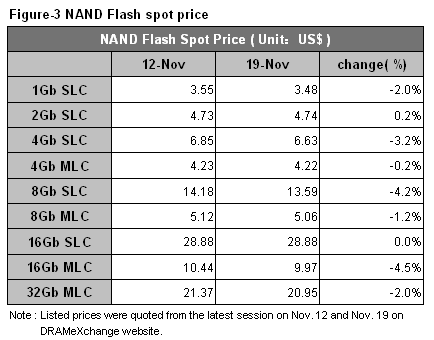
In the week of November 12 to 19, 1Gb SLC NAND Flash dropped by 2% on week to US$3.48; 4Gb by 3.2% to US$6.63; 8Gb by 4.2% to US$13.59. Only 2Gb saw a mild sequential growth of 0.2% to US$4.74 and 16Gb part kept flat. In the MLC segment, 4Gb dropped by 0.2% to US$4.22; 8Gb 1.2% to US$13.59; 16Gb 4.5% to US$9.97 and 32Gb 2% to US$20.95.