DDR2 eTT spot price falls below US$1 and may sink further; 3Q07 DRAM ranking shows Hynix as the top performer
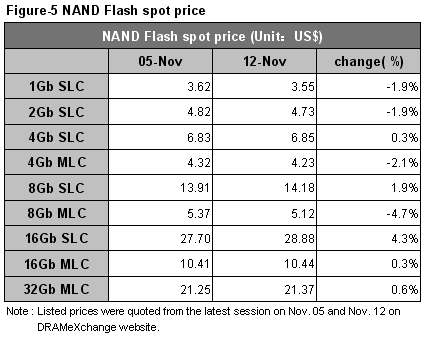
As projected by DRAMeXchange, the DDR2 eTT spot price slipped past US$1.0 last week. The DDR2 512Mb eTT declined from US$1.03 on Nov 5 to US$0.95 on Nov 12, down by roughly 7.7%. In the branded chip segment, the spot price dropped from US$1.13 on Nov 5 to US$1.06 on Nov 12, down by roughly 6.1%. As the low-price modules from branded manufacturers continued to influence the market, the DDR2 eTT spot price was still unstable. Coupled by the sluggish demand and high inventory levels, the DDR2 eTT chip price may fall below the US$0.9 level.
Thanks to a weaken price drop along with slow-down capacity growth in 3Q07, global DRAM sales posted a mild growth in the quarter, according to DRAMeXchange. Projecting DRAM bit growth for 2007 as a whole, DRAMeXchange estimates the rate to be 90% with ASP subjects to further drop in 2H07 due to oversupply. The research firm does not expect a meaningful turnaround in ASP trend as the oversupply is expected to persist through 2Q08 as DRAM makers generally choose to speed up their process migration to counter weak pricing, instead of trimming their capacity.
Branded DRAM makers saw their sales grew by a mild 3.6% QoQ in 3Q07 on a stabilizing price trend. DRAMeXchange records that DRAM ASP grew mildly in contract market and dropped by only 9% in the spot market in 3Q07. ASP trend among chipmakers varied in the quarter in accordance to product mix.
The blackout at Samsung NAND Flash fab during early August that prompted Korean suppliers grew their NAND Flash capacity, resulted in a QoQ bit growth of 9%, in contrast to the 24% QoQ growth in previous quarter. ASP also benefited with a stable price trend, versus to the 40% ASP decline as seen in 2Q07.
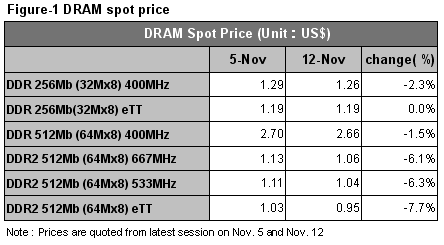
Korean chipmakers saw their market share grew mildly to 49.6% in 3Q074, followed by Taiwan makers’ 13.1%. Taiwan makers had their market share decline by 0.5ppts QoQ due to the growth of eTT sales proportion, where DDR2 eTT price dropped by 7% QoQ in 3Q07.
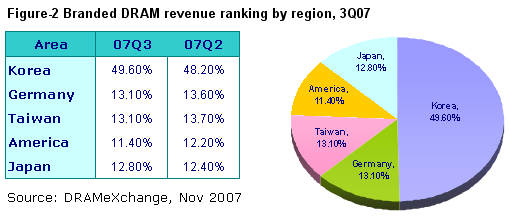
Sales breakdown by company highlights the noticeable achievement that Hynix made in 3Q07 (Fig 3). The company saw its sales grew by 15.4% QoQ in 3Q07, thanks to the 17% QoQ shipments, as well as the 3% QoQ ASP growth in the contract market. As of 3Q07, Hynix saw 15% of its DRAM production is fabricated on 70nm.
Sales breakdown by major production camp in 3Q07 notionally maintains unchanged in 3Q07, besides Hynix’s head-to-head competition with Samsung on its extending influence in the DRAM market (Fig 4). As present ASP trend suggests that DRAM makers are producing with widening losses, general market consensus is only a rapid trim in capacity could resume price to normality. But from the perspective of DRAM makers, capacity trim somehow means whittling down their power in the race at the meantime. Therefore, they try to swing the poor pricing environment by suppressing cost further down with new process capacity ramp and yield improvement. DRAMeXchange believes oversupply should maintain through 2Q08 accordingly.

The shortage of 1GB Micro SD-used dies abates;NAND FLASH Contract Price to Decline roughly 0~5% in 1H November
For the past several months, down stream memory card manufacturers of 1GB MicroSD were plagued by chip shortage, primarily due to a limited production output of the 8 Gb die based on 5X nm technology. But with continued improvement in manufacturing process, DRAMeXchange anticipates the shortage will gradually abate by year end.
Memory card manufacturers previously produce 1 GB MicroSD by stacking 2 6Xnm, 4 Gb dies. With the upstream process gradually shifting to 5Xnm, memory card manufacturers can now begin to switch to packaging a single 5Xnm 8 Gb die and thereby achieve significant cost reduction. However amid yield problems plaguing the 5Xnm 8 Gb dies for the past several months, down stream memory card manufacturers frequently have encountered a chip shortage. As the yield problem of 5Xnm 8 Gb chip is gradually resolved, manufacturers can now see some relief from their predicament the inability in meeting the strong demand from cell phone users and the coming peak season.
Excluding the 4Gb MLC, the 1H November contract price of other NAND Flash densities experienced a drop of roughly 0~5%. The rate of decline was smaller than what was seen during September~October. The drop is mainly attributed to NAND Flash downstream makers lowering their inventories in October. As the market expects the downstream makers to begin stocking up again in preparation for the year-end holiday sales around mid-November, the NAND Flash price stabilized during early November. At the moment, with the supply of chips manufactured via the 5X nm manufacturing node increasing, the downstream makers have focused more in purchasing 8Gb & 16Gb MLC chips. Therefore, the drop in the TSOP 4G MLC reached roughly 11%, which was the highest among the other specs. Amid the persisting price drops starting from early September, the NAND Flash contract price could keep more stable in the short term, as the year-end holiday sales approaches.
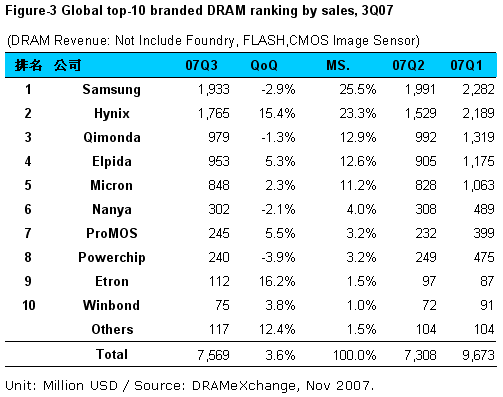
Finally, a comparison of the listed NAND Flash prices from the last session on November 5 and November 12 is shown below. Spot prices of the 1Gb SLC chip slipped from US$3.62 to US$3.55, a 1.9% decline. For 2Gb SLC, they fell 1.9% to US$4.73; 4G SLC up 0.3% to US$6.85; 4Gb MLC down 2.1% to US$4.23; 8Gb SLC up 1.9% to US$14.18. Meanwhile, the 8Gb MLC decreased from US$5.37 to US$5.12, down by 4.7%. The 16Gb SLC was up 4.3% to US$28.88; 16Gb MLC up 0.3% to US$10.44; 32Gb MLC down 0.6% to US$21.37.