Reduced supply of DDR2 eTT spurs short-tem spot price rebound
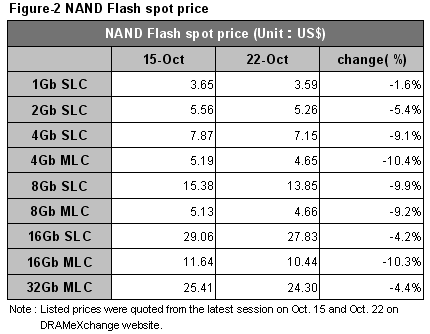
Bucking against the persisting price declines, the eTT spot price underwent a sharp increase last week, where the DDR2 512Mb eTT jumped from USD 1.03 on Oct 15 to USD 1.17 on Oct 22, a WoW increase of 11.9%. By contrast, minimal fluctuations were seen in the branded DRAM chip prices. Amid the eTT rebound, prices increased merely by 1.4%. According to market observers, the price jump in the DDR2 eTT stemmed from the ongoing 70nm process transition by major suppliers, which resulted in a smaller production output. In addition, the prices were also buoyed by the strategic chip purchases from some buyers. Apparently, the latest spot price rebound was mainly due to an increase in market activity, and not the result of a rise in the end demand. Meanwhile, as the chip buying was mainly concentrated in the DDR2 eTT segment, it did not help drive up the branded chip prices. As for the near-term market outlook, some observers believe a huge supply increase will be seen in the DDR2 eTT, rendering it to fall back to the USD 1 level. Separately, in the DDR 512Mb segment, amid stable demand, the price closed at USD 2.51 on Oct/22, down by 5.9%.
In the module house segment, the DRAM price jump helped trigger an inventory pull-in in the Europe and US regions. However, as China stepped up its anti-piracy efforts in the wake of the 17th National Congress, the overall market demand remained sluggish. Thus, a top priority for module houses will be to find ways in clearing out their excess inventory.
Traditionally, October usually represents a period of strong PC shipments. However, as October also marks the quarterly end for Dell and HP, coupled by the weak DRAM pricing environment, the two SI giants are wary of permitting any component inventory increase. Although prices of the DDR2 UDIMM/SODIMM module contract prices slipped by 20% in 1HOct, it was still unable to stimulate demand in the contract market. Prices have thus slipped another 10% in 2HOct. Due to the continuing price declines in the contract market, it has helped raise the DRAM content per box. In the consumer-based NB market, 2GB of memory now accounts for nearly 60% of all NBs. If prices plummet further, the ratio may rise to 70%~80%. With no clear signs of a decrease in the production output by DRAM makers, it may set the stage for the DRAM prices to remain below the manufacturing costs for the next 2 quarters.
From a cost analysis standpoint, Elpida, Samsung, and Hynix, who are at the forefront in the 70nm manufacturing node, manufactures only 20% of the 1Gb chip via the more advanced 70nm process. Even if the yield rate is further improved, and the fact that the fabs are already running at fully capacity, the total manufacturing costs (includes depreciation and testing) of the 1Gb will still entail a minimum of USD 2.7~USD 3.0, while 512Mb chips will require USD 1.7~USD 1.9. According to DRAMeXchange, with the capacity expansion of the 12” fabs already slowing down, and the 8” fabs being tasked to produce other types of chips, the 2008 DRAM bit growth is projected to decrease from this year's 93% to roughly 50%. However, in terms of demand, as the 2GB content per box for consumer NBs and PCs will respectively reach above 70% and 60% by the end of 2007, the 2008 growth momentum will arise mainly from the corporate NB sector. All in all, if DRAM makers do not scale back their production, an oversupply may still occur in the DRAM market for next year.
Flash makers showcase numerous NAND Flash application solutions in mobile device and PC segments
Organized by Samsung, the 5th annual Flash Day event was held in Taipei on Oct 19th. During the event, a variety of NAND Flash applications were showcased. In addition, seminars were also held in delineating the company's optimistic outlook towards the NAND Flash market. A large portion of the attendees consisted of Samsung's downstream clients, along with a handful of other Flash-related vendors.
A main focus this year was on the current development trend of Flash storage applications in the various mobile devices and NBs. At the moment, memory cards and USB drives account for roughly two-thirds of the NAND Flash consumption. However, as portable devices become smaller, lighter and more multi-functioned, there is a growing trend in which the Flash chip is packaged together with other memory or logic products into one IC. Thus, Samsung highlighted the special characteristics of its OneNAND and moviNAND products for use in portable devices. It also indicated that some of the current high-end smart phones, digital cameras, GPS and MP3/PMP devices seen on the market are already starting to employ such memory chips.
Meanwhile, as NAND Flash manufacturing progresses to even narrower circuits, which will subsequently further drive down costs, Samsung has high hopes on the future development of the SSD in the NB market. During the exhibition, Samsung introduced several 2.5 inch and 1.8 inch SSDs with 32GB or 64GB storage densities. Currently, some Japan and US NB vendors have started to utilize such products. DRAMeXchange believes that when the NAND Flash production node migrates to 4Xnm in 2H08 or 3Xnm after 2008, the Flash density now used in a variety of technology products will increase sharply. Needless to say, these factors will spur further development in the NAND Flash industry.
Separately, during the Intel IDF show in Taipei (Oct 15~16), Intel also revealed its ideas on how NAND Flash may be applied in the PC sector. It plans to unveil NAND Flash DIMM connectors for use in NBs and DT PCs. Research will also be conducted on a higher speed 3Gbps SATA SSD and faster ONFI 2.0 (~133MB/s per channel) interfaces. These new developments will help further promote the benefits of NAND Flash in enhancing the overall PC performance and efficiency.
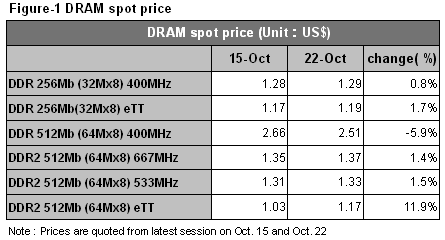
Finally, a comparison of the listed NAND Flash prices from the last session on October 15 and October 22 is shown below. Spot prices of the 1Gb SLC chip fell from US$3.65 to US$3.59, a 1.6% decrease. For 2Gb SLC, they fell 5.4% to US$5.26; 4G SLC down 9.1% to US$7.15; 4Gb MLC down 10.4% to US$4.65; 8Gb SLC down 9.9% to US$13.85. Meanwhile, the 8Gb MLC dropped from US$5.13 to US$4.66, down by 9.2%. The 16Gb SLC was down 4.2% to US$27.83; 16Gb MLC down 10.3% to US$10.44; 32Gb MLC down 4.4% to US$24.3.