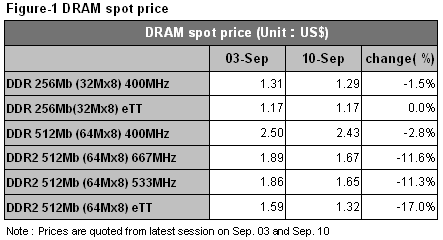
DRAM spot price slips below 1H07 trough; contract market under mounting price pressure
Last week the DRAM spot price was in an evident decline, where the average drop for the DDR2 exceeded 10%. DDR2 512Mb 667MHz dipped to USD1.67, while the DDR2 512Mb eTT slid to USD 1.32. Due to the weak spot market demand, it has spurred many retailers and module houses to sell the DRAM chips at lower prices, resulting in the DDR2 eTT price to fall through May's low of USD 1.32.
The significant spot price erosion remains closely correlated to the sluggish market demand. As the second half of the year usually marks a typically stronger PC market, many module houses and retailers increased their DRAM inventory during the end of 2Q07. According to the 2Q07 earnings report of each respective module house, the average inventory level rose to more than a month's worth. Yet, as the PC market enters into September, the PC upturn will not last long. Coupled by the gradual DRAM price decline, many manufacturers have started to clear away their excess inventory. These actions subsequently prompted prices to slide even further.
The spot market is now waiting to see when China's National Day holidays in October will start to drive up sales. Based on previous experiences, demand from China-based retailers usually occurs after 1HSep. However, amid China's strict anti-smuggling measures, the pull-in effect is projected to be weaker than before.
DRAMeXchange believes that the overall chip supply will increase minimally in 4Q07. Although Taiwan DRAM makers will have several new operational 12 inch fabs during the quarter, mass production will not occur until 1Q08. As for the Korea players, in the wake of Samsung's power outage incident in August, it has diverted some of its DRAM production to Flash instead. In general, the overall industry supply in 4Q07 will see limited growth.
As the current DRAM prices have fallen to the manufacturing cost levels of DRAM makers, chances for a spot price rebound has increased. Contract prices currently have a price gap of more than 20% with the spot price. Thus, they are expected to continue trending downwards, and thereby draw closer to the spot price.
New handsets&MP3 players with large built-in memory set to consume high-density NAND Flash chips
In 2007, NAND Flash makers have gradually improved their manufacturing nodes to the 50~56nm level. As manufacturers employ the advanced process in producing 16Gb MLC chips, it has indirectly helped rapidly upgrade the built-in memory of the various NAND Flash applications. In the advent of Apple's 4GB and 8GB iPhone launch during the end of June, handset leader Nokia has also unveiled two new high-density premium models--the 8GB N95 and N81. As for SonyEricsson, who is another key handset manufacturer, it plans to introduce the new W960i in October (also equipped with 8G of built-in NAND Flash). Separately, last week Apple showcased its latest iPod Touch, where the memory density has been upgraded to 8GB and 16GB. DRAMeXchange forecasts the aggregated shipment volume of these new devices will amount to roughly 10 million. We believe these products will be a primary consumer for high-density chips.
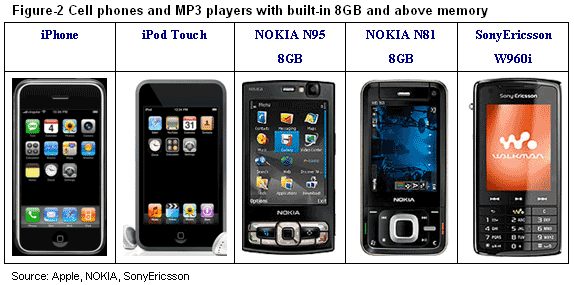
In 1H07, Samsung, SanDisk and Toshiba have subsequently successfully developed 16Gb MLC chips based on the 50 and 56nm manufacturing node. After undergoing a multi-stack packaging process, the Flash chips can be embedded inside the handheld electronic product, such as cell phones, MP3 players and GPS navigational devices by the TSOP or MCP approach. Figure 1 shows the cell phones and MP3 players that will be key promotional products of Apple, Nokia and SonyEricsson during 4Q07. Each product will be equipped with 8GB of built-in Flash. Apple has even introduced the latest 16GB iPod Touch. Amid the current flat demand in the NAND Flash end market, the performance of the aforementioned products during 4Q07 will markedly decide the demand and supply dynamics of the high-density Flash market in the next 2~3 months.
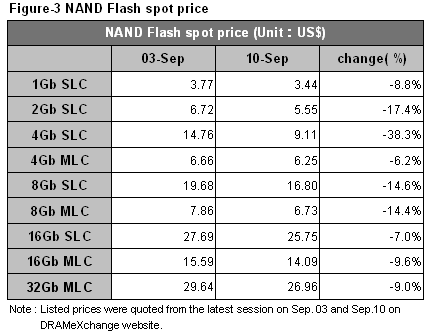
Finally, a comparison of the listed NAND Flash prices from the last session on September 3 and September 10 is shown below. Spot prices of the 1Gb SLC chip slipped from US$3.77 to US$3.44, a 8.8% decline. For 2Gb SLC, they fell 17.4% to US$5.55; 4G SLC down 38.3% to US$9.11; 4Gb MLC down 6.2% to US$6.25; 8Gb SLC down 14.6% to US$16.8. Meanwhile, the 8Gb MLC dropped from US$7.86 to US$6.73, down by 14.4%. The 16Gb SLC was down 7% to US$25.75; 16Gb MLC down 9.6% to US$14.09; 32Gb MLC down 9.0% to US$26.96.