Contract prices face downward pressure in 1HSep; spot market remains in the doldrums
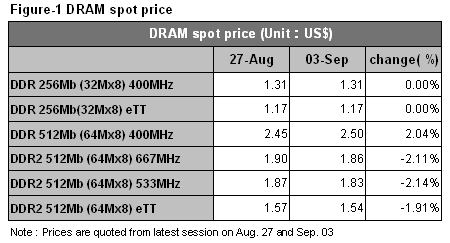
The DRAM spot market continues to remain in the doldrums. Although the DDR2 512Mb 64Mbx8 eTT reached US$1.80 last Monday (8/27), following the upward price trend on Friday (8/24) in the week before, prices soon began to decline again. For the entire week, it hovered near the US$1.50~1.60 level. The DDR1 also did not experience huge price changes. As for the DDR2, prices declined slightly, roughly by 2%. Meanwhile, the original DDR2 667 1GB UDIMM (DRAM Vender brand module) was quoted at US$32~34. These developments are not considered conducive factors to the DRAM contract price trend for 1HSep.
Shipments remain strong in the DRAM contract market. In addition to stable demand in the UDIMM segment, demand for the SODIMM has also risen, where the growth rate has exceeded 10%. With AMD and Intel increasing their sales promotion of server-based CPUs, OEMs have subsequently increased their DRAM memory stockpile used for servers. However, due to the limited amount of suppliers of RDIMM/FBDIMM, compared to standard UDIMM, a shortage began to surface beginning from 2HAug.
Although demand has not weakened from the OEM side, the persisting declines in the spot price will not bode well for the contract price. Some OEMs hope prices will drop 10%, or in other words, see the DDR2 667 512MB UDIMM slip to the US$18~19 price range.
September marks the last month for the 3rd quarter. Amid the sluggish spot market, the back to school and China's National Day holidays may help bring the much needed market momentum. If OEMs hope to witness more demand, they may have to wait until October, where the Christmas and fiscal quarter-end factors arrive.
NAND Flash to see more widespread usage in PC market in 2008
Excluding the UFD, NAND Flash is currently mainly employed in the DSC, MP3 and cell phone segments. However, according to the product roadmaps of NAND Flash-related companies, this may begin to change in 2008, as more and more PC applications that take advantage of this NV memory technology arrive in the market.
Since 2H07, NB PC vendors have started to introduce models equipped with 16~32GB SSDs. As the NAND Flash 5X nm manufacturing process is set to become cheaper and more mature in 2008, NBs using solid state storage technology should see their densities increase to 64GB or above. Even the disk-drives in the low-price PCs, such as OLPC, Eee PC & Classmate PC, will begin to use 1~32GB SSDs beginning from 4Q07. Intel & MIT have also agreed to respectively unveil various low-price PC models in targeting the under US$500 PC education market. The growth potential remains strong, where future shipments may exceed 10 million annually. Meanwhile, since 2H07, the UMPC has also started to use SSDs ranging currently from 8~32GB.
In the PC cache memory section, NAND Flash is only being employed in NBs at the moment, as evidenced by the Turbo memory 1.0 technology installed on the latest Santa Rosa NB PC platform. In 1H08, an improved version of the Turbo memory technology will be employed on the desktop PC. By 3Q08, the new Montevina NB PC platform will utilize the enhanced Turbo memory 2.0, boosting the NAND Flash cache size in the PC from 512MB~1GB to 2~8GB in 2008. Meanwhile, the NAND Flash module concept may also be incorporated in the ONFI 2.0 standard as a means in further expanding the PC storage size.
With the release of Vista SP1 in 1H08, the performance of the Ready boost & Ready drive functions integrated with the memory card, UFD, Hybrid HDD, Turbo memory & SSDs will be further upgraded. This will enable more market applications of NAND Flash based PC cache memory. Moreover, with the memory card density already reaching 32GB, it is expected that by 2008, the UFD density will climb above 32GB, which will serve as a viable option when choosing an external portable storage device.
Amid cost concerns, DRAMeXchange forecasts PC related NAND Flash applications to account for roughly 10% of NAND Flash consumption in 2008. Nevertheless, beginning from 2009, growth will become more apparent, as the 4X nm process matures. Ultimately, it should help pave the way for more diversified NAND Flash applications in the PC market.
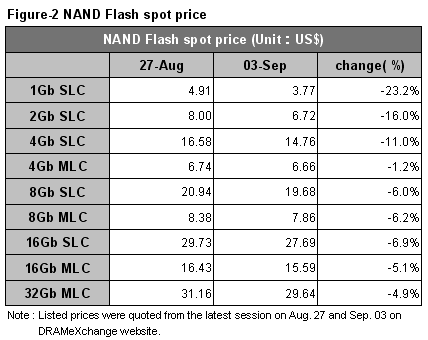
Finally, a comparison of the listed NAND Flash prices from the last session on August 27 and September 3 is shown below. Spot prices of the 1Gb SLC chip slipped from US$4.91 to US$3.77, a 23.2% decline. For 2Gb SLC, they fell 16% to US$6.72; 4G SLC down 11% to US$14.76; 4Gb MLC down 1.2% to US$6.66; 8Gb SLC down 6% to US$19.68. Meanwhile, the 8Gb MLC dropped from US$8.38 to US$7.86, down by 6.2%. The 16Gb SLC was down 6.9% to US$27.69; 16Gb MLC down 5.1% to US$15.59; 32Gb MLC down 4.9% to US$29.64.