Market outlook turns cautious as weak DRAM spot trading slightly drives down prices
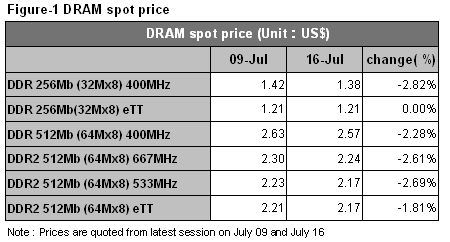
Compared to the previous two weeks, the weaker trading in the DRAM spot market caused prices to slightly drop. The DDR2 eTT chip fell 1.81% to $2.17, while the branded DDR2 512Mb 64Mx8 slipped 2.61% to $2.24.
According to DRAMeXchange's survey, one of the reasons behind the decreased market demand stemmed from consumers holding off purchases until Intel's upcoming CPU price cuts in 2HJul. In addition, with the DRAM spot price already exceeding the contract price last month, there was little incentive for further price increases. Module houses have instead focused in removing their older product inventory to boost profits. The current pricing levels have generally left retailers and module houses uninterested in increasing their inventory. On a different note, amid the DRAM contract price hike in early July, the DDR2 512Mb chip price has jumped past the $2 level. Trading has slowed, as the market waits to see if more contract price increases may occur, which may in turn stimulate more spot market transactions.
In the contract market, the upward climb in prices has driven up the DDR2 667 512MB UDIMM by more than 16%in 1HJul. OEM orders remain stable, and show no signs of declining as prices go up. DRAM manufacturers predict the DDR2 667MHz 512MB UDIMM/SODIMM and DDR2 667 512Mb to respectively hit roughly US$20-21 and $2.2 in 2HJul. DRAM makers are expected to reap strong profits if they successfully boost the output of 70nm DDR2 1Gb chips.
On July 13th, Samsung announced its second quarter earning results. In light of the DRAM price decline of more than 30% in 2Q07, its semiconductor department posted revenues reaching US$4,589 million, a 4% QoQ decline. Meanwhile, its operating margin reached only 8%, a sequential decline of 39%. Although Samsung's profits were affected by the weak DRAM prices, bit growth jumped 31% QoQ---an indication that amid the weak DRAM pricing environment, manufacturers have not opted to produce more NAND Flash chips. Determined to maintain its No.1 DRAM market share, Samsung has aggressively raised the output ratio of 80nm or below chips to more than 50%.
Switch to more advanced process technology hits snag; Flash prices to continue rising in near term
For the past three months, both the NAND Flash spot price and contract price has been experiencing rapid increases. Initially, the increase began with the low-density SLC chips, as supply tightened. Later on, prices of the MLC chips also started to go up. According to DRAMeXchange’s survey, the switch to more advanced manufacturing processes have caused a drop in the yield rate, resulting in lower production outputs.
Beginning from 2Q07, NAND Flash makers have begun to switch to even more advanced manufacturing processes. Some have migrated from 70nm to 60nm or 50nm, while others have switched from 60nm to 50nm. However, as the technology is not entirely mature yet, the current output has been unable to meet original production plans. Coupled by the fact that a huge portion of the capacity is being allocated for the anticipated demand from Apple’s iPhone and iPod in 2H07, many downstream vendors have been unable to secure a sufficient amount of Flash chips.
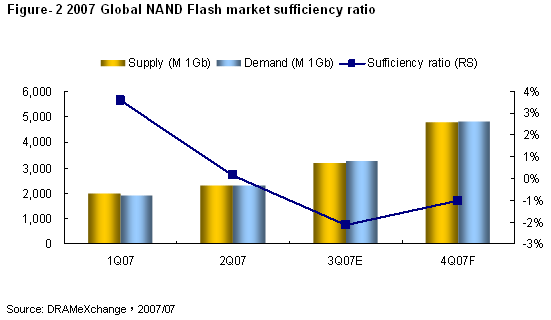
According to DRAMeXchange's observation, it will take roughly 2 to 3 quarters before manufacturers can enhance the yield rate to a more acceptable level. In other words, a Flash chip shortage will likely occur. In addition, as many downstream vendors begin to stock up on inventory ahead of the year end Christmas sales, the undersupply could grow more serious. In general, the Flash supply in 3Q07 is projected to remain insufficient, while prices are expected to rise further.
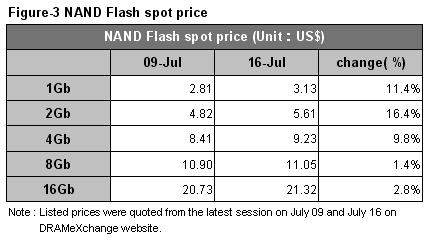
Finally, a comparison of the listed NAND Flash prices from the last session on July 9 and July 16 is shown below. Spot prices of the 1Gb chip rose from US$2.81 to US$3.13, a 11.4% increase. For 2Gb, they climbed 16.4% to US$5.61; 4G up 9.8% to US$9.23, 8Gb up 1.4% to US$11.05 and 16Gb up 2.8% to US$21.32.