China's summer sales prompts inventory build-up, DRAM Spot price to stay above US$2
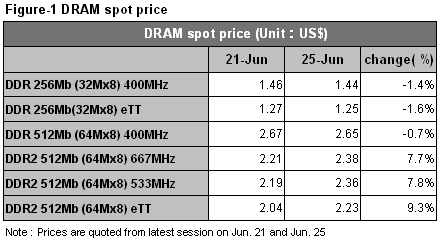
The DRAM spot price continued to maintain its upward climb last week. However, after a succession of rapid price increases, the momentum has slowed down. The DDR2eTT chip jumped 9.3% to US$2.23, while the DDR2 512Mb 64Mx8 leapt to US$2.38, up 7.7%. Increases in the chip price are also driving up branded module prices. Samsung's DDR2 667MHz 1GB module reached to a high of US$48. In contrast to a low of US$31 last week, this marked a 54%increase.
The recent DRAM price uptick has substantially increased trading in the spot market. Amid the plummeting DRAM prices seen earlier, retailers were unwilling to place huge orders. However, China's summer sales that begin in July, along with Intel's expected low-end CPU price cuts in August should help improve the overall market conditions. Demand in the spot market is already on the rise, as brokers and distributors seek to increase their inventory levels. On a different note, the Hong Kong and Shenzhen regions have been strengthening their anti-piracy activities. Distributors engaged in extremely large trading activities have been arrested. Therefore, the amount of DRAM chips smuggled from Hong Kong to China has decreased significantly. How the DRAM prices, which are imposed with overly high taxes, will affect the actual demand in the China market, will be a key factor in determining the success of retailers and channels in their inventory clear-out.
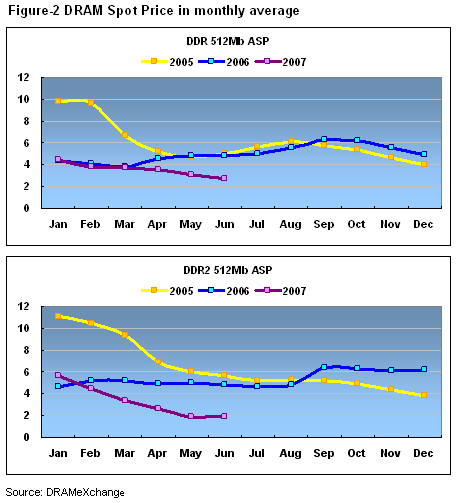
In the past two years, the DRAM spot price performed more strongly during the second half (Figure 2). Thus, despite the huge recovery in the spot price, the traditional strong seasonality of 2H07 will keep DRAM makers from conceding to any additional price cuts. DRAMeXchange predicts the spot market price will hover near the US$2.0-US$2.5 level.
The contract price has not been following the same trend as the spot price in 2HJun. PC OEMs still need to manage their low-cost DRAM inventory, and the global supply of DRAM chips is still on the rise. July marks the month, where US-based PC OEMs begin to release their quarterly earnings results. They are thus expected to increase their sales in July, in order to provide a better quarterly sales figure. This will help boost the overall DRAM demand. DRAMeXchange projects contract prices may begin to rebound after 2HJul.
SLC NAND Flash output less sufficient; prices expected to increase further
In June, minimal fluctuations were seen in the demand for Flash-based application products. Nevertheless, the shortage of SLC Flash has caused its price to increase. Its production output is set to decrease further, as MLC Flash becomes more prevalently used in a variety of products. In addition, manufacturers have no plans in boosting the production of SLC Flash. As their end market demand decreases gradually, DRAMeXchange projects the SLC NAND Flash prices to rise steadily in the near term.
The production costs for MLC NAND is roughly 20%-30% lower than the same-density SLC NAND. Coupled by its adequate read/write speeds and lifetime in various applications, such as USB drives, memory cards, MP3 players and so forth, NAND Flash suppliers have been raising the MLC NAND output ratio ever since last year. At the moment, the ratio has reached nearly 80%. Based on DRAMeXchange's survey, it is expected to hit 85% by the end of 2007.
The increases in the MLC NAND production ratio have evidently driven down the manufacturing of its SLC counterpart. However, there are still a handful of products that employ SLC NAND. This includes GPS navigation devices, high-speed memory cards used in DSLRs, Sony's exclusive Memory Stick, Nintendo's Wii consoles and the recently much talked about SSD (Solid State Drive). Such products emphasize more on the stability, read/write speeds and lifetime of the Flash chips. As these niche products are expected to experience stable growth in the near future, the current supply of SLC NAND is less sufficient.
In the short term, we believe the overall NAND Flash market price will remain stable, as the SLC Flash output is expected to decline further. Chances for the NAND Flash prices to drop are minimal. Meanwhile, the more balanced supply and demand mechanisms and imminent arrival of the traditional hot seasonal sales are likely to keep the NAND Flash price trend stable in the third quarter.
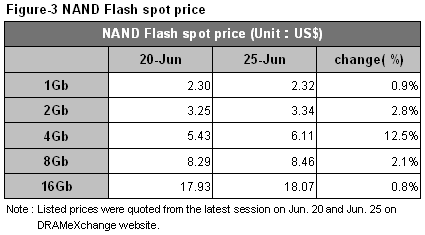
Finally, a comparison of the listed NAND Flash prices from the last session on June 20 and June 25 is shown below. Spot prices of the 1Gb chip rose from US$2.30 to US$2.32, a 0.9% increase. For 2Gb, they climbed 2.8% to US$3.34; 4G up 12.5% to US$6.11, 8Gb up 2.1% to US$8.46 and 16Gb up 0.8% to $18.07.