Spot market continues to be soft. Low-price PC has good potential
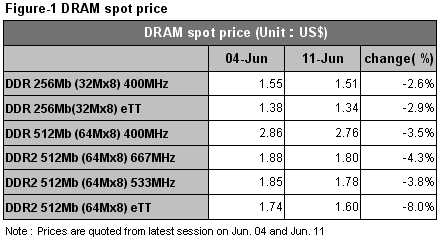
DRAM spot market was quite last week as most buyers attended Computex. DRAM spot price was on a mild decline, with DDR2 eTT slipping 8% to US$1.6. Branded 512Mb (64Mbx8) DDR2 price slowly eroded to US$1.8.
Most of the major DRAM module players such as Kingston, Kingmax, ADATA, Transcend and PQI attended Computex. Nanya Tech also showcased its Elixir lines. Qimonda, on the other hand, showcased DDR3 to demonstrate its technology competitiveness.
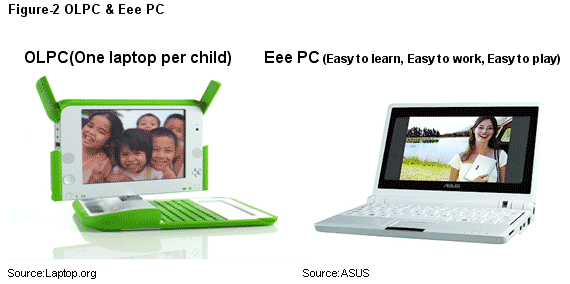
This year, handheld PCs are PC companies' focus, such as Quanta's Linux-based OLPC with AMD Geode LX-700 CPU, 256MB DDR 333 and 1GB NAND flash instead of HDD. The price tag is USD 170. Quanta aims to ship 1m OLPCs this year. Asustek on the other hand demonstrated the Eee PC, which is also based on Linus OS with 512MB DDR2 400 and 2-32GB NAND flash for storage. EeePC's hardware specification does not stand out but the price tag of USD199-349 caught a lot of attention. Asustek aims for 500K shipments this year.
Contrasting to Asus's Eee PC, Quanta's OLPC distinct itself in terms of target market group and flexibility over specification. OLPC targets for emerging markets' government bidding projects at initial stage while Eee PC targets for general consumers. As loads of component suppliers involve in the specification establishment process of OLPC, it results in less flexibility on component adjustment. Any adjustment that made on any component in OLPC involves fundamental change, meaning less choice over component procurement in return. In contrast, EeePC is based on Intel's classmate PC platform but Asustek has autonomy on the hardwares. For instance, Asustek chooses DDR2 400 as the standard memory despite that DDR3 has been introduced. However, DDR2 has two more years of life cycle and is currently cheaper than DDR or DDR2 667, allowing AsusTek to offer a competitive pricing. Additionally, Asustek can leverage its sales channel to drive Eee PC's shipment. Pricing and marketing strategy will be the two key factors to low-price PC's shipments.
DRAMeXchange forecast that the low-price PC will account for less than 1% of DRAM and NAND flash demand in FY07. However, the simple functions and attractive price points will be low-end PC's main advantages. Users in the developing countries may use low-end PCs as the alternative mean to connect to the internet. Thus, DRAMeXchange sees the low-end PC as a potential key demand driver to DRAM and Flash in the future.
Tight low-density NAND Flash chips supply spurs price up
Recent NAND Flash price trend is beating seasonal pattern as seen in the persistent upward trend in 1Gb and 2Gb chips over the past few weeks. According to DRAMeXchange's gathered closing prices on June 11, prices of the aforementioned chips increased to US$2.48 and US$3.33 respectively, representing a sequential growth of 18.1% and 22.9%.
According to DRAMeXchange's survey, critical output reduction is the main cause in sustaining the upward price trend for low-density chips. After experiencing the price plummet from last year and 1Q07, chipmakers who found their gross margin on 1Gb and 2Gb no longer competitive as compare with 8Gb and over density chips, trimmed their low-density chips capacity, which resulted in a better supply-demand balance.
Currently chipmakers are reserving their 1Gb and 2Gb supply for vendors who produce devices with built-in NAND Flash. Most of these customers have already booked their required capacity ever since 2H06, meaning demand for these chips are relatively stable. Mobile phone makers and channel distributors, who are increasing the bundled microSD card density t


