DRAM contract prices slips 5% in 1HJun, hopes for a price rebound may occur in July
Spot price went up last week on lack of new DRAM chip supply, while contract prices tumbled another 5%. It is projected that after the 2007 Taipei Computex draws to a close, prices will have a chance in experiencing a rebound. Elpida's CSO has suggested his bullish view to 2H07 and he anticipate supply may tighten in 2H07.
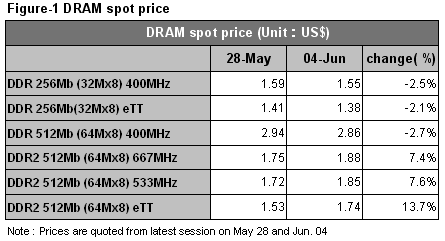
Spot price continued to head north in the last week of May. 512Mb 64Mx8 DDR2 increased to US$1.74, up 13.7%. The original chips also went up by more than 7%. The strong performance was due to chipmakers'lower inventory. Chipmakers controlled supply to stage the ASP rebound and supply indeed increase as ASP go up.
Although DRAM makers still hope to maintain a USD 16 contract price in May, special deals were signed at USD 15 in taking care of the excess inventory of DRAM makers.
In light of the spot price increase, declines in the contract prices have been limited in 1HJun, mostly being concluded at USD 15-USD 17. According to DRAMeXchange's observation, despite the expected increase in the total DRAM output in July from Korean makers, their commodity DDR2 chips decline roughly 15-20%. Contract prices in July stand a chance of rising slightly, as prices are already below the costs of DRAM makers.
In an interview dated June 4, Elpida's CSO suggested his bullish view to the 2H07 outlook. Elpida thinks PC OEM's inventory is already, low and contract price should have bottomed in 2H May. Elpida anticipate supply to turn tight later this year.
Currently, the mobile and consumer memory produced in Japan is Elpida's biggest earnings driver given the sluggish commodity DRAM market. The Hiroshima fab's wafer start is currently 80K per month and may trend up to 100-120K next year. The fab's non-PC memory wafer start will continue to increase. Its cost will go down as it migrates to 70nm process and starts 1Gb DDR2 production.
Taiwan's miCARD to offer more choice
The MultiMedia Card Association (MMCA) recently approved miCARD as a new form of memory cards. MiCARD was co-developed by 12 Taiwanese companies including AsusTek, ADATA and ASE and production is slated for 3Q07. The fact that it is developed by Taiwan has a big implication to Taiwan's IT industry. Before miCARD, the card standards (SD, MMC, MS, CF and XD) had been set by non-Taiwanese companies and Taiwan companies were simply the manufacturers. Many Taiwanese card makers are in a competitive disadvantage as they have to pay royalty for their cards.
SD is currently the most popular card standard. DRAMeXchange estimates that SD memory cards have 50% market share in the memory card industry. SD memory's success is driven by SanDisk's good marketing strategy. SanDisk is one of the SD developers. Key handset brands such as Nokia, Motorola, Samsung and LG all support SD memory. Additionally, Toshiba and Panasonic, the other two standard setters, have successfully promoted SD as the mainstream format for DSC in Japan. Sony, Olympus and Fujifilm are the only three brands that do not support SD as the mainstream card format.
MMCA is willing to accept miCARD because it wants to offer another choice to the consumers. Having a USB 2.0 connectivity on the card allows easy computability, and consumers may more rapidly accept the new feature. miCARD has many good features, including fast transmission, low power consumption, small form, big density, multiple interface support and card-reader free. It can be a good solution for handsets, DSCs and other portable consumer devices. Because miCARD is USB compatible, consumers can transfer data to PCs, printers and other devices without plugging and unplugging. MiCARD is half the size of SD card. It is also inter-connectible with MMC-enabled device


