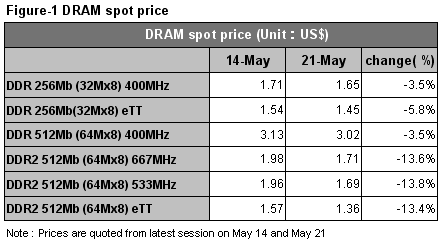
DRAM spot price declines further, capacity reduction by some makers should help bring some balance in 2H07
For last week, the spot market showed no increase in demand, as prices slipped more than 10%. Hovering between the USD1.35-1.50 level, the DDR2 512Mb (64Mx8) 667MHz eTT plunged to a low of USD1.32. DDR2 512Mb (64Mx8) 667MHz, on the other hand, dipped to a weekly low of USD1.50.By contrast, DDR chips maintained a more gradual price decline, where DDR 256Mb/512MB 400MHz saw a drop of roughly 3.5%. SDRAM prices remained flat, due to stable demand and supply mechanisms.
Amid the tumbling contract prices, DRAM makers are already experiencing a loss. Despite the already dismal prices, the continuing ramp up from DRAM makers are allowing OEMs to ask for further price cuts. With DDR2 512MB U-DIMM 667MHz now only at USD17.00, there are at least some signs of a price stabilization in 2HMay. Contract Prices are expected to drop less severely in 2HMay, as some manufacturers have already reflected the persisting downward price trend in their 1HMay quotes. Thus, the pricing levels in 2HMay may be relatively the same as in 1HMay.In light of the current oversupply, some DRAM makers are reducing their losses by transferring some of their capacity to other types of products. This should help partly alleviate the demand and supply imbalance.
The release of Santa Rosa last week is already starting to boost the overall NB shipments. However, motherboard shipments are not performing as strong, where they could fall short of expectations in May. A possible explanation for the weaker MB demand is the market anticipation of newer products set to appear in the upcoming Computex 2007, which is only two weeks from now.
How the OLPC and Classmate PC may bring new NAND Flash Business Opportunities
Spearheaded by Professor Nicholas Negroponte from the Massachusetts Institute of Technology, the primary mission of the OLPC program is to help elementary school students from third world or developing countries in learning how to use a computer. The ongoing program aims to help participating countries purchase 1 million units of the USD 100 NBs for their elementary school students, where they can have the chance to work with a computer and browse the Internet. At the moment, the program encompasses countries from Argentina, Brazil, Cambodia, Costa Rica, Dominican Republic, Egypt, Libya, Nigeria, Pakistan, Rwanda, Tunisia, USA(Massachusetts and Maine)and Uruguay.
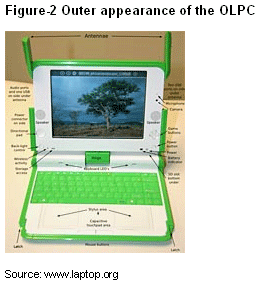
Despite the fact that the actual pricing of the OLPC has not reached as low as USD 100 (currently USD135-175), the organization is working towards this price target. Currently, Quanta, the world's largest NB contract manufacturer, is in charge of the OLPC production. During the initial stages, the OLPC was originally planned to be equipped with Intel's CPU, but was later switched to the AMD platform. In response, Intel withdrew from the OLPC program and developed its own Classmate PC. The more expensive Classmate PC targets the same market segment as the OLPC.
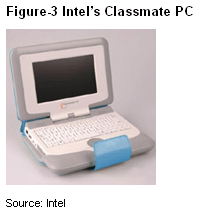
In consideration of the manufacturing costs and the ability to execute simple functions only, both the OLPC and the Classmate PC employ NAND Flash instead of the HDD as the machine's storage media, where roughly 1-2GB of memory are used. Although this is significantly lower than the typical densities used in other Flash applications, the opportunity in allowing children living in remote areas to gain access to computers and the Internet exposes them more to the use of technology. In the long term, implementation of the program should help relevant companies further expand their business opportunities in these countries.
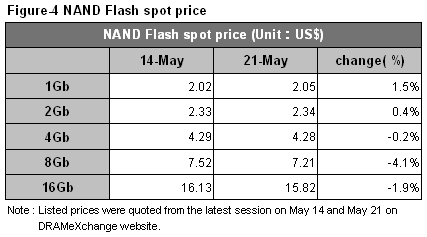
Finally, a comparison of the listed NAND Flash prices from the last session on May 14 and May 21 is shown below. Spot prices of the 1Gb chip rose from US$2.02 to US$2.05, a 1.5% increase. For 2Gb, they increased 0.4% to US$2.34; 4G down 0.2% to US$4.28, 8Gb down 4.1% to US$7.21 and 16Gb down 1.9% to $15.82.