DDR3 supportable Motherboards soon to be launched; DDR3 unlikely to become mainstream in 2007 due to high price
Amid sluggish market demand, DRAM spot prices continued to drop. Contract prices for 2HApr are also expected to decline further, but at a slower rate. On a different note, Intel will officially unveil the Bearlake chipsets for DTs at the end of April. The new P35 and G33 will be compatible with both the DDR2 and DDR3 memory modules. Therefore, DDR3 supportable motherboards and modules will soon begin to appear in the market in 2Q07. However, as the DDR3 512Mb chip price is still too expensive, it is expected they won't become the new mainstream standard until 2009.
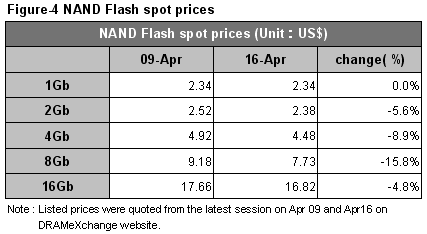
Declining prices continued to be seen in the weak spot market. The DDR2 512Mb 667MHz slipped to USD 2.69, and the DDR2 eTT tumbled to USD 2.36. Contract prices for 2HApr should also experience additional declines, due to the quarterly results released by US-based PC OEMs. However, prices do appear to be stabilizing, as the DDR2 667MHz 512MB contract price may be settled at roughly USD 20.
With May approaching, the high seasonal PC sales of 3Q07 is also drawing closer. The increased PC shipments and Vista adoption rates should help boost the DRAM content per box in 2H07. Therefore, numerous retailers and module houses are beginning to build their inventory levels ahead of the anticipated strong DRAM demand in 2H07, which will help stabilize the DRAM prices.
Another development worthy of pointing out is the Bearlake chipset launch for the DT at the end of April by Intel. The new chipset includes the mainstream Bearlake-P and IGP Bearlake-G in handling the future DT requirements. Among the various models, the P35 and G33 chipsets not only feature a 1333MHz FSB, it is also compatible with both the DDR2 and DDR3 memory modules, supporting both DDR2-800 and DDR3-1333. Therefore, DDR3 motherboards and DRAM modules will soon begin to appear in the market in 2Q07.
The DDR3 can achieve a maximum transfer speed of 1600MHz. By contrast, the DDR2 runs merely at 800MHz. The DDR3 is also more power-consuming, as it uses only 1.5V of power, instead of the 1.8V for DDR2. By comparing the DDR3 800, DDR3 1066 and DDR3 1333 with the DDR2 800, the average power usage drops respectively by 25%, 29% and 40%.
With the DDR3 512Mb chip still above the USD 20 level, the DDR3 512MB module price currently stands at roughly USD 180. This is 8 times higher than the USD 23 DDR2 512MB modules. In light of the high prices, the DDR3 is not expected to become the new standard in 2007. Only until the 70nm manufacturing process becomes more mature, will DRAM makers be able to mass produce the DDR3 chips, which is not expected to occur until 2009.
How Apple's 100 million iPod sales have changed the NAND Flash market
On April 9th (California time), Apple announced that the accumulated sales of its iPod had officially exceeded the 100 million mark. Ever since the iPod was first introduced on October 23rd , 2001 it took only 5.5 years for Apple in achieving the 100 million sales mark. To any consumer electronics company, this is truly a remarkable performance.
When the iPod was initially released, it employed a 1.8" HDD as the storage medium. The subsequent release of the iPod mini utilized a 1" microdrive. In 2005, when Apple unveiled the even smaller iPod shuffle, it switched to NAND Flash for the data storage. However, the first generation iPod shuffle came only in the 512MB and 1GB versions, which didn't really affect the NAND Flash market supply. Only until the introduction of the iPod nano did it really begin to create an impact on the market.

When the 1st generation iPod nano was released, it came in 1GB, 2GB or 4GB models. According to Apple's fiscal 1Q06 financial results (actual time period is 4Q05), its iPod shipment figures reached 14.04 million units. In contrast to the 5.31 - 6.45 million shipment figures seen in the previous three quarters, the overall growth rate exceeded 100%. Due to the launch of the iPod nano in 4Q05, the worldwide NAND Flash demand began to outpace supply.
Higher storage capacities were seen for the 2nd generation iPod nano and shuffle, which was unveiled in Sep06. The nano products were equipped with 2GB, 4GB and 8GB of memory, while the shuffle models only came in 1GB sizes. In 4Q06, a total of 21.06 million iPods were sold, up 50% from the sales figure in 4Q05. However, the NAND Flash industry did not experience an undersupply in 4Q06. This was mainly attributed to the bigger production capacity, as the amount of NAND Flash suppliers increased, and the migration to more advanced manufacturing processes.

Figure 3 shows the quarterly sales figures of the iPod player, where a high growth rate can evidently be seen for the past two years. Needless to say, when Apple launches its iPhone in Jun07 and its newly improved iPod models later in the year, it will create a powerful effect in the NAND Flash market.
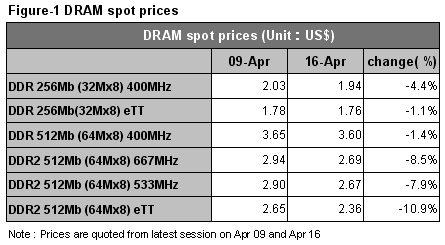
Finally, a comparison of the listed NAND Flash prices from the last session on Apr 9 and Apr 16 is shown below. Spot prices of the 1Gb chip stayed at US$2.34. For 2Gb, they decreased 5.6% to US$2.38; 4G down 8.9% to US$4.48, 8Gb down 15.8% to US$7.73 and 16Gb down 4.8% to $16.82.