Spot Price Continues to Fall; DDR price drop less severe than DDR2
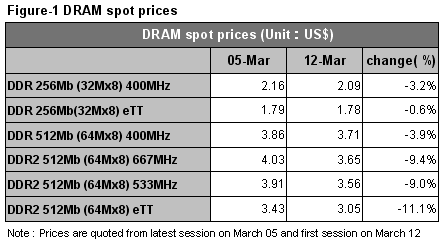
As the DRAM contract price dropped more than 10% last week, the DDR2 512MB 667MHz slipped lower than the spot price of branded chips.. In the spot market, both the DDR and DDR2 declined slightly, due to sluggish market demand. In contrast to the ongoing DDR2 ramp up, demand is not keeping up with the supply. Although the demand for DDR is also weak, its price is stronger than the DDR2, as there are no increases in the output.
Recently, the DDR output from DRAM makers have been decreasing continuously. According to DRAMeXchange's statistics, the monthly DDR production accounted for roughly 10% of the total DRAM output. With the DDR3 set to become the next generation memory in 2008, it is expected that the DDR will continue to see a drop in production. In terms of the DDR price, after undergoing the high season in 2006Q3, DRAM prices have climbed back to the USD3.7-3.8 price level.
Based on DRAMeXchange's compiled data, the DDR price drop has recently become less severe. Despite the decreased production from DRAM makers, roughly 25% of AMD CPUs still employ DDR chips. Furthermore, the memories used in some consumer electronics products have also switched from SDRAM to DDR. It is expected that when Microsoft's Windows Vista program becomes more widely accepted, it will also spur another wave of DDR memory upgrade demand, as some consumers will opt to only partially upgrade their memory or graphics card, instead of purchasing a brand new computer. Thus, it is projected that in future months, the DDR price drop will be more stable than DDR2.
Samsung Officially Unveils Vista Compatible Hybrid Hard Drives; Consumers can better understand Flash Applications on PC
Samsung has officially begun supplying built-in Flash Hybrid Hard Drives (HHD) to OEMs. The model, which is dubbed MH80, is a 2.5 inch HHD that comes in 80GB, 120GB and 160Gb densities. Each type carries 128 or 256MB of OneNAND Flash.
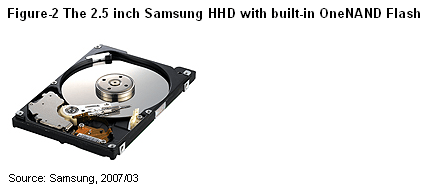
Hybrid Hard Drives are the newest Flash application, which is supportable of the ReadyDrive feature of the Vista Operating System. According to the Microsoft's official website, the Flash memory is used primarily as a so-called "buffer zone" for the OS boot up process or commonly used programs. More power is saved, as it allows less access time to the mechanical HDD. In addition, when the PC is in sleep mode, it lets the PC return faster to its normal operations, along with boosting the reliability of relevant data accessing.
According to Samsung's official data, the MH80 HHD can cut down the computer boot time by 50%. In addition, it can save up to 70%-90% of power consumption, when compared to traditional HDDs. When used on the Notebook, it can extend the battery life approximately 30 minutes. Although Samsung's HHD employs both 128MB and 256MB of OneNAND Flash, it does not contribute to the NAND Flash demand. However, the HHD can be used to educate the public on a new Flash application on PCs. Through Vista's ReadyDrive function, users can clearly see how the Flash memory can boost the overall PC performance. In the near future, we also expect other HHD suppliers in introducing built-in NAND Flash HDD, which will most certainly become a new source in NAND Flash consumption. Needless to say, when the manufacturing costs of the NAND Flash based Solid State Disk drops to a more acceptable level, consumers will be even more willing to buy an NB equipped with an SSD.
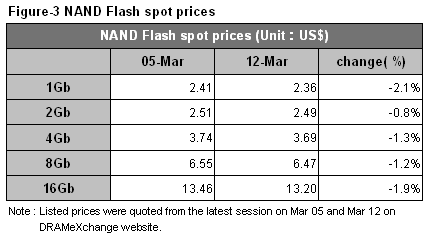
Finally, a comparison of the listed NAND Flash prices from the last session on Mar 5 and Mar 12 is shown below. Spot prices of the 1Gb chip dropped from US$2.41 to US$2.36, a 2.1% decline. For 2Gb, they fell 0.8% to US$2.49; 4G down 1.3% to US$3.69, 8Gb down 1.2% to US$6.47 and 16Gb down 1.9% to $13.20.