Whether DDR2 eTT price increase represents a rebound depends on DRAM inventory levels
On February 19th, Elpida announced it will sell the processing equipment from its 8 inch fab located in Hiroshima to SMIC's partner--Cension Semiconductor Manufacturing Corporation. The sale shows Elpida is currently trying to devote more of its efforts in improving the manufacturing process and output of its 12 inch fabs. With DDR2 800Hz set to become the new mainstream memory in 2H07, their supply may be affected if the 8 inch fabs do not successfully migrate to the 90nm process. Therefore, knowing how to effectively utilize the older 8 inch fabs will become a particularly vexing problem for DRAM makers in 2007.
Currently, DRAM makers mostly employ their 8 inch fabs for foundry or specialty DRAM, Flash and other products. As Elpida has only one 8 inch fab that has a capacity of roughly 40K, in contrast to other makers, the burden is not as heavy. Although the total processing equipment sales amount is uncertain, it is evident that Elpida is allocating more of its resources to the expansion of its 12 inch wafer capacity. Moreover, its joint venture with Powerchip in constructing 4 new 12 inch fabs, along with the increased yearly capex of US$1200M for 2007, evidently reveals its intentions in grabbing a bigger market share than Samsung after 2010. However, it should be noted that Samsung will not necessarily give up its leading market position in order to secure its profit margins. The "12 inch wafer battle" is expected to become more intense between the DRAM players in the future.
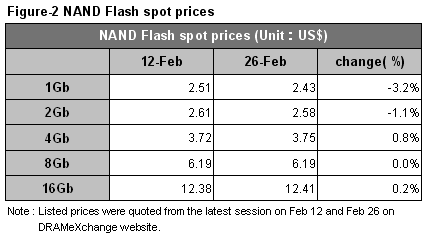
During the Chinese New Year, there was minimal transaction in the DRAM spot market, as prices continued to decline. DDR2 512Mb 667MHz dropped to US$4.21, while DDR2 eTT surprisingly climbed to US$3.25. With the inventory levels still relatively high, the DDR2 eTT price rise can only be viewed as an increase from the previous sharp declines. Whether the price actually bottoms out relies on the inventory levels in March.
DRAM contract prices continued to drop in 2HFeb. DDR2 512MB 667MHz module price has slipped past the US$40 mark, arriving at roughly US$38. For each DDR2 512Mb 667MHz chip, it costs approximately US$4.38. It can be seen that the contract price and spot price has grown almost the same.
4GB USB Flash Drive or above beginning to mature
Although the USB Flash Drive or UFD is not the biggest consumer of NAND Flash, its importance has never been overlooked by Flash makers. According to DRAMeXchange, UFD global shipments reached roughly 105 million units for 2006. During 1H06, 512 MB and 1GB UFDs were the two most popular storage size, but beginning from Q306, 1GB began to emerge as the mainstream UFD. By Q406, it started to shift towards 2GB UFDs, as their production ratio began to increase sharply.
In the wake of the rapid NAND Flash price declines, the UFD market price has also been spiraling downwards. The market price of a 2GB UFD is now roughly US $15-25, while a 4GB UFD carries a price tag of approximately US $30-60. In general, when the mainstream capacity of the UFD or memory card crosses a new threshold, it usually takes place when the product's price slips below US $30. With the lowest priced 4GB UFDs now falling to roughly US $30, DRAMeXchange believes demand for 4GB UFDs should begin to pick up during Q207 at the soonest.
The wide price range of UFDs based on the same capacity that is currently seen in the market can be mainly attributed to the new functions that makers are adding to these mature products. As UFDs are primarily used for data backup purposes, manufacturers have unveiled a wide range of UFDs that are more attractively or innovatively designed to boost sales. To entice potential buyers, some UFDs are made to resemble a name card or other eye-catching appearances, while others have included enhanced functions, such as being waterproof, fingerprint recognition, data encryption and so forth.
Although UFDs are already a mature product, DRAMeXchange believes their market growth should reach roughly 20% for 2007. This is due to 1) Vista's Ready Boost feature, 2) more attractive and personalized UFDs and 3) more embedded functions. Furthermore, with the 4GB and above UFDs gaining popularity, it is expected they will help consume a significant portion of the future NAND Flash capacity.
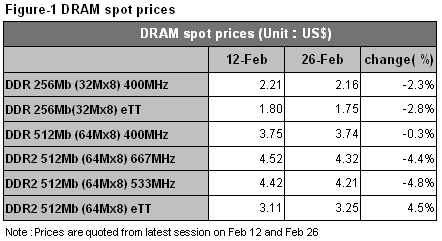
Finally, a comparison of the listed NAND Flash prices from the last session on Feb 12 and Feb 26 is shown below. Spot prices of the 1Gb chip decreased from US$2.51 to US$2.43, a 3.2% drop. For 2Gb, they fell 1.1% to US$2.58; 4G up 0.8% to US$3.75, 8Gb remained the same at US$6.19 and 16Gb up 0.2% to $12.41.