Approaching Chinese New Year leads to sluggish spot market demand
The upcoming Chinese New Year has further contributed to a weaker DRAM market, as the DDR2 spot price continued to decline. The DXI index fell from 4139 to 3998. However, in contrast to the weak DRAM market, the successful issuing of a 350 million ECB by ProMOS shows that investors are still willing to conduct long term investments in the DRAM industry.
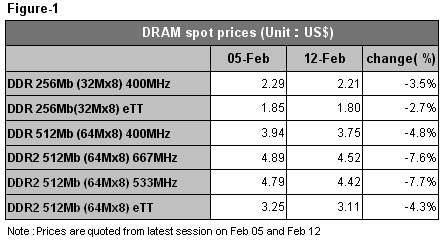
Despite the ongoing price declines, demand remains sluggish in the spot market. DDR2 512Mb 667MHz slipped to US $4.52. DDR2 512Mb eTT declined to US $3.11, down 4.3% in a single week. DDR 512Mb 400MHz dropped to US $3.75, down 4.8%.
After experiencing the steep price declines in January, it is worthy to note that the more recent price drops appear to be growing less severe. Although the spot market demand is currently unclear, the production lines of the module houses are operating at full capacity. Many module houses are increasing their production utilization rates in preparation for the expected demand during the upcoming Chinese New Year holidays. The holidays last for at least a week, and is usually celebrated in the Greater China area. However, excluding production lines that require temporary suspension for routine maintenance, most of the other fabs of the upstream DRAM makers will continue to roll out products during the Chinese New Year. This may further exacerbate the oversupply problem.
The DRAM spot price has declined substantially during January. For example, the price drop for the DDR2 eTT has already reached 40%. For DDR2 512Mb 667MHz, the price drop has already hit 24%. Moreover, during Micron's recent investor conference, the DRAM maker stated that the DRAM price for Q406 saw a QoQ 15% drop.
In contrast to the weak DRAM seasonality, the capital market appears to be more positive towards the DRAM industry. ProMOS has successfully completed its issuance of a 350 million ECB, where the conversion price and conversion premium respectively reached 14.7 NT dollars and 19%. Under the current downbeat outlook, the successful issuance demonstrates that investors are still willing to perform long-term investments in the DRAM industry.
Industry downturn prompts NAND Flash vendors to roll out new applications to stimulate demand
Prices in the NAND Flash market have been sharply declining for the past three months. Except for the more moderate fall in the 1Gb chip, 2Gb and above chips have been experiencing price drops reaching roughly 50%. The traditionally weak seasonality has brought forth a huge demand and supply imbalance, which has led to the industry's current downturn.
NAND Flash suppliers have been aggressively enhancing their process technology in order to gain additional market share. For the past two years, several NAND Flash suppliers have expanded the number of their 12 inch fabs. The manufacturing process has also migrated from the original 90 nm to 70nm, 60nm, and even to 50 nm. This has led to substantial growth in the NAND production. From a NAND Flash demand perspective, many CE products now employ NAND Flash as the storage medium. These applications include MP3 players, multimedia cell phones, digital cameras, USB drives, GPS handheld devices, game consoles and so forth. However, the market demand for certain high capacity storage devices is still not very high, which makes them unable to effectively digest the capacity ramp up from the NAND Flash manufacturers. This has been a major reason in why NAND Flash prices have been on the decline for the past three months.
Amid the current industry downturn, suppliers are trying to alleviate the oversupply problem by putting on hold the construction of additional 12 inch fabs, and switching to the production of DRAM chips instead. Each player is also trying to look for new NAND Flash applications in stimulating additional demand, along with lowering the inventory level, in hoping to prevent prices from dropping further.
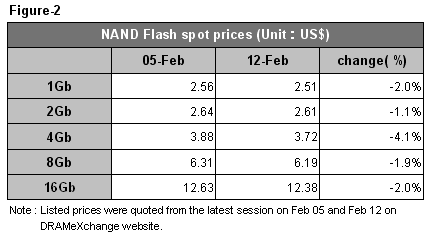
Finally, a comparison of the listed NAND Flash prices from the last session on Feb 5 and Feb 12 showed a price drop in all the various chip densities. Spot prices of the 1Gb chip decreased from US$2.56 to US$2.51, a 2.0% drop. For 2Gb, they fell 1.1% to US$2.61; 4G 4.1% to US$3.72, 8Gb 1.9% to US$6.19 and 16Gb 2.0% to $12.38.