Increased supply in spot market from DRAM makers further drives down DDR2 spot price; 8 inch wafer plants becoming less cost-effective
A weak market demand, coupled by an increased DRAM supply, further drove down the DDR2 spot price, where the DXI index plunged from 4363 to 4262. On a different note, DRAM makers have subsequently released their earnings result for Q406. Manufacturers that owned a higher ratio of the more cost effective 12 inch fabs evidently performed better. Thus, for players that largely operate 8 inch fabs, it is expected that they will be faced with a tougher year ahead.
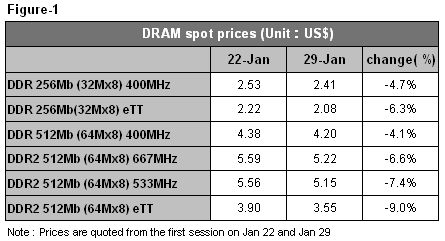
Vendors remain cautions towards the DRAM spot market, as module makers and brokers continue to lower their inventory levels. The Chinese and Hong Kong markets were similarly sluggish, as well. The flat market prompted the DRAM price to continue declining. DDR2 512MB eTT was down 9% at US$3.55. DDR2 512Mb 667MHz slipped to US $5.22, down 6.6%. DDR prices also dropped on the back of the falling DDR2 prices, where DDR 512Mb 400MHz declined 4% to US$4.2.
As PC OEM makers have mostly finished their inventory stockpiling, demand has begun to grow weaker in the contract market. Thus, amid the increasing production capacity outputs, DRAM makers must rely on the spot market to digest their products, resulting in continued spot price declines. Needless to say, the price declines and reduced working days in February may cause the contract price to drop. From the current US $5.2 spot price for a DDR2 512 Mb 667 MHz, its contract price may drop to a similar level in February. There may be a chance to see DDR2 512MB modules dropping below the US $45 level.
From the recent Q406 earnings results, all of the DRAM makers posted a profit. The table below reveals that the operating margins of the Taiwanese DRAM makers are higher than the other players. This can be attributed to their more unified DRAM production lines. Furthermore, the huge R&D expenses from the other DRAM makers were also a key factor to their smaller operating margins. Therefore, to share the growing expenses, it is anticipated that more cooperation will be seen between the DRAM players in the future.
The 12 inch fabs are proving their worth, as they are more cost effective in the DRAM production. From the operating margins shown below, the profit of companies that still operate a significant portion of the 8 inch fabs are much lower than their competitors. Despite the fact that more advanced processing technology are being adopted by the 8 inch facilities, for 70nm or below, new equipment must be purchased. Depreciation will undoubtedly increase, causing the production costs to grow as well. Consequently, for DRAM makers that have a high ratio of 8 inch wafer plants, 2007 is projected to be a tougher year for them.

50 nm 16Gb chips from Samsung and Toshiba/SanDisk usher in a new era of NAND Flash process technology
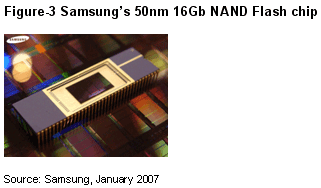
This January, Samsung and Toshiba/SanDisk, the top 2 global NAND Flash makers, subsequently unveiled their latest NAND Flash memory chips. Samsung announced samples of its 50 nm 16Gb MLC NAND Flash chips have been delivered to its clients. The newly developed chips are set to enter mass production in Q107. On the other hand, last week Toshiba/SanDisk also revealed to the public the successful development of its 56 nm 8Gb and 16Gb MLC Flash chips. Commercial samples of the 8GB Flash chips are already being shipped, while the 16GB ones are planned for Q207.
In contrast to other memory products, the manufacturing process is particularly important to NAND Flash makers. The more advanced the process is, the more capable manufacturers can "squeeze in" additional storage capacity into a single chip. In addition, same density chips that are produced through a more advanced technology are more cost effective, as they are shrunk to even smaller sizes. For example, in contrast to the 90 nm process, the use of 70nm circuitry further shrinks the die area cut from a 12-inch wafer. The smaller area allows more chips to be produced, translating to lower manufacturing costs.
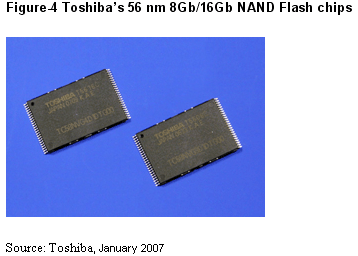
A company's competitiveness depends a great deal on how advanced their process technology is. Thus, relevant manufacturers have devoted significant resources in enhancing their fabrication process. By looking at the current top 4 NAND Flash makers, Samsung and Toshiba/SanDisk are at the forefront, where the two have already successfully unveiled 50/56 nm 16Gb chips. Although Hynix/STMicroelectronics and Intel/Micron trail behind, they are also scheduling to roll out 50-60nm chips this year.
DRAMeXchange believes that as NAND Flash makers continue to improve their process technology, more cost-effective and higher capacity products are expected to hit the market in the near future. This will undoubtedly help drive up demand in the NAND Flash market.
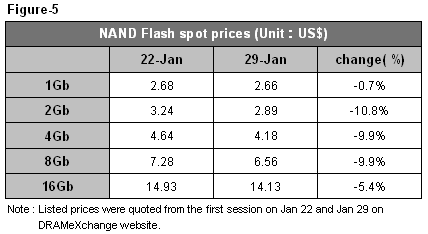
Finally, a comparison of the listed NAND Flash prices from the last session on Jan 22 and Jan 29 showed a price drop in all the various chip densities. Spot prices of the 1Gb chip decreased from US$2.68 to US$2.66, a 0.7% drop. For 2Gb, they plunged 10.8% to US$2.89; 4G 9.9% to US$4.18, 8Gb 9.9% to US$6.56 and 16Gb 5.4% to $14.13.