Lowering of DDR2 inventory drives down spot market price; evident contract price decline may be seen after February
A weak market demand drove down the DDR2 spot price for last week, where the DXI index slid from 4549 to 4363. As price negotiations between some of the DRAM and PC OEM makers are conducted on a monthly basis now, the DDR2 contract price drop in 2HJan was still within 3%. It is anticipated that a more evident price decline will be witnessed after February.
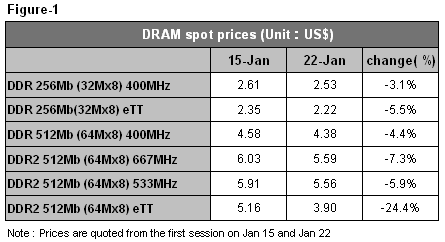
The sluggish DDR2 market prompted some of the module vendors to begin selling off their inventory, severely weakening the market price. Minimal transactions were seen in the Chinese and Hong Kong markets as well. Due to the rapid DDR2 price decline, module vendors and brokers have adopted a "wait and see approach", which further dragged down the price. For last week, DDR2 512Mb eTT slid below the US$4 level, reaching to US$3.9. This represented a 24% drop in just one week. DDR2 512Mb 667MHz stood at US$5.59, down 7.3%. The DDR price was also affected by the DDR2 price drop, where DDR 512Mb 400 MHz experienced a 4.4% drop, reaching to US$4.38.
In contrast to the plunging spot market price, the drop in the DDR2 contract price was still within 3%. The switch in the price negotiations between DRAM and OEM makers to a monthly basis was the main reason behind the smaller price drops. Thus, the DRAM price in 2HJan appears to be relatively the same as in 1HJan. The average price of DDR2 512MB U-DIMM 667MHz and DDR2 1GB U-DIMM 667MHz respectively slid below the US$50 and US$100 mark. It can be seen that the price gap between the two is narrowing.
As the inventory levels of PC OEMs have already grown higher amid the weak seasonality between 2HDec and January, its growth is already waning. Coupled by the huge spot price plunge, it is expected that PC OEM makers will be more aggressive in future DRAM price negotiations. Thus, the DDR2 contract price is expected to decline more evidently after February. However, in light of the insufficient supply of DDR2 that began in 2H06, many PC OEM makers had already finalized the contract price for Q1. Therefore, DRAMeXchange projects that the price drop of the DDR2 contract market for Q1 should be lower than the spot market.
According to DRAMeXchange's DRAM testing report (2007/1/16) in running the new Vista program, in contrast to 512MB, 1GB of DRAM will improve the platform's efficiency by at least 17.2%. If Office 2007 is also installed, the recommended memory content is 2GB. As the current DDR2 1GB module costs roughly US$100, it takes up approximately 12.5% of the overall NB BOM costs. Therefore, PC OEM makers are hoping that the DDR2 512MB module price will slip to US$35. This will make the 1GB DRAM module to account for less than 10% of the overall NB BOM costs, and also generate more 2GB DRAM demand. Therefore, although continued DDR2 price declines are foreseen, under the new Vista operating system, they will reach to a level where additional PC upgrades will be stimulated. In addition, as the 90nm manufacturing process of 12 inch plants keeps the fully loaded DDR2 costs below US$3, DRAM makers are still expected to acquire a certain amount of profit.
Can the iPhone become the next killer application for the NAND Flash market?
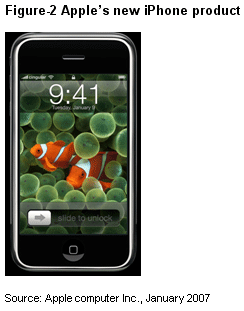
The long-awaited iPhone was finally unveiled to the public at the MacWorld Conference & Expo 2007, where the sleek and multi-function phone immediately became the center of worldwide attention. Its potential can not be overlooked, as it may become a powerful player in the cell phone and NAND Flash market in the future.
The reason in why the NAND Flash market has been paying close attention to the iPhone is attributed to another hit product from Apple---the iPod. When Apple introduced the iPod shuffle and iPod nano, NAND Flash was deemed as a better storage medium than the HDD for the portable MP3 player. With annual sales in the millions, the iPod has ascended to the No.1 spot in the MP3 player industry. Apple's decision in employing NAND Flash for the storage medium significantly raised its importance in the NAND Flash supply chain. The sales of the iPod have thus become one of the key factors in affecting the NAND Flash price.
The huge success of the iPod has undoubtedly prompted many people to wonder if the iPhone can be just as successful. Upstream NAND Flash component makers are anticipating that the iPhone will bring forth a capacity crunch. From its numerous functions that were showcased during the MacWorld Conference & Expo 2007, it is apparent that the iPhone aspires in becoming the next "iPod". Its slim design, 3.5 inch high resolution and multi-touch screen, multiple wireless specs (Wi-Fi 802.11b/g + EDGE + Bluetooth 2.0), 2 million pixel camera function, 4GB and 8Gb high NAND Flash storage capacities were just a few of its innovative features.. However, quite surprisingly, the 3G wireless networking standard was not included in the phone.
What people are most curious about is how the iPhone will perform after it is launched in the North American and European markets respectively in Jun07 and Q407. Apple's CEO, Steve Job, anticipates that the global sales of the iPhone will hit 10 million units in 2008. Assuming that this is achieved, along with the fact that 4GB and 8GB models each account for 50% of the sales volume, the iPhone will consume 480mn ( in 1GB equiv.) of the NAND Flash capacity. This is roughly 3.8% of the 2007 global NAND Flash market. Whether or not the iPhone will eventually become a "big hit" remains to be seen, but needless to say, both the iPod and iPhone will be key drivers of the future NAND Flash market.
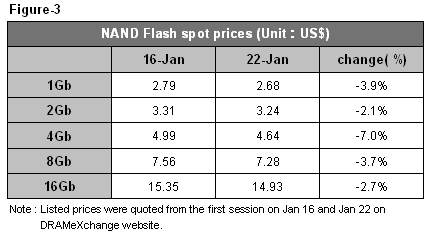
Finally, a comparison of the listed prices from the last session on Jan 16 and Jan 22 showed a price drop in all the various NAND Flash chips. Spot prices of the 1Gb chip decreased from US$2.79 to US$2.68, a 3.9% drop. For 2Gb, they tumbled 2.1% to US$3.24; 4G 7.0% to US$4.64, 8Gb 3.7% to US$7.28 and 16Gb 2.7% to $14.93.