DRAM Spot price drops amid weak Christmas demand
Due to the approaching Christmas holidays, module vendors and brokers are adopting a wait and see attitude. Minimal transaction volume has resulted in the DRAM spot price to grow weaker, where the DXI lost 11 points, declining from 4644 to 4633. The DRAM contract price remained relatively the same in 2HDec, as several PC OEM makers have been experiencing better than expected sales.
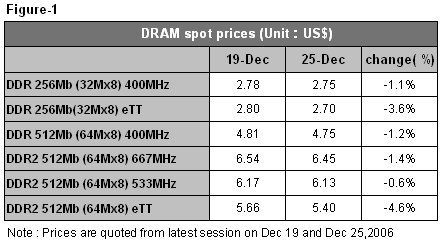
In light of the upcoming Christmas holidays, module vendors and brokers have been unwilling to increase their inventory levels. The same situation can be seen in the Chinese and Hong Kong markets as well. Transactions in the spot market have been weak, rendering a more evident price decline for last week. DDR2 512Mb 667MHz slipped to $6.45, while DDR2 eTT dropped to $5.43. However, the continuing price drops seems to have begun to generate some sales. After the DDR2 eTT slid to $5.5, relevant buying is seen to be on the increase. Some are still betting on the memory upgrade demand that Vista will create in Q1, 2007.
The DDR2 contract price in 2HDec remains stable. Most of the DDR2 512MB 667MHz contract price has been above $50, which is mainly attributed by a better than expected sales in the NB end market. Thus, minimal changes are seen in the DRAM contract prices, as manufacturers prepare for the channel demand in Q1, 2007. In light of the changes in the mainstream memory specifications, DDR demand is rapidly diminishing. DDR 512 MB 400MHz has already dipped below $43.
Although the DRAM spot price has been consecutively dropping for several days, the market is still placing high hopes on the expected memory upgrade cycle generated by Vista. Despite the low price, DRAM buying is still ongoing. Nevertheless, the home edition of Vista will not be released until the end of January, 2007. Thus, demand will not become evident until Q2, 2007. The DRAM contract price is projected to fluctuate only slightly, as it is supported by the aggressive stockpiling from PC OEM makers in the traditionally slow season. The gradual decline in the contract price should help minimize the price drop range in the spot market.
Micron's Q1 financial results for fiscal 2007 (Sep-Nov) showed that its sales revenue experienced a 15% QoQ increase. Net profit reached $192 million, which was 3 times higher than the $64 million recorded for the previous quarter. The main reason behind the profit jump lied in the DRAM price hike, which rendered a 31% gross profit. As Taiwanese DRAM makers only produce DRAM products, they also enjoyed a 50% gross profit for Q4. Despite the expected price drop for 2007, DRAM makers will be enjoying another good year in 2007, as the cost for the 90 nm manufacturing process dips below $2.5.
How NAND Flash is applied in Vista Ready Boost
On November 30th, 2006, the business edition of Microsoft's new Vista operating system was officially released to the market. Its home edition is expected to be introduced during the end of January, 2007. One of the highlights of the system is the newly added Ready Boost function, which provides supplementary cache memory for the computer to use after the boot up process. The external memory can be utilized to store frequently used programs, which helps decrease the HDD's (Hard Disk Drive) access frequency, and enhance the overall computer performance. In general, UFD (USB Flash drives), memory cards, SSD (solid state disks), Hybrid HDD, Robson module, MP3 players..etc, are equipped with NAND Flash storage devices that are potentially capable of employing Ready Boost. During the beginning, it is expected that the Ready Boost function will be employed in high speed UFD and memory cards.
Ready boost is essentially carried out by Vista's SuperFetch & EMD (External memory device) functions. SuperFetch employs a more intelligent memory caching method by preloading the user's most frequently used programs. Therefore, even if the computer is turned on for the first time, or different files are accessed by different users, the system response time is very quick. The EMD, on the other hand, makes use of the UFD or memory card's flash memory in serving as the system's virtual memory. The virtual memory is not used as often as the system's main memory. However, its access speed is considerably much faster than the HDD. Without adding additional main memory modules, computers can run even faster by retrieving files from the EMD's virtual memory.
Moreover, when the user removes the UFD or memory card, the EMD will automatically transfer the stored files in the EMD's virtual memory to the HDD. Thus, the improved computer performance from Ready Boost does not cause any data loss or operational disruptions. As Vista utilizes a unique algorithm to optimize the UFD or memory card, their life spans will not be shortened by the EMD. The EMD also encrypts and compresses data that are stored in the virtual memory of the UFD. This increases the capacity of the storage medium, and prevents any unauthorized access.
As the access time (ns or us grade) of CPUs & memory ICS, which are electronic components, are much quicker than the HDD's mechanical access time (ms grade). PC vendors have proposed several system enhancement methods. Thus, the hardware transfer speed must meet Microsoft's requirements, when they work with the Ready Boost function in Vista. For example, the UFD should use a USB2.0 specification that owns a transfer speed of up to 480M bps. High speed UFD or memory cards must at least attain a read speed of 5MB/s (4KB block), and a write speed above 3MB/s (512KB block). Thus, vendors will first employ the faster SLC NAND Flash to serve as the Ready Boost application product. It is anticipated that under the support of Flash controller vendors, MLC NAND Flash products will be Ready Boost available in the future. Furthermore, the 230MB-4GB of the supplementary NAND Flash memory provided from the Ready Boost UFD or memory card can be used for the virtual memory storage. The remaining portion can still be employed to store regular data files, where a storage capacity of at least 512MB is suggested.
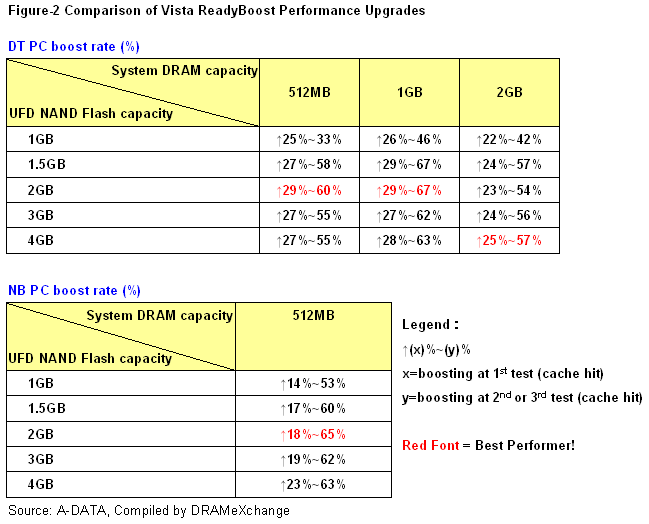
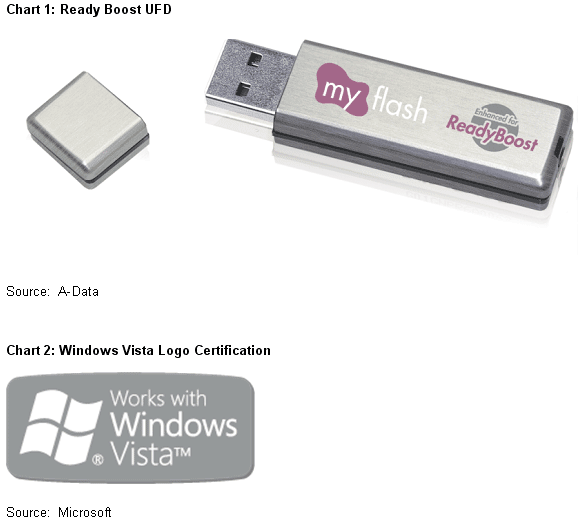
Industry tests have shown that when the Ready Boost function works on the Vista system, it can approximately be enhanced by over 30%. When the application software is more complex, the improvement becomes more evident. In general, if the system's random access requires a more obvious increase in the computer speed, the DRAM and NAND Flash ratio should be at least 1:1-1:2. In other words, if 1-2GB of DRAM is used in running Vista, there should be at least 1-4GB of NAND Flash. Needless to say, when the UFD owns a larger storage capacity and faster transfer speeds, the Ready Boost function will perform better. (Refer to Figure 2) This will certainly play a key role in elevating the 2GB and 4GB UFD in becoming the new mainstream specification for 2007. A Ready Boost logo will appear on the USB 2.0 UFD or high-speed memory card to help consumers differentiate whether it is workable on the Vista system. (Refer to Chart 1 & Chart 2)
Currently, most of the NB PC's HDD rotation speeds are 4200 RPM or 5400 RPM. In contrast to the faster 5400 RPM or 7200 RPM of the DT PC's HDD, if the same CPU is used, the NB PC's performance is degraded by the slower HDD. In addition, expanding the NB PC's memory is subject to several factors-memory costs, limited memory slots, difficulties in configuring or upgrading the computer and so forth. Moreover, computers are mostly used in saving or accessing small files, such as word processing and Internet browsing. They are considered few application programs that can be used by many files. These programs are considered as random access applications. Therefore, high-speed UFD or memory cards that are Ready Boost compatible will initially see more applications in NB PCs. It is projected that when the Vista and Ready Boost products become more popular in 1Q07, the NAND Flash demand will grow as well.
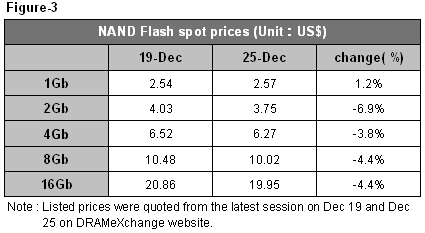
Finally, in the line up to the upcoming Christmas holidays last week, except for the 1GB chip, the remaining NAND Flash prices continued to decline. 1GB chips grew 1.2%, increasing from $2.54 to $2.57. Prices for 2GB chips saw the biggest drop, losing 6.9%.