PC OEMs start inventory pre-stocking; Limited DRAM contract price fluctuation in 2HDec
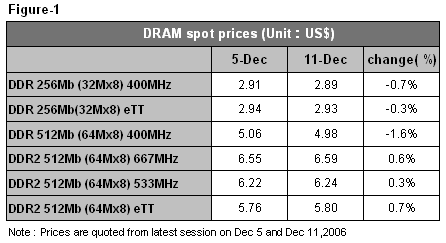
DDR2 pricing maintains static at the spot market during the week Dec5-11 where contract market should sustain its price stability in 2HDec amid concern of insufficient stock.
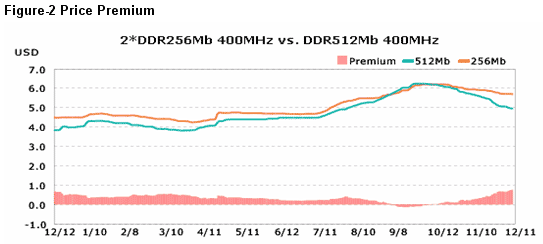
Since branded DDR2 chips supply continues falling short of demand at sport market, limited available stocks at the marketplace spurred DDR2 512Mb 667MHz grew by a mild 0.6% sequentially to US$6.59 on Dec11. eTT (UTT) DDR2 chip prices, that showed rebounding price signs on Dec4, did not hold this upward trend due to declining transaction afterwards with final quotes maintained at us$5.80. Price for DDR 256Mb came relatively stable, thanks to reducing output and extending applications on consumer electronics (pls refer to Nov28 weekly dispatch). Currently prices of two individual DDR 256Mb chips are 16% higher than one single 512Mb part (Figure 2).
As Christmas is approaching, procurement prior to this seasonal festival had come to an end. Although DRAMeXchange observes demand reduces comparatively among PC OEMs, pricing should hold firm in 2HDec since PC OEMs are still aware of their inventory after experiencing the 90nm transition issues at some DRAM makers before. In light of the present inventory level has been reduced to below 10 days, PC OEMs start pre-stocking inventory in order to secure sufficient stock for 1H07 and this should provide a healthy environment for DRAM contract pricing in 2HDec.
Note that the recent DRAM shortage in the contract market is rare. From supply side of view, the previous 90nm transition issue at some DRAM makers has trim overall output. Demand grows at the meantime when the consumer version of new Microsoft OS Vista about to hit the shelves. Long term speaking, we anticipate the present shortage to be eased in 1H07 since PC OEMs have already started piling up inventory. Brisk DRAM outlook should persist through 1Q07 on healthy demand-supply environment.
Vista's ReadyBoost function will generate new growth in UFD
According to Microsoft's official website, the long awaited Windows Vista Home Edition is scheduled to hit the market in January 30, 2007. Among the newly added features, we will focus on the Readyboost and ReadyDrive functions, which have been designed to boost the operational efficiency of the PC.
Affected by the hard drive's writing speed, DRAM storage capacity and so forth, the boot up time of Microsoft's operating systems often required a considerable amount of time. However, this problem will be alleviated by the ReadyBoost and ReadyDrive technologies from Microsoft. ReadyBoost essentially improves the overall PC speed by providing extra memory from compatible USB Flash Drives(UFD)to the system. ReadyDrive, on the other hand, makes use of the Hybrid Hard Disk's (HDD) NAND Flash to serve as a buffer, which reduces the burden on the hard disk drive and conserves the amount of power needed. The function also enhances the PC recovery time when it is in sleeping mode and reliability of data accessing.
Vista's ReadyBoost feature will be an important catalyst to the business of UFD suppliers. In contrast to other NAND Flash applications, UFD are deemed a more mature industry, as their market demand is strongly correlated with the PC shipments, and are largely used as a backup for data storage. Nevertheless, this may begin to change, as consumers who seek to enhance their PC performance, may opt to purchase ReadyBoost compatible UFD. In light of the anticipated increased demand for UFD, many of the manufacturers are adding the ReadyBoost function into their products. DRAMeXchange believes that the Vista launch next year will help spur growth in the NAND Flash market.
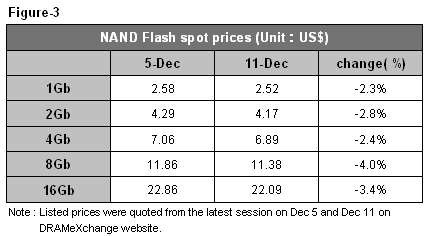
From Dec. 5 to 12, the NAND Flash market experienced a decline in all segments. (1) 1GB spot price: declined from 2.58 to 2.52; a 2.3% drop. (2) 2GB spot price: declined from 4.29 to 4.17, a 2.8% drop. (3) 4GB spot price: declined from 7.06 to 6.89; a 2.4% drop. (4) 8GB spot price: declined from 11.86 to 11.38, a 4.0% drop. (5) 16GB spot price: declined from 22.86 to 22.09, a 3.4% drop.