Stable DDR2 contract price in 1H of Dec, contract market still tight.
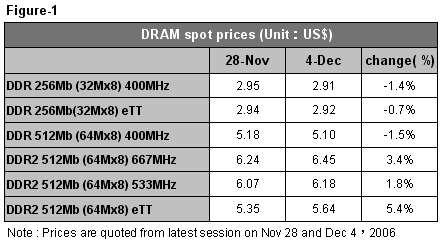
Month-end financial pressure has eased in the spot market. The DDR2 spot price has begun to show a rebound, as reflected by the DXI, where it increased from 4561 to the 4492 level. DDR2 contract prices in the 1H of Dec has remained relatively stable, as some DRAM makers still have bottlenecks in the 90nm manufacturing process, thus, the sufficiency gap is still tight.
Last week, DDR2 eTT spot price saw a bigger fluctuation, which was mainly caused by the fact that various brokers and module makers were busy trying to attain their month-end financial results. The inventory clear out at the end of November rendered the price of DDR2 eTT to drop as low as $5.35. Prices have gone up a bit to $5.5 in the beginning of December. Amid the shortage of branded DDR2 in the contract market, their supply to the spot market has been limited. Therefore, prices for DDR2 512Mb 667MHz merely experienced a slight increase of 3.4% to $6.45.
Overall speaking, there is small demand for DDR chips in the spot market. The prices continue to go down, as shown by the 1~2% drop in last week's quote. The price gap with DDR2 is approximately 15%. Many brokers are unwilling to increase DDR2 inventory levels for the Christmas holidays. Demand should grow more evidently, once the holiday vacation is over.
The DDR2 contract price in December remains quite stable. Module prices for DDR2 512MB 533MHz are approximately $49 to $51. Except for rush orders that spurred the contract price for DDR2 512MB 667MHz to reach $55, the majority are above $50. Despite the weak demand anticipated for the 2H of Dec, the contract price for December should still be relatively stable, as the supply from some DRAM makers remains unstable. DDR contract price may see a 5% drop, in the wake of minimal demand from PC OEM makers.
For 1Q, 2007, the launch of Windows Vista will create an increased DRAM requirement. Coupled by the fact the some PC OEM makers have signed long-term agreement; the contract price for Q1 should perform better than during the slow season.
Wii - the final salvo but chief NAND Flash capacity filler
We are now ready to wave goodbye to 2006 but the curtain of new-generation game console competition just unveils in November. The first new generation game console that hits the shelves is Microsoft's Xbox 360, which launched almost a year ago and had accumulated shipments of almost 6m units. Sony's PS3 and Nintendo's Wii, both long anticipated by gamers, are finally introduced recently- a year after Xbox 360.
Due to the problematic Cell processor and Blu-ray PUH issues, Sony keeps postponing PS3's launch schedule with final launch came on Nov 11. Given the relatively high retail prices (US$499 and US$599), as well as supply issue, only limited stocks are available in Japan and US market. Sony officially said it expects to ship 2m PS3 by end of this year.
Wii , officially hits the US market on Nov 19 and Nintendo officially claims it had sold 600,000 units of Wii within 8 days' time. When the sold-out news was heard from the Japan market on Dec 2, Nintendo said it now targets to ship 4m of Wii by year-end. Robust sales are actually driven not only from the friendly price (US$250) but also the innovative interactive game features. When it comes to the topic of NAND Flash, DRAMeXchange regards Wii as a capacity filler since each Wii equips with 512MB of NAND Flash. Memory density here might not be that critical as compare to others but when sales keep growing, associated benefits to chipmakers is unquestionable.
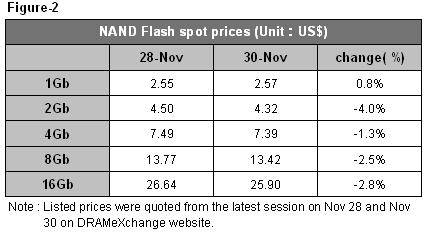
In related news, NAND Flash price trend in Nov 28-30 notionally presents a weaken sequential price fall. Most density chips, except for 2Gb, found their sequential fall narrowed where 1Gb chip even gained by 0.8% on week at US$2.57. Prices of 2Gb dropped by 4% to US$4.32; 4Gb 1.3% to US$7.39; 8Gb 2.5% to US$13.42 and 16Gb 2.8% to US$25.90.