DRAM demand warms up, spot price drop weakens
Spot prices of DDR2 continue trending downward disregard demand surfaces again after holidays in Asian regions. DXI grew slightly from 4,400 to 4,402 last week. For the contract market, DRAMeXchange still sees opportunity of price up for the "high" range price level of DDR2 512MB DIMMs since second-tier PC OEMs still unable to secure sufficient stocks.
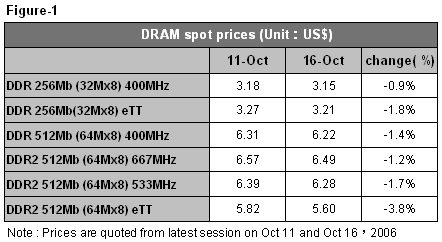
Although observing the warming up demand at the spot market recently, buyers are relatively strong to insist for lower quotes and dragged overall closed prices slipped further in a comparatively weakening strength. Branded DDR2 667MHz dropped by 1.2% on week at US$6.49 while non-branded eTT (UTT) continued the price correction and closed at US$5.60. Price correction is undergoing as we expected but the rate is constrained amid the seasonality demand swell. Price of eTT (UTT) DDR2 should average at US$5.50 in 4Q06 with price fluctuation limit in 10% range, said Powerchip on Oct 16's investor conference.
For the contract market, first-tier PC OEMs do not face any shortage concern and the quotes they may get in 2HOct should maintain stable. Second-tier players, on the other hand, should expose to further price up pressure since DRAM makers should continue reserving stocks to tier-one players. The "high" range price level of DDR2 512MB may have chance to exceed 1HOct's US$50 level.
NAND Flash price and transaction slows down
Demand for NAND Flash starts weaken with spot price trend corrects down after experiencing five consecutive weeks' persistent growth or flattish price trend. DRAMeXchange sees slowing down demand and price trend from late Sep up to present.
NAND Flash transaction and price trend once grew briskly in Sep amid insufficient supply and ramping up demand. However, this situation swung from late-Sep as a result of:
- Some downstream players start landing supply last week after suppliers reserved stocks for their key customers for a while. Buyers hold their procurement and expect prices to quote lower, thus overall sales being discouraged with prices showing correction signs.
- Sales of Apple's latest version of iPod, which are said to be weaker than expected, prompt both buyers and sellers holding a more conservative outlook. Although the rumor could not be justified at the moment, the skeptical atmosphere that the rumors spread over is undeniably influential.
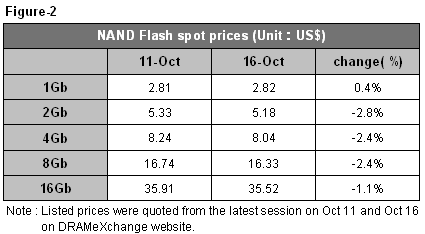
Prices of 2Gb, 4Gb and 8Gb were the three density of chips that reported largest sequential changes. All chips reported either extended loss or swung to loss except for 1Gb chip. Price of 1G grew continuously by 0.4% to US$2.82; 2Gb dropped by 2.8% to US$5.18; 4Gb dropped 2.4% to US$8.04; 8Gbit dropped 2.4% to US$16.33 and 16Gb dropped 1.1% to US$35.52.