Price upside of DDR2 weakened but overall pricing should remain firm
Disregard spot prices of DDR2 weakened after distributors obtained satisfactory profit during previous price uptick, the traditional PC shipment peak season should still held prices above US$6 level. Contract prices, at the meantime, should also sustain its growth momentum through Oct as we previously estimated.
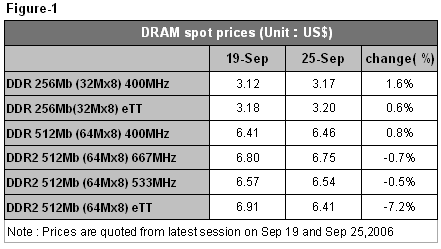
Prices of DDR2 eTT (UTT) encountered larger price adjustment since distributors slow down their consumption after earning pleasing profit while downstream demand trends weaker amid the previous price swell. The 7.2% sequential price fall of 512Mb DDR2 eTT(UTT) chips had lowered the price of eTT(UTT) below the price level of branded 512Mb DDR2 667Mhz (US$6.41 vs. US$6.75). Prices of DDR were notionally stable without any critical changes. Although seeing price adjustment emerges, price correction should be interpreted as a price adjustment to reasonable level, rather than a fundamental change.
For the contract market, first- and second-tier PC OEMs experience divergent scenes. Although supply is still lagging behind, most DRAM makers are striving to fulfill demand from first-tier PC OEMs. Since the shortage gap is not as critical as 1Q's and Korean makers are expected to boost their output in 4Q, PC OEMs who are threatening to lower DRAM content per box will constrain further price upside. Second-tier OEMs, on the contrary, are experiencing much greater price adjustment than tier one players upon the relatively small procurement amount and lack of long-term supply deal agreement. Take DDR2 512MB 533MHz for instance, first-tier PC OEMs take their quotes at US$44-45 but tier two players are taking at as high as US$48. Foreseeing the PC shipment peak during Oct and Nov, DRAMeXchange, still maintains our positive projection to contract price trend through Oct.
Mild decline observed but price growth chances are still there
Although spot price growth of NAND Flash trended weak last week, the absence of sufficient high-density chips should still offer price growth chances. When supply situation grows clear, we should able to see a clearer price indication regarding this price up adjustment.
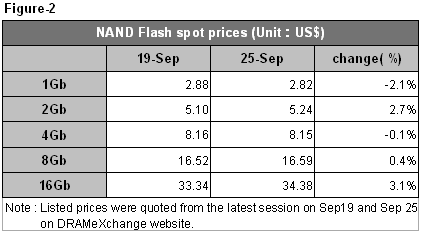
Spot prices of NAND Flash veer back to a mild decline after two weeks' growth from the third week of September due to the weaken demand and conservative outlook. All density parts report drop on a sequential basis with only 2Gb parts gained by US$0.05 on week and closed at US$5.15 on Sep 21.
Despite spot prices of high-density NAND Flash grew by more than 10% over the past two weeks, many downstream players are discourage by the rocket pricing and hold their consumption prior to a clear supply indication. The supply situation is misty since some major NAND Flash suppliers limit their supply to specific customers in Sep on the anticipated demand growth for NAND Flash-based applications.
DRAMeXchange observes that the weakening price trend somehow trended up again on Sep 25. Market intelligence pointed out that downstream players had secured much lesser than expected amount of goods (particularly high-density ones like 8Gb and 16Gb) and we believe spot price trend should have chance to adjust up again this week, though the rate of the adjustment is subject to further observation.
Comparing the closed prices on Sep 19 and 25, 1Gb dropped 2.1% at US$2.82; 2Gb grew 2.7% to US$5.24; 4Gb dropped 0.1% to US$8.15; 8Gb grew 0.4% to US$16.59 and 16Gb grew 3.1% to US$34.38. This trend prompts us projecting that high-density parts (8Gb and 16Gb) should see greater opportunity for further gain while 1-4Gb parts could hardly trend up amid the relative sufficient supply.