DRAM spot price up momentum weakens, contract price trend to sustain growth through Oct
Disregard the slowing down price uptick of DDR2 trend at the spot market, DXI still enjoyed a slight growth from 4,256 to 4,285 last week. The recent price swell has now whittled down procurement interest among downstream players and the entire market is likely to source for the pre-stocked low-priced inventory in near term. While the upward trend slows down at the spot market, the upward strength at contract market is likely to persist through Oct.
Powerchip that released its eTT (UTT) DDR2 at as high as US$7 last week had once spurred overall eTT (UTT) DDR2 prices to US$7.17. The rocket price later being weakens after the price rally. DDR2 512Mb 64Mbx8 667MHz was closed at US$6.77 today while the same-density DDR 64Mbx8 400MHz enjoyed a sequential gain of 1-2% and closed at US$6.36 on persistent demand.
Since some downstream distributors have piled up low-priced inventory prior to the price hike from early Jul, they turn conservative after noticing DDR2 prices surpassed US$7 level recently. DRAMeXchange believes that they are likely to utilize the upcoming 1-2 weeks' time to consume this batch of pre-stocked inventory prior to new consumption. Spot price should depend much on the acceptance of price up and any possible upgrade demand should still spur prices up further.
Price negotiation for 2HSep at the contract price is still underway but both suppliers and buyers have reached the consensus that DDR2 price should continue trending upward. DRAMeXchange estimates the sequential growth will fall in range of 3-5% with DDR2 512MB 667MHz price believed to exceed US$45 . We believe that contract prices should stay strong in Oct, thanks to the anticipated shipment peak of PC during Oct and Nov. DRAM makers are very likely to sustain the price momentum in 1HOct as well. Although the overall price trend is positive, we do not think any critical price up will be seen in the future as DRAM content per box has been keep rising recently.

Mobile RAM race, Mobile SDRAM likely to take the lead
SRAM, Mobile SDRAM, PSRAM and Cellular RAM are the four major memory that are utilized as storage media in handset in addition to NAND Flash. Among these four memory types, Mobile SDRAM should outpace the other three and enjoy the highest growth amid the anticipated enhancement of handset functionality.
From the design perspective, Mobile SDRAM and DRAM are similar to each other and could be classified in SDR and DDR. It is the new memory type that DRAM makers prefer producing most and the most outstanding feature of the memory is the low voltage.
However, the current application of Mobile SDRAM is still bond to high-end mobile phone or smart phone amid the relatively high memory density size. Demand for Mobile SDRAM from mid-range to low-end handsets are comparatively smaller.
Based on the anticipated 950mn handset shipment in 2006, the keep rising proportion of high-end handsets (like MP3 and camera equipped ones) should help spurring Mobile SDRAM accordingly.
In addition to SDRAM, we can easily spot the presence of SRAM at handsets. The current mainstream density of handset-use SRAM is 4Mb and SRAM are mostly adopted by entry-level handsets. Most of them are packed with 8Mb/16Mb NAND Flash as a MCP package.
PSRAM is also adopted by handset as the memory that handles data execution between NOR Flash. PSRAM are sometimes present in the form of Cellular RAM at handsets. With the complete compatible interface with low-power Flash interface, the enhanced memory could make the data execution time considerably.
NAND Flash price and transaction volume trend divergently
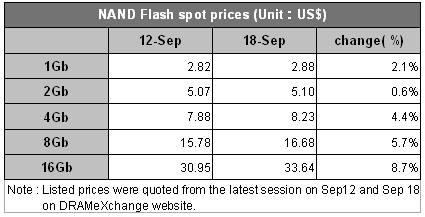
Since those chief suppliers will only release their stocks to key customers in Sep, downstream players who are force to source for stock from spot market supply positive elements for the upward trend. The continual reduction of SLC NAND Flash supply, somehow, disappointed downstream players since many devices still require SLC for most applications. The recent boost in SLC prices thus also stimulates MLC NAND Flash price trend up at the meantime. DRAMeXchange believes that price trend will crystallize after the contract price announcement soon.
Reviewing the spot market trend last week, transaction of NAND Flash kept buoyant during Sep 11-14 with high-density chips (4Gb and above) enjoyed higher growth- a clear indication to testify high-density parts as the red-hot items. Of which, the shortage of 16Gb spurred corresponding price up in a faster pace. Transaction recessed on Sep 15 after some suppliers reduce their quotes to stimulate sales. Price rally was observed and overall prices were dragged down after marketers being discouraged by the price fluctuation.