DDR2 spot prices correction observed; contract prices stay firm through August
Spot prices of DDR were stimulated by the production suspension news of certain PSC's DDR chips while DDR2 prices continued trending downward amid the inventory clearance among industry players.
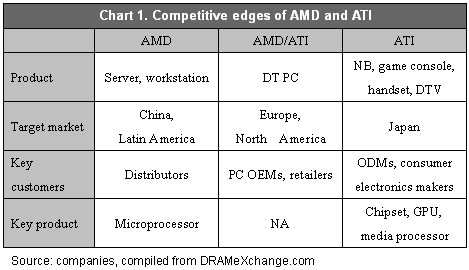
The news regarding PSC's upcoming production suspension on DDR 256Mb 32Mbx8 400MHz spurred prices of related chips last week. Both branded and eTT (uTT) enjoyed a 2.3% sequential gain and reached US$2.71 and US$2.68 respectively. Prices of high-density DDR 512Mb 64Mbx8 400MHz were also encouraged by the news and grew to US$5.23 on July 31, versus the same-density DDR2 chips' US$US$4.70 and US$4.52.
DDR2 prices were still subject to drop amid the inventory clearance pressure among traders and memory module makers. These makers who are expose to heavier month-end pressures pushed their stocks and dragged overall prices down. Prices of both DDR2 512Mb 64Mbx8 533/667MHz DDR2 chips reported a sequential drop of over 2% and closed at US$4.52 and US$4.70 respectively on July 31. PSC's, which sells most of its DDR2 eTT (uTT) chips in 667MHz and offers quotes lower than mainstream chips, attracts sales though and narrows the price gap with 533MHz part.
Projecting the DRAM contract price trend in August, the supply insufficiency for both DDR and DDR2 persist on continual demand ramp-up from PC OEMs while memory makers are still lagging behind in terms of expansion pace. DRAMeXchange estimates that DDR2 should continue to escalate with a 2-3% price growth to be seen in August. Since those DDR2 DIMM that are quoted below US$40 are rarely seen at the current market, those which used to quote too low before should see prices to correct to reasonable level in 1HAug. Prices of 512MB DDR2 DIMM should hit US$44-45 in September while prices of DDR should remain firm. Prices of DDR DIMM may see price fall pressure after October when demand declines.
NAND Flash prices dampen amid swell of inventory and supply growth
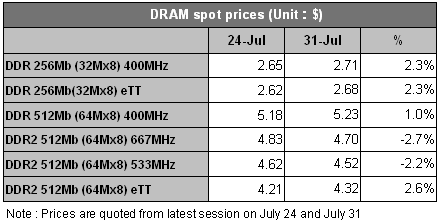
Spot prices of NAND Flash were dampened amid the fresh stock release from Samsung and Hynix as well as the month-end inventory clearance pressure among industry players. Chips in 16Gb, 8Gb and 1Gb densities lead the fall and reported an average of over 10% sequential drop on a week-on-week basis.
After holding its stock release for three weeks' long, Samsung resumes its supply last week while Hynix also follows its routine to supply stocks for Asia Pacific customers in the fourth week of each month. Since demand does not trend as expected, downstream players still hold inventory despite Samsung attempted to stimulate demand via temporally holding its supply to specific regions before. The month-end pressure further aggravates the situation with swell of stocks, overall pricing were dragged downward. Price fall of the listed chips was far higher than the rate we report in June.
Kingston founder David Sun mentioned at a recent PTI investors conference that NAND Flash price correction is normal as NAND Flash chips are widely adopted by consumer electronics. This sentiment echoes the historical price trend in the past year - price only picked up when Apple's iPod nano and shuffle created hot sales during 2H05 amid the tighten supply.
DRAMeXchange believes the lack of clear demand growth catalyst over the coming two weeks does not offer any ingredient for price growth. Prices will only stabilize if suppliers adopt a cautious measure on stock releasing strategy. Meaningful NAND Flash spot price growth will only emerge unless a killer application arrives.
Conroe waves goodbye to P4; AMD-ATI acquisition raises eyebrows
Big names dominate the media recently with Intel debuts its new Core 2 Duo CPU line while rival AMD shocked the market by acquiring ATI.
Intel unveiled its new Core 2 Duo DT lineup, Conroe, last week and marks the official migration from the Pentium 4 era. Conroe not only promises enhanced performance but also a 40% reduction in power consumption. Fabricated on 65nm, the shrink of die size in compare with 90nm-made P4 CPU lineup implies lower cost and the anticipated faster acceptance among mainstream consumers. Intel plans to ship a million of Conroe CPUs in ten weeks, versus than a year's time for the company to deliver the same amount of P4 CPUs.
The five Core 2 Duo CPU versions cover the high-end version that priced at US$999 and comes with a 2.93GHz CPU, 1066MHz FSB and 4MB cache while the US$183 one is target for the mainstream segment with a 1.8GHz CPU, same FSB speed and half density of cache than the high-end model.
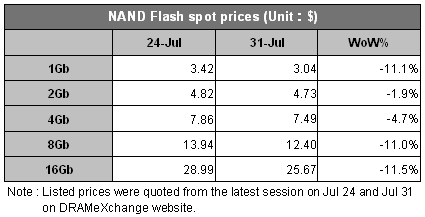
On the sideline of the new Intel CPU era, the long-circulated rumors about the pact of AMD and ATI finally materialized last week. The two chipmakers announced the win-win consolidation and the comprehensive product lineup of these two giants should benefit consumers with no doubt. AMD will rise as the chipmaker that offers a complete product lineup that covers CPU, graphics chips and chipsets among peers.
This acquisition enables AMD to enjoy ATI's strength in digital home and game console applications while ATI could extend its graphics chips and chipsets coverage to the growing server and workstations development of AMD.
The acquisition is slated to complete in 4Q06 and the new entity will debut its new product lineup in 2007. ATI stated that the first product that hits the market will be a NB solution that builds on ATI's power-saving technology and the new entity is also preparing to roll out a co-developed CPU after 2008. When referring to ATI's current solutions for Intel's northbridge chipset, ATI highlighted that all present product lineups' roadmap will remain static and the company will continue supporting Intel's chipset.