Insufficient DDR supply pressures on graphics chips makers
The price uptick of DDR slightly boosts DXI index trends up to 3,405 from 3,374 last week. Prices of DDR stay strong amid the persistent insufficient supply and the reduction of inventory among module houses.
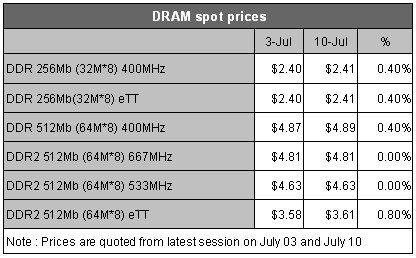
Prices of DDR 256Mb eTT (UTT) had edged to the same level as branded chips at US$2.41. Prices of high-density 512Mb DDR 64Mbx8 400MHz grew by a slight 0.4% to US$4.89. DRAMeXchange observes that the influence of growing tight DDR supply spreads over graphics chips makers and they are pushed to source for stock from the spot market, thus boosting prices of DDR 256Mb 16Mbx16 grew to US$2.19.
Transaction volume of DDR2 remains minimal. Prices of DDR2 512Mb 64Mbx8 533MHz stayed flat at US$4.63 while the same specification eTT (UTT) DDR2 chips rebounded to US$3.61, representing a 0.8% sequential growth.
1HJul DDR contract prices trend up, healthy signs sustained by continual tight supply through September
DRAM contract prices notionally stayed flat or slipped slightly in 1HJul as most DRAM makers found their inventory level reduced to less than seven days or below level. The growing tight supply thus failed PC OEMs' request for a minimum of 5% reduction for DDR2 chips in the previous negotiation period.
Noted that the released "low" price range of DDR2 512MB DIMM prices for 2HJun that quoted at US$38 was the "special" offer made by one chipmaker, most DDR2 512MB DIMMs were set at the price range of US$40 in 2H June. DRAM makers generally expressed that they could only accept the lowest price tag being set at US$38 in 1HJul.
Since second-tier system makers hold weaker bargaining power over first-tier peers when negotiating deal and Samsung insists to quote their chips flat, the released DDR2 512MB DIMM price were US$38-43 in 1HJul. Prices of 512MB DDR DIMM varied among makers and prices were generally increased by US$1-2 at the range of US$39-43.
Projecting DRAM contract prices for 2HJul, no consensus were made among chipmakers yet with some believe prices to stay flat while some others still confident about the proposed price up.
Marketers generally believe that the shortage of DRAM will persist through September even system makers start piling up inventory recently. DRAMeXchange expects DDR2 512MB 533MHz DIMM contract prices should boost to US$44-45 in September. Prices of the higher frequency 667MHz DDR2 DIMM, should stay at similar price level or enjoy only a US$1 price premium over 533MHz DIMM at US$45-46 in the same period.
Demand for NAND Flash to pick up after July, spot prices tend to stabilize
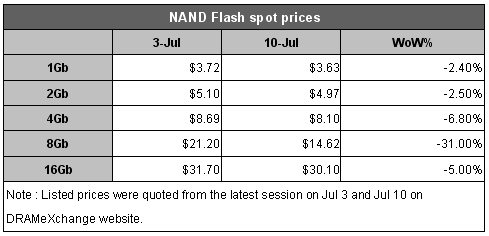
Although the traditional seasonality trough, quarterly financial pressures among industry players and the World Cup fever keep misting NAND Flash price trend at the spot market with continual drops, DRAMeXchange observes that the sluggish price trend shows rebounding signs from last Thursday (July 6) afternoon, buoyed from the strained supply of 2Gb and 4Gb that spurred demand for all density parts.
Leading players including Apple, Microsoft and SanDisk whom prepare launch of higher density MP3 players in 2H supplies positive ingredients for the entire market. Samsung expects demand to warm up from late July while some other players also express bullish outlook for the August to November period.
DRAMeXchange sees clearer price trend will only arrive until late July disregard the mentioned price uptick signs. Present visibility for 2H's outlook is still insufficient for us to judge a concrete outlook. However, in light of the demand for NAND Flash is expected to improve in late July, the spot prices will tend to stabilize.
Note:
The price slump of 4Gb and 8Gb chips that listed in above table is a reflection of excluding K9W8G(8G QDP) and K9K4G(4G QDP) from our baskets of variables from July 5th. Short term price fluctuation during July 5-8 was normal and the overall price trends of 4Gb and 8Gb will restore to normal next week.
What Vista promises to consumer
Since the ongoing innovation on both hardwares and softwares satisfy consumers with the current PC functionalities for either documentation or multimedia content playing, demand for PC could hardly spurs by pure technology innovations. Looking back to the launch of Windows 95 and Windows 98 in 1995 and 1998, the advancement of software capabilities come in line with a massive PC replacement during those days of rapid PC growth. When Microsoft introduced Windows XP in 2001 after the replacement fever during the millennium, it is obvious that the new OS's strength to push PC replacement trended weaker.
Software makers stress their new solutions' selling point at the leap of performance when pushing new products since the lifecycle of nowadays' PC have been extended along with technology advancement. Five years now after the previous OS launched, Microsoft rolls out its long-anticipated OS, Vista and the chip giant said there are bunch of convincing reasons for consumers to take their steps forward.
Kevin Kutz, director of Windows Marketing Communications for Microsoft, highlighted that the main difference of Vista over previous generations OSs is the strengthened searching and organization capability, security mechanism and connectivity features. Microsoft has incorporated certain technologies/tools to deliver the mentioned features, these technologies/tools include the new QuickSearch engine, Search Explorer and the data synchronization application Windows Mobility Center.
On the security front, Vista delivers features including user account control, Internet Explorer that runs under protected mode, a comprehensive encryption feature "BitLocker", etc. IT professions are able to manage different users' access authority, simplifies management works and delivers custom platforms via the categorization of as many as 400 user group types. Vista also promises an user-friendly system and users will be instructed step-by-step when processing their tasks. The smart OS may even automatically execute tasks after users established guidelines.


