DDR2 533MHz sees growing pressure amid inventory clearance
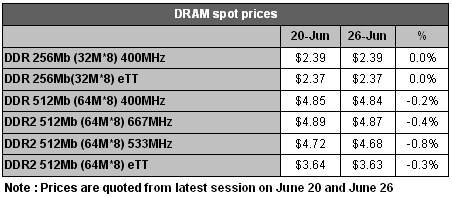
The spot market transaction of DRAM remains static in the week June 20-27 with DXI trends up by 20 points to 3,344. Overall DDR prices maintain its steady trend but DDR2 were subject to price pressure on inventory clearance among PC OEMs.
DRAMeXchange sees the weak DDR2 demand prompts some DRAM makes to bundle sale of DDR2 with DDR. Although PC OEMs are ramping up their penetration on DDR2 667MHz, DDR2 533MHz is still the mainstream DDR2 commodity at the spot market. Those PC OEMs who still hold DDR2 533MHz chips on hand cleared inventory, thus, dragged DDR2 prices down slightly.
Prices of DDR 256Mb 32Mbx8 and the same-specification 512Mb closed flat on week while eTT (UTT) DDR chips was also stabilized at US$2.37 as marketers are still awaiting for the latest quotes from PSC. Prices of DDR2 512Mb 64Mbx8 slipped to US$4.68 while the same-specification eTT (UTT) also dropped to US$3.63.
DRAM shortage in 3Q to break market equilibrium at contract market
Although DRAMeXchange sees positive ingredients for the entire DRAM market in 2H06 and expect shortage to arrive, we predict ASP for both 512MB DDR and DDR2 to trend weaker in 3Q.
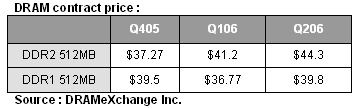
Contract price of DDR2 512MB module continued growth momentum in the first two quarters of 2006 and reported a consecutive quarterly growth from 1Q06's US$41.20 (or US$4.78 / 512Mb) to 2Q's US$44.30 (or US$5.16 / 512Mb )
Sustaining the approximate 10.5% QoQ ASP growth in 1Q, DDR2 512MB enjoyed a three month straight up growth (January: US$35.15, up 20% to US$42.30 in February and another 9% up to US$46.20 in March). Although we see price declined in late May, the drop rate was limited and stabilized prices at US$45.90 and US$45.50 in April and May. June quotes were closed at US$41.50 and the overall quarterly ASP still trend upward by 7.5% at US$44.30 in 2Q06.
Price of the same-density DDR 512MB, on the other hand, was more volatile. ASP in 1Q reported a 7% QoQ drop at US$36.77 as price was stayed at the high level during last October and November. Our historical data shows that ASP of DDR 512MB still enjoyed a price premium of about 5% over the same-density DDR2 in October. However, the price trend gained growth power during May to June and boosted overall quarterly ASP grew by 8% QoQ at US$39.50 in 2Q06.
DRAMeXchange believes the upcoming Intel price reduction in July, as well as the back-to-school demand, should jointly warm demand up. The demand for DDR2 1GB and 667MHz modules should pick up accordingly and we already observed some system makers negotiate deals for 3Q or even 4Q in attempt to ensure a sufficient supply.
Although we see positive elements in 2H06, the anticipated demand growth in July makes shortage inevitable. In terms of price, we estimate that quarterly ASP for DDR2 512MB should slip to US$42 (or US$4.88 /512Mb)) in 3Q. Since ASP in the contract market had already dropped to US$40.80 in 2HJune, DDR2 ASP in September has to reach over $47 to maintain Q3 ASP the same as Q2 ASP.
We believe that the highest price level should only hit US$44-45 and further growth is unlikely.
Overall bullish DRAM outlook, however, will not benefit price trend of DDR 512MB. We expect ASP to slide by 8% QoQ in 3Q as demand from the spot market should migrate to DDR2 module during the back-to-school season in August to September.
Sluggish NAND Flash transaction persist with enlarged drop rate
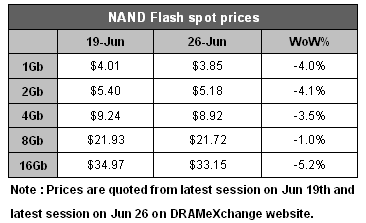
Sluggish NAND Flash transaction persisted in the week June 20-27 and we observe larger price fall arrived (except for 8Gb part) at an average drop rate of over 3%. Prices of 2Gb and 16Gb even reported the largest price drop rate in this quarter at over 4%. DRAMeXchange concludes the listless transaction as well as continual price drops as follows:
The spot price continue the down trend in the recent month, there are three major points effect this market trend.
1.Traditional slow seasonality during May and June slows transaction. Marketers who look for new products during the recent Computex Taipei 2006 in June and place orders for Q3 and Q4 also affects component transaction at the spot market.
2. Periodical financial result preparation that concentrates in these two weeks prompts industry players to dump inventory to the spot market, thus pressures on both supply and pricing recently. The overage of NAND supply in 1Q led to the over 50% quarterly price plummet and shadowed industry players' 1Q profitability. The eroded profitability as well as the growing tight 2Q financial pressure thus jointly heavily anxious players to trim inventory down.
3. World Cup fever that holds the breath among soccer fans indirectly mutes transactionamong regions like Europe and central Americas as mentioned last week and led to the recent lukewarm NAND transaction.
HP optimistic about NB growth
Hewlett-Packard (HP) delivers its positive outlook for the notebook (NB) industry recently,saying that it remains bullish regarding the upcoming back-to-school demand boost to its NB sales. Despite the setback of NB growth in 2Q, HP anticipates continual NB growth to sustain globally with substantial demand flooding from emerging markets like China and India.It also stresses that HP should enjoy satisfactory growth in India market.
In order to fulfill the anticipated NB demand growth and the upcoming seasonality demand pick up, HP rolled out more than a dozen of new NB models/solutions early last month for both consumer and commercial sectors. This new product lineup includes the newly re-designed business NBs and the HP Pavilion and Compaq Presario NBs for consumers.
HP records its NB revenues rose by 27% YoY in its FY 2Q06, with overall PC revenues also grew by 10% to US$7bn. Operating profit margin stayed at 3.6%, versus the 2.3% over the same period last year.
HP streamlines business group structure
HP said it would further streamline its business by integrating existing operations, a continual operation reshuffle following last year's 15,000 workforce reduction.
The move will give its three main business groups -- Imaging and Printing, Technology Solutions and the PC division, Personal Systems -- responsibility for supply chain, logistics, order fulfillment and certain marketing functions.
HP centralized its component procurement and logistics management under one global operation entity prior to this reshuffle and the transformation will assign these tasks to each of the mentioned business group accordingly.
The PC business will host central direct procurement and handle procurement across the company while the Imaging & Printing group will be responsible for worldwide logistics management.


