Intel's upcoming price cuts freezes demand from 2HJun
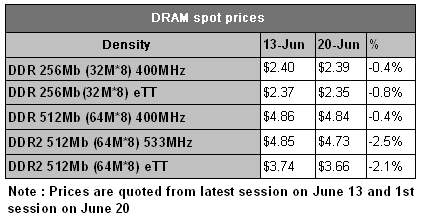
DDR spot prices trended weak in the week Jun 13-20 as module houses and distributors had pre-stock sufficient inventory on hand. DDR2 prices start encountering price drop pressure amid ramping up DDR2 output proportion among several Taiwan-based chipmakers.
DXI felt by 16 points and closed at 3,323 on Jun 20, reflecting the weakening DDR2 price trend. Overall DDR prices dropped within a 0.5% range with DDR 256Mb 32Mbx8 400MHz dropped to US$2.39 while the same-spec. 512Mb closed at US$4.84. eTT (uTT) DDR price started slipping from US$2.37 to US$2.35 once PSC finally released their quotes after two weeks' long. Prices of DDR2 512Mb 64Mbx8 533MHz dropped to US$4.73 while the same-spec. eTT (uTT) reported similar drop rate and closed at US$3.66.
DRAM contract prices show weakening sings from 2HJun. We record the low-range of DDR prices being shaken by the aggressive price reduction requests from PC OEMs, though overall DDR supply remains in short. Price drop of DDR2 remain unchanged at a drop rate of 4-5%.
Price drop of DDR2 remain unchanged at a drop rate of 4-5% in 2HJun
Overall DRAM demand remains minimal as PC demand has been postponed since Intel had foretold its July price reduction. The influx of stock amid chipmakers' mid-year financial pressure also strained prices further, especially starting from 2HJun.
DRAMeXchange anticipates DRAM prices trend to move in a more positive way after Aug when consumers resume their consumption interest. The growth momentum, however, should be limited despite the traditional seasonality upturn in 3Q. History tells us that supply is the critical reason factoring price trend (excluding the accidental situations like production yield issue), thus, the keep growing supply should still shadow on prices.
World Cup fever stagnates NAND Flash transaction
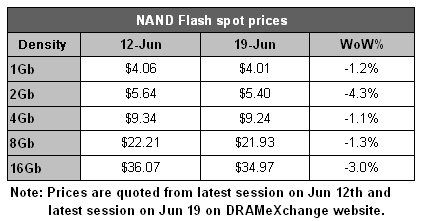
DRAMeXchange does not see any meaningful NAND Flash demand pickup last week as most downstream players had secured timely delivery by mid June, following the orders that placed in 2HMay. These players who were content with adequate stock are not hasten to secure stocks from stock market, thus, muted transaction and weakened prices. Spot transaction also came to a standstill at Europe and South America regions amid the ongoing World Cup fever.
DRAMeXchange observes that prices of Hynix's MLC-made 4Gb NAND were firm last week, along with the demand boost in compare with SLC solutions. Since considerable price difference of 4Gb NAND from Hynix and Samsung is still maintained at a certain rate, consumers whom await for any potential price cut from Samsung hold their consumption. Hynix's MLC NAND prices were firm with demand being comparatively large then SLC NAND.
DRAMeXchange believes the mentioned price difference is due to the absence of MLC-made 4Gb NAND from Samsung and the lack of confidence over Hynix's solution. Consumers remain cautious when adopting the immature MLC-made 4Gb NAND from Hynix. Similar price difference situation between these Korea makers also apply on 8Gb NAND.
Key PC names shock market - Intel/AMD feud sparks price competition; Gates farewells daily roles at Microsoft
AMD fights back via hacking chip prices
The aggressive price cut from Intel stimulates rival AMD to partner with several motherboard (MB) makers on the price adjustment for its complete product lineup. The losing ground on pricing amid its capacity lag makes a comprehensive price reduction inevitable for AMD to counter against rival, though it may scarify its margins and profitability at the meantime.
AMD announced that it plans to introduce a minimum of 25% price reduction or even half the price of the dual-core Athlon 64 X2 CPUs in July 24, following the the proposed 20-30% price reduction for four Athlon 64 (single-core) CPU models in mid-June. The prices of entry-level Sempron (single-core) will be also reduced by 10-15%.
Intel, on the other hand, shows its dedication on conquering more market share by rolling out new CPU lineup as well as deployment reshuffle. In line with rolling out its next generation Core-socket CPUs (Woodcrest, Conroe and Merom), Intel also strengthens both of its notebook (NB) and desktop (DT) channel strategies via the introduction of a 90-day reshuffle program.
The chip giant attempts to manipulate its dominant power on both technology and supply to prevent AMD from gaining more attraction by offering competitive prices. It also strives to suppress the rising role of AMD, especially when AMD does not roll out any "killer solution" in 2006 yet.
In response to market concern about capacity and margins, AMD reiterates that overall margins and profits maintain stable currently, despite the anticipated drawbacks after the price reduction. It stresses that any negative impact over margins and profits will not last over two quarters and the company will not encounter any financial burden nor profitability shrink.
AMD also guarantees sufficient capacity through 2008 along with the fresh announcement of the latest Dresden fab conversion (from 8-inch to 12-inch). The reorganized Fab 38 will officially commence 65nm volume production in 4Q06 and the capacity backup from foundry partner Chartered Semiconductor should jointly ensure sufficient capacity.
Microsoft enters post-Gates era
Although remaining his chairman position at Microsoft, Bill Gates announced that he would end his day-to-day role at the company. The "farewell" news came along with the influx of stiff challenges that the software giant is facing: gloomy share price, competition from Google, Vista delay, etc.
Microsoft's chief technical officer (CTO) Ray Ozzie will be appointed as chief software architect and Craig Mundie, another CTO, will oversee Microsoft's strategy and research and take up Gates' research and recruitment duties. Gates will work closely with Ozzie on the transition but the mentioned executives will have to report their duties directly to company CEO Steve Ballmer after a year's time.
Gates had actually paved his way for the step-back with Ballmer for months and Microsoft had once planned to discuss the issue in an internal conference meeting in July, prior to the announcement made last week. Tracking back the company top executives' arrangement history, Ballmer's handover of the CEO position from Gates in 2000 as well as the establishment of chief software architect both stunned fellow IT professions.


