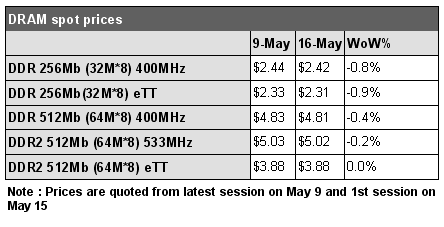
DRAMeXchange sees no critical transaction in the DRAM spot market after the week-long holiday at Asian regions. The upward price trend of DDR weakened while prices of DDR2 stayed notionally flat on week.
Although DRAM makers who reduce their DDR output led to tight supply to module houses, the upbeat of DDR prices finally weakened as these module makers and traders still hold relatively low-priced inventory on hand and were then reluctant to purchase additional stock with high prices. Prices of DDR 256Mb eTT (uTT) reduced slightly to US$2.31 while prices of DDR 256Mb 32Mbx8 400MHz stayed at the US$2.42 level. Higher-density 512Mb 64Mbx8 400MHz were closed at around US$4.81.
Demand for DDR2 is also sluggish recently amid the traditional seasonality impact. Prices of DDR2 512Mb 64Mbx8 533MHz stayed at US$5.02 while prices for the same specification N.M.B ones were closed at US$3.88.
DDR2 contract prices to be flat or drop by 3-5% in 2HMay
DRAMeXchange estimates that the high contract price ranges of DDR should persist through June while the continual DDR2 shortage should constrain the price reduction at a limited level. Sources at motherboard makers indicated that the inventory of DDR-supported Intel 865-series chipset should ease during late June, which interprets that demand for DDR should last through mid-July. However, as supply for DDR drops, prices of eTT had once hit to the similar price levels of branded DDR at US$2.45 last week while the majority of DDR still traded in the range of US$2.30-2.35. Although many module houses are optimistic about the price trend through late June and accumulate inventory, DRAMeXchange estimates that overall inventory level at the spot market among distributors and these module houses are only kept at the 1-2 week level whereas inventory at contract market is minimal.
For DDR2, although some chipmakers may lower their DDR2 quotes by 3-5% during late May to June, overall drop range should be limited. We observe that some leading PC system makers had expressed concern over memory prices and supply for the 2H amid the uptick price trend in 1H. Sources hinted that the leading PC system maker had secured long term supply agreement with the leading DRAM maker in attempt to ensure the supply for the rest of this year.
NAND Flash shows vibrant signs, a reflection of Samsung/Hynix's official prices raise
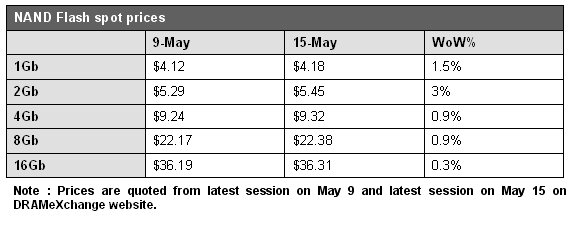
Prices of NAND Flash were steadily picking up last week despite the actual transaction volume was not growing in a rapid way. As both Samsung and Hynix released news about their price raises earlier, prices of all density NAND were trended upward. Buyers still attempted to seek for lower quotes, thus, holding overall transaction volume not to grow significantly on a weekly basis.
Overall speaking, 2Gb enjoyed the largest gain over other density NAND amid the tight supply. Price of 2Gb trended up by 3% to US$5.45 from the previous week's averaged US$5.29. Sources attributed the growth to Apple's recent deal with Samsung. Apple is said to book a considerable 2Gb production capacity at Samsung and led to the shortage of 2Gb parts at the market. Since most 4Gb/8Gb/16Gb applications are stacked with a 2Gb (combo die), the growing tight 2Gb supply thus led to an industry-wide price upbeat.
Intel expands emerged market with CBB project
Microsoft proposes "rebates" to support Intel's CBB
Already introduced in 2004, Intel further strengthens its ties with component suppliers on its Common Building Blocks (CBB) initiative which is aimed to standardizing notebook(NB)-use components for a hortened time-to-market schedules and simplified integration. System makers who joined the policy will enjoy a rebate/discount under certain circumstances.
Intel's promise on initiating a standardized notebook (NB) component supply chain finally materialized last week as Microsoft will offer a US$5-10 rebate/unit for any Windows OS that are applied on customized NBs.
Microsoft will examine the impact on this rebating program in 2007. For Intel, it had already offered rebating subsidy of about US$25 for its Core Duo CPUs. Storage devices maker Seagate also join the program by offering a 4-20% discount for its Momentus 5,400rpm hard disk drive (HDD) lineup.
System makers have to embed the listed components with an Intel-verified while box chassis from distributors like Synnex or ASI in order to get the rebates/discounts. These verified chassis will equip with a set of standardized components including drivers, LCD panel, batteries and AC adapters.
Intel targets NB DIY market at ChinaThe ultimate goal of CBB is to consolidate upstream component suppliers, system makers and downstream distributors on standardizing component, validation, production and distribution. The new supply chain will directly address customers' demand via rolling out competitive NBs. Li Xiang, Intel's China marketing director, had also introduced the concept of DIY 2.0 (or NB DIY) for the China NB market via partnership with numerous component suppliers.
According to statistics from Intel, about 15% of Australia's PC market is occupied DIY makers with most of the DIY made products are high-end ones. For Vietnam, the DIY rate is as high as 90% while China also sees 40% of its PC market contributed by DIY makers. Based on the statistics of DIY penetration among these mentioned Asia regions, it is obvious that the ratio of DIY trends divergently against the region's economic scale. Take China for instance, the desktop (DT) market keeps eroding amid the price competition among makers. NB market, on the other hand, is steadily picking up and provide China with a favorable environment for the NB DIY market.
Intel targets its CBB NB market to performance consumers, small- to mid-range scale enterprises and students. The market deployment among performance consumers is relatively easy as these groups of buyers are already familiar with the basic structure of PCs and are more eager to pursue for innovative technologies. Demand from small- to mid-range scale enterprises also drive demand for customized PCs as these enterprises could enjoy the benefit of low procurement cost despite the relatively in comprehensive after-sell service. The PC DIY market among students is also rapidly expanding at China. Students are now replacing their DT PCs with NBs along with the advancement of NB functionalities and the shrinking price gap between DT and NBs.


