Overall DRAM transaction at spot market slows down last week amid the week-long May1 long holiday at some Asia regions. Both DDR and DDR2 stayed flat or just trend up slightly and DXI grew by a dismal 0.9% (or 29 points) to 3,249.
Prices of DDR 256Mb eTT (uTT) chips gained by 0.9% sequentially at US$2.37 while the same density 32Mbx8 400MHz DDR stayed flat at US$2.47 level. Higher-density 512Mb 64Mbx8 400MHz enjoyed a relative stronger growth rate at 1.5% and closed at US$4.88.
The anticipated mainstream role of DDR2 continues stimulating DDR2 prices heading upward. As some marketers starting re loading their DDR2 inventory from spot market, price of DDR2 512Mb 64Mbx8 533MHz was stabilized at US$5.05. Price uptick of same-specification N.M.B. followed and grew by 2.4% to US$3.79 (or grew by 2.2% to US$3.78?).

The price fall of DDR2 contract prices came to an end in January and shoot in February, the price growth momentum continued in March and persisted through April.
Although some expected that the price uptick might turn weak in late March, the production issues at a leading DRAM maker that affected an entire month's (during late March to early April) output had led to shortages of both DDR and DDR2 in April.
Some chipmakers even grabbed this opportunity and raised their quotes slightly. The entire DRAM industry is pose under a mist of uncertainties, especially when DDR2 price trends did not stay in line with normal seasonality pattern in the previous two quarters.
DDR2 that topped the high price levels in April should be able to result in a higher QoQ ASP growth in 2Q06, if DDR2 contract prices to drop within 10% MoM in May and June.
Projecting ASPs trend in 2H06, DRAMeXchange doubts the possibility of any sharp price growth in 2H06. Disregard DDR2 ASPs may still enjoy a 2-3% MoM growth in 3Q, quarterly ASPs should slip by 3% QoQ. Assuming DDR2 ASPs may pick up its strength again in 4Q, the price levels should top at the highest level in 4Q on an annual basis.
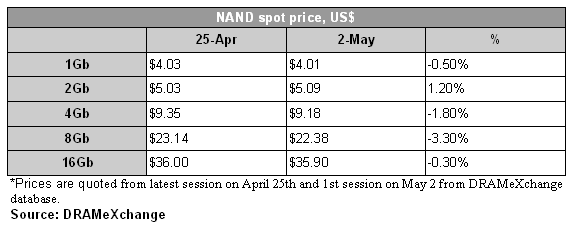
Marketers who dumped their stocks at spot market under the previous quarterly/annually financial accounting pressures had dragged overall NAND prices slashed by 30-40% in March. Samsung that suffered a harder drop than Hynix has reduced its output, as well as controlled its shipment frequencies in order to stabilize prices in April. Under Samsung's measures, spot prices did trend upward at a trivial rate.
However, as overall demand for end-products like Flash cards, digital cameras and MP3 players were listless, demands are barely stimulate. The ramp up of Hynix MLC-made NAND (4Gb and 8Gb) also grows supply considerably at spot market from mid April. Hynix that quotes its MLC-made NAND with lower rates then SLC-made parts hold consumers' interest aside.
The majority of demand was concerted at the 2Gb and 16Gb last week. Most buyers wait aside for clearer price trend amid the May1 holiday and anticipated new products. The expected demand pick up for the holiday failed marketers, buyers did not pre stock their inventory before the holiday.
Although some suggested that the nose-dived contract prices should supplement growth ingredient for the market, some others observe that the blur demand for end products still exist. DRAMeXchange sees quotes for Toshiba's 1GB and 2GB Flash card keep declining, which implies a lower chance for contract prices to go up soon in the near term.