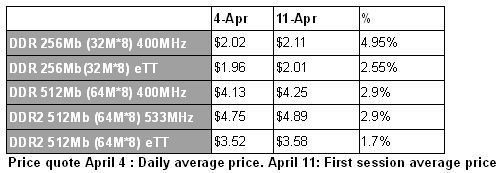
DRAM: The slight rebound of both DDR and DDR2 spot pricings had lifted DXI slightly grew by 15 points to 3,045 in the week Apr4-11.
Spot price of DDR 256Mb eTT (uTT) chips had once topped at US$2.01 but pulled back to US$1.95 on last Friday amid drop of transaction volume. A few marketers who tried to earn profits by clearing stocks also dragged prices down. Transaction trended up again this week with quotes picked up to US$2.01 on Apr11.
The narrowing down price difference between the same density 256Mb eTT (uTT) and major branded DDR 256Mb 32Mbx8 400MHz shows the upside price momentum. Price of branded chips had grown to US$2.11 from US$2.02 and resulted in a US$0.1 price difference over eTT (uTT) chips last week.
By tracking historical records, the rate of difference between these two chips reflect different price trend. Any upside price momentum will reflect in a drop of price difference and vice versa. Prices of eTT chips usually grow stronger than branded chips during price uptick but drop sharper than branded chips during downward trend as eTT chips transaction always fill with speculation.
Price of eTT (uTT) had exceeded the same specification branded DDR along amid the demand swell. Marketers shifted to source for eTT (uTT) chips in order to earn profits when chipmakers could hardly fulfill demand for branded chips.
Price difference between the same density 256Mb eTT (uTT) and branded DDR 256Mb 32Mbx8 400MHz were minimal during early Jan but enlarged to US$0.3 in late March. The price difference again showed eliminating signs in early Apr.
Prices of DDR2 512Mb 64Mbx8 rebounded by 2.9% from last week's sequential loss along while the same specification DDR also trended up at the same rate. Overall prices pick-up is still constrained under the cyclical downturn.
NAND Flash price lull restores as DRAMeXchange forecasted
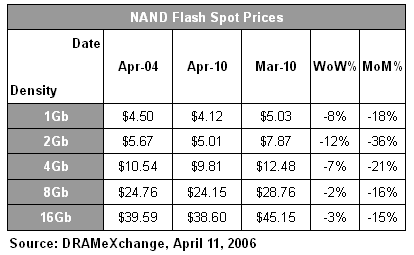
NAND Flash spot prices trended down again after last week's shortage illusion as DRAMeXchange predicted. Overall price drops resulted in the sequential drop range of 2-12% and a MoM drop range of 15-36% among all densities.
NAND Flash spot market transaction volume picking up as a result of slow down on price drop.
NAND Flash spot market transaction volume does pick up on slowing down price fall. DRAMeXchange observes that the price fall started weakening on a MoM basis along with the growth of transaction volume. Most demand is driven from factories at Greater China regions. As price risks still persist, traders are still cautious on consumption and maintain their inventory at low levels in order to avoid duplicating the experience of dampen profits as in 1Q06.
1Q06 demand of NAND Flash chips to shift to 4Gb to 16Gb chips leaving 1Gb and 2Gb chips to suffer the most severe price drops.
According to our observations on spot transaction, total transacted volume for 4Gb/8Gb/16Gb chips had crossed over the 50% threshold in 1Q06, versus the mere 30% in 4Q05. This trend highlights the capacity migration to higher density and implies an encouraging sign of consumption breakdown by density at retail market.
Prices of 1Gb and 2Gb NAND, however, are now edging to manufacturing costs amid the deteriorating price falls. We believe further drop is limited with the fall rate shows softening signs. As anticipated 60nm SLC NAND come into mass production this month, it may spark future potential price war if demand still remains sluggish.
April contract price still remain skeptical with sufficient NAND Flash supply and weak demand for higher densities yet might see price rebound on low densities.
NAND contract prices of Apr still remain subtle on ample supply and weak demand for higher densities. Although the listed contract prices from most NAND Flash suppliers report a sequential price growth of 10-20% this month, the piled up inventory levels at downstream players, both channel and module houses, from 1Q06 still constrain customers' interests. Added with a soft demand coming from the upcoming Labor Day holiday in PRC limited demand is expected to spur and making overall demand at a fairly dismal.
Yet, DRAMeXchange sees price rebounding signs for low density NAND, namely 128Mb-256Mb, thanks to the trimmed down wafer-in for these densities in 1Q06 on poor customer forecasts and limited volume on certified parts. Since limited NAND are certified for consumer electronics goods like digital cameras, potential shortage may occur over coming weeks along with the anticipated short-lived demand spike.
PC market watch: AMD to tackle over Intel amid "stable image" CSIP launch
- To mass chipset firms for resisting Intel's threat
Built on AMD's Commercial Stable Image Platform (CSIP), Nvidia is now in partnership with the CPU maker on the rollout of a testing and certification platform that ensures stable image process without frequent driver update in attempt to tackle over the growing threat that Intel poses.
AMD first launched its CSIP in Sep05 with graphics chips and motherboard makers for the small- to medium-sized business market. Nvidia then follows the pace and offers the CISP-compliant Business Platform in Mar06. This CSIP outgrowth is built on the core of AMD CPU and Nvidia-made graphics chips and offers a stable image platform solution with the quality and reliability that business operations demand.
The new platform that emphasizes the certified stable platform with lowering total cost and enhancing manageability should help boosting AMD's name at the desktop or white-box markets on substantial support from fellow industry players like Asustek, Gigabyte, MSI, Foxconn.
The CSIP that AMD introduced is actually not an innovative idea on the "stable image" platform history. Intel had once debuted its SIPP platform, or later the Business Platform (named after 2005), for the business market before. Eyeing the satisfactory market share that Intel grabs at this market, AMD follows its pace and introduces the CSIP by partnering with industry players including Nvidia, SiS and VIA, as well as leading motherboard makers.
Although AMD does show its ambition to oust Intel from this market, or at least, takes a bite from the big pile, it will only success by devoting continuing dedication amid Intel's dominancy and the relatively high entry level.
- Channel distributors help to boost AMD's market share on variety of choices offer
On top of the proven P/P ratio over Intel's CPU, AMD secures its 20% foothold by extending its presence beyond the clone/white box market to the business channels. By offering technical support and back up, as well as engineering samples and physical funding aids, AMD strives to attract channel distributors and system builders to join its camp against Intel. The chip maker also plays an aggressive move on securing bidding orders from institutions in attempt to enlarge its share from the channel market.
In line with the competitive role that AMD takes at the channel market, Intel does cultivate its share at this segment for years. Along with the complete product line offering, Intel also provides aids on technical support with quarterly recruitment on channel management. Although the move that AMD takes recently should pressure on Intel inevitably, it offers more alternatives for sales agencies on the variety of choices. Disregard that AMD's new deployment could only interpret as an advancement of service that is competitive with Intel's, channel agencies that are open to multiple choices should help boosting AMD's shares at the channel.


