DDR2 spot price falls stronger than DDR
DXI descended to 2,986 from 2,998 in the week Mar14-20 with spot prices of both DDR and DDR2 encountered slight drops. Among the drops of all density DRAM, we observe that the drop range of DDR2 came larger than DDR.
DDR2 512Mb 64Mbx8 dropped by a slight 1.4% at US$4.97 while the same-specification eTT (UTT) chips recorded a larger drop of 3.2% at US$3.9 in the same period. DDR managed with a reasonable drop. Spot prices of 256Mb 32Mbx8 eTT (UTT) dropped by 2.2% at US$1.74 while the same-specification DDR dropped by 1.9% at US$2.04. The higher-density DDR 512Mb 64Mbx8 400MHz was the only part that able to counter drop with the drop rate limited at 0.8% at US$3.83.
DRAM contract prices stay flat in 2HMar
DRAM contract prices currently are settled flat in 2HMarch as DRAM makers seem stop proposing price raise for both DDR and DDR2 modules. Although some PC OEMs attempted to seek for lower quotes, the present DDR2 shortage, though as not severe as Feb, still helps to hold prices firm.
The 'low' price range of DDR2 512MB DIMM maintains at US$44 while the "high" range only drops by a slight 2% sequentially to US$48 from US$49. Noted that the transaction volume of US$49-priced DDR2 modules was minimal in 2HFeb, thus, the prices stay flat in 2HMar. For DDR 512MB DIMM, the "lowest" range edges by 2.78% to US$37 with the average stays flat as well.
Projecting DRAM prices in 2Q06, DRAMeXchange observes that most DRAM makers stay positive. DRAM prices should start sliding during Apr-May and bottom out in June with price rebound to soon follow.
DRAMeXchange is conservative about overall DRAM supply bit growth in 1H, especially the growth for commodity DRAM in 2Q. We are now trim down our 2006 DRAM supply bit growth forecast to 44.6%, down from the initial estimated 46.3%. The growth momentum should concentrate in 2H06 as the output in 1H should still constrained by the capacity transition to other memory products and the yields concern on 90nm production.
DRAM supply bit growth per quarter should limit below 10% on quarter in 1H and pick up to 12-15% in 2H according to our analysis in DRAM industry.
Record-high NAND Flash MoM decline at 36% most
The quarterly end financial pressure from most firms in the NAND Flash industry and yearend burdens from Japan-based companies have extended the sluggish demand. Supply that grows along with improved yields and advanced technologies should also eliminate any price rebound momentum at both contract and spot markets in 1Q06.
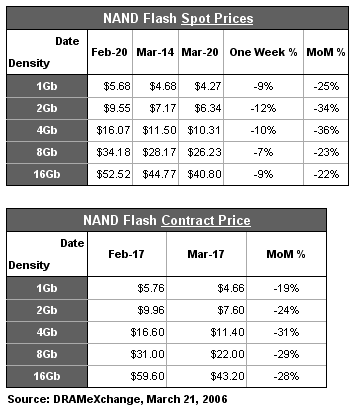
The NAND Flash industry experienced the largest MoM price drop this year at a 19-31% range, as reflected in our Mar17 contract price update. The MoM spot price drop comes comparatively larger than the contract market drop of 22-36%. Take the mainstream density of 4Gb for instance, its prices had dipped to US$11.4 and US$10.31 in contract and spot market respectively. As spot prices are still lower than contract quotes, the current price level is not strong enough to spur demand with most customers still await for prices to hit bottom.
Industry players, no matter suppliers or customers, strive to suppress their inventories at minimum levels amid the quarterly/annually financial pressures, especially those Japan-based makers whom about to report their annual performances in April.
Downstream players still house bountiful stocks on hand and are reluctant to build up additional stocks. Output, on the other hand, is still on the rise. Hynix has started mass production for its MLC Flash components while Samsung is waiting for validations for its 60nm-made SLC flash. Although chipmakers have shifted capacity away from Flash production during mid-Jan, the total output is still picking up. The current supply/demand scenario should drag Flash prices to drop further by March.
Order landed situations at CeBIT show are quite disappointing through our channel checks. However, looking forward into April, potential demand might surface with Japan market starting a new financial year and the upcoming golden week, together with the week-long vacation at China in early May. Noted that 2Q is usually the slow season for PC and consumer electronics and this should pose downside risks on demand trend.
PC market watch: Intel and Microsoft’s consolidation on UMPC
Ultra Mobile PC (UMPC) is the key item that Intel debuted at the 2006 spring IDF (Intel Developer Forum) and this PC positions in the category between notebook (NB) and smartphone. The physical weight of UMPC comes lighter than NB and its functions come stronger than standard handset. Currently Intel partners with Samsung, Asustek and the China-based Founder International on UMPC production and the first UMPC had officially exhibited at the recent CeBIT.
The Samsung-made UMPC runs on the Celeron M ULV core and supports the tailor-made "Windows XP Tablet" OS. With the 7-inch LCD touch panel, the physical size of the device only 227.5mmx139.5mmx24.5mm and the weight is 779g. In terms of interface connection, this UMPC supports WLAN 802.11b/g standards and Bluetooth 2.0. Consumers could also choose the DMB (Digital Multimedia Broadcasting) connection and GPS navigation system. This multi-functional PC serves as a PDA, game console, DMB TV, MP3 player and MP3 player in an all-in-one package.
Intel starts developing UMPC in 2005, aiming to offer customers with strong functions but highly mobile device. By supporting a wide-range of input methods like keypad, pen and touch pad, UMPC’s comprehensive connection with entertainment and multimedia contents brings consumers to a new era of portable entertainment experience.
In order to meet the compact size requirement of UMPC, Intel develops loads of technologies on strengthening the heat dissipation and shrinking component sizes. The chipmaker aims to suppress UMPC’s heat dissipation by 10 times over the couple years. In addition to the technology advancement, Microsoft also provides a software suite, Touch Pack, that includes Internet Explorer, Windows Media Player, GPS mapping, especially design for different outfits and interfaces of the Windows XP Tablet OS-based UMPCs. on the Windows XP Tablet PC platform. All the softwares/hardwares embedded at UMPC are compatible with the existing Windows XP Tablet OS.
VIA offers C7-M ULV for UMPC solutions
In line with Intel's UMPC launch, VIA has also rolled out its C7-M ULV processor for UMPC. VIA is now the x86 architecture CPU that runs with lowest power dissipation rate at a TDP rate of 3.5 watts only. Its stand-by power dissipation is even as low as 0.1 watt, which highlights the highly-efficiency of the power utilization of the processor. C7-M ULV runs at a core frequency of 1.0GHz-1.5GHz and it is packed under the nanoBGA2 package. The compact size of the processor (21mmx21mm) has completely fulfilled demand of portability.
C7-M ULV also supports Windows with basic PC functionality. The UMPC, SmartCaddie, from Japan-based PBJ, adopts VIA's solutions and the device equips with Microsoft R XP and the Touch Pack software suite.


