DRAM spot market was notionally still in the week Feb 21-28 with only uTT (eTT) DDR reports positive news with a slight rebound. Despite the listless spot pricings, DRAMeXchange maintains our positive expectation for both DDR and DDR2 contract prices for 1HMar.
DXI slipped by 0.36% (or 11 points) to 3,031 from Feb 21 to 28. Spot price of uTT (eTT) DDR rebounded to $1.8 after edged to the lowest quote of US$1.75 and price of DDR 256Mb 32Mbx8 400 MHz also stabilized at US$2.13. Although DDR2 contract prices should continue trending upward, marketers tend conservative over price trend after March and started clearing stocks, thus dragged spot price of DDR2 512Mb 64Mbx8 533 MHz to US$5.2 from US$5.22.
Global DRAM output dropped by 0.4% MoM in January 2006
Global DRAM output dropped by 0.4% MoM at 671.8 million units (in 256Mb equiv.) in January with DDR output reduced by 0.3% while DDR2 by 3.6%. Production portion breakdown for DDR and DDR2 were split at 61:39.
Demand for DDR2 at contract market had exceeded 70% on average but remains as low as 10% at spot market. The overall DDR2 demand ratio averaged at 55-60%, which is much higher than the output ratio of 39% and further illustrate the present DDR2 shortage. DDR prices do not encounter rapid drop amid the positive impact from DDR2. Some PC OEMs still accept DDR prices to stay flat or grow slightly in order to exchange for sufficient DDR2 supply.
DRAMeXchange observes that some DRAM makers whom converted capacity during last October to November from DDR2 to other memory including mobile RAM, graphics memory or consumer DDR, not only converted to commodity DDR. Our data shows that the sequential output growth for mobile RAM and graphics memory is 9.5% and 13.4% in January in line with the 2.5% MoM growth of SDRAM output.
We estimate that the present DDR2 shortage should persist through late March with DRAM makers proposing further contract price raise for DDR2. DDR2 contract price should grow by a minimum of 5-10% sequentially in 1HMar while DDR should stay flat or slight grow
Considerable NAND capacity transition from Samsung unlikely
Regarding recent rumors claiming that Samsung shifted a considerable of NAND Flash (20k-30k) back to DDR2, the rumors are contradict our capacity survey with reliable sources. Our survey shows that Samsung boosted up its NAND capacity rapidly at every single quarter in 2005. Although the amount shows declining signs in 1Q06, Samsung plans to continue growing NAND capacity in 2Q and stabilize the amount in 2H.
In line with growing NAND capacity in 2Q, Samsung plans to maintain the wafer in ratio balance between DRAM in 2006 with wafer in amount for DRAM expected to stay flat through 2Q06. The capacity of DRAM production should escalate by 5-6% MoM in 3Q and stabilize in 4Q. Samsung's overall DRAM wafer in (in 8-inch equiv.) amount should grow by 8% YoY while NAND should grow by 25% and exceed DRAM's total wafer in amount in 2006.
Samsung only shifted 5-6k/month between its NAND and DRAM capacity at its Fab 12 (12-inch fab that produces both DRAM and NAND) in 2006, according to our update. The chipmaker will only execute meaningful capacity reallocation in 2007, following the rapid growth of output from its Fab 15.
Samsung is expected to grow its DDR2 production ratio to 44% in 2Q06 while ratio for DDR will be slightly lower than 20%. The production ratio for other DRAM ICs including consumer, SDRAM, mobile and graphics RAM will stay at an approximate of 36%.
Rival Hynix, at the meantime, is preparing to transit about half of its Icheon , Korea 's 8-inch fab equipment (with total of 100k capacity) to Wuxi , China during March to April and this upcoming reallocation should reduce Hynix's DRAM capacity by 50-60k (in 8-inch equiv.). Disregard Hynix's own M10 12-inch fab and ProMOS's Taichung, Taiwan fab capacity could compensate the cut back of capacity, Hynix' total DRAM output should still reduce by 15% QoQ, or a QoQ bit growth drop of 10% in the second quarter of 2006.
NAND Flash spot prices drop trend moderate, sufficient supply to limit price rebound
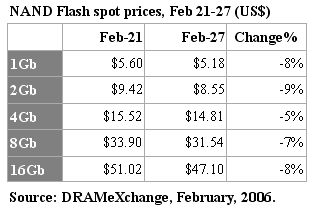
Month-end pressure and slow demand dragged NAND Flash spot prices continue trended downwards with a maximum drop of 9% for 2Gb NAND Flash chips. However, we observe that NAND Flash spot price drops trended moderate during the last few days of February as suppliers interfering the supply at spot market and set February NAND contract price bottoms.
8Gb and 16Gb NAND Flash chips suffered the hardest price drops earlier last week with single day drop of 3.83% and 6.9% recorded on Feb22. We saw Korean agents and traders acted as price killers and supply most high densities parts with low prices.
During the week of Feb.21-27, 2006, 1Gb to 16Gb NAND Flash spot prices closed at US$5.18, US$8.55, US$14.81, US$31.54 and US$47.1, with percentage drops recorded at -8%, -9%, -5%, -7% and -8%, respectively.
DRAMeXchange is still skeptical about NAND Flash spot price trend in March. General demand still seems to be sluggish. Although some memory card makers in China have started to grow their consumption under this downward price trend, the limited procured quantities are still not enough to restore the supply and demand balance. Unless NAND/DRAM capacity transition happened in January is large enough to reduce the NAND Flash output in March, we believe NAND Flash market will still remain at a oversupply situation this month.