TrendForce: Micron Takes Second in 1Q14 Global Mobile DRAM Revenue Ranking
According to DRAMeXchange, a division of global research firm TrendForce, mobile DRAM revenue amounted to US$2.915 billion in the first quarter of 2014, accounting for 29.3% of the global DRAM industry but representing a 34.3% QoQ drop. The decline in mobile DRAM average selling price has slowed, only falling 5% in the first quarter. Mobile DRAM industry value shrank in the first quarter as the recovery of production capacity at SK Hynix’s Wuxi fab mainly benefitted commodity DRAM.
Looking at the global revenue ranking of mobile DRAM manufacturers, Samsung held onto the crown while Micron came in second, surpassing SK Hynix by a mere 1.7%. With Elpida on its side, Micron’s mobile DRAM market share is expected to continue expanding. SK Hynix continues to focus on commodity DRAM production due to profit considerations, leading to the change in revenue ranking.
Looking ahead to the second quarter of 2014, as seasonal demand picks up, global smartphone shipment growth is projected to hit 8.6% (289.9 million units), which will in turn stimulate mobile DRAM demand. Additionally, as the mobile memory supply is slightly tight at the moment, average selling price is unlikely to fall. Average selling price is expected to experience a mere 3-5% decline and mobile DRAM industry value may see growth again in the second quarter.
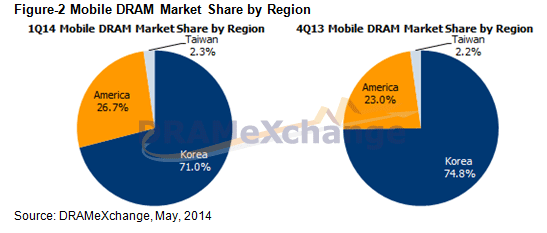
Korean Manufacturers Share 70% of Global Mobile DRAM Market, Technology Advancement Race Heated Despite Market Oligopoly
Looking at cost structure and technology migration, as commodity memory remains more profitable than mobile memory, global memory makers continue to focus on PC DRAM products. Samsung’s Galaxy S5 sales did not meet expectations and mobile DRAM market share fell to 46% in the first quarter, but the Korean manufacturer is ahead of the pack with 23nm process technology and consistently has the highest average selling price in the industry. TrendForce projects Samsung’s mobile memory market share will remain in the 40-50% range. SK Hynix’s mobile memory products are also highly competitive and the company is migrating to 25nm process technology. While SK Hynix is behind Samsung and Micron when it comes to the development of LPDDR3, fortunately the Korean memory maker’s share of the smartphone market in China continues to expand, giving the company a leg up when component supply from Samsung is tight. TrendForce estimates SK Hynix’s mobile market share will remain above 20%.
The new Micron group’s mobile DRAM market share was 26.7% in the first quarter, the bulk of which is attributed to demand from Elpida’s largest client, Apple. In addition to adoption in smartphone and tablet products, Apple’s MacBook Air and this year’s MacBook Pro use LPDDR3 – much more of it than the handheld mobile devices, which will make a notable contribution to Micron’s revenue. Micron’s future plans include ramping mobile DRAM production at Elpida’s Hiroshima fab and focusing on eMCP product shipments. TrendForce expects Micron’s mobile memory business will grow by leaps and bounds in 2015.
Korean Memory Makers No Longer the Only Option as Taiwanese Manufacturers Focus on Mobile DRAM
Following a drop in average selling price and affected by foreign exchange loss, Nanya’s first quarter mobile DRAM revenue fell by approximately 8.1% QoQ, with market share down by 0.1% QoQ. Unlike other manufacturers who sell memory by the chip or as eMCP products, Nanya is still selling by the wafer. However, the memory maker is currently working with top-tier module makers to product eMCP products. As Nanya may begin volume production of LPDDR3 in the second half of the year, the manufacturer might be joining the eMCP battle, which would increase mobile DRAM capacity and push mobile revenue from the current 10% to 15-20%. Winbond’s mobile DRAM revenue grew by 12% QoQ, accounting for 12% of total revenue and bringing the manufacturer’s global market share to 1%. The growth is attributed to strong shipments of low to medium density 512Mb and 1Gb mobile memory products. Currently, Winbond’s 46nm process products account for around 60% of its mobile DRAM revenue, a figure that will only continue to rise with time. To ensure future technology advancement, the memory maker is in talks to license technology from major international memory manufacturers. Worth noting, while manufacturers like Elite Semiconductor Memory Technology and Kingston Solutions do not manufacture mobile DRAM themselves, they have successfully entered China’s MCP market, providing an alternative to the Korean heavyweights when it comes to mobile memory solutions.