By Joyce Yang, Marketing Intelligence Team, DRAMeXchange
Most DRAM makers have offered DDR 256MB 1H June contract prices $0.50 higher since mid June. However, some OEMs buyers have delayed placing orders in a way to keep the prices stable. After negotiation for several days, most buyers have set the contract prices unchanged. DRAM makers mentioned though they've set the prices flat for most, they’ve applied $0.50 higher for some upside or urgent orders. DRAM makers insist that they will raise July contract prices much higher in a projection of higher demand and upside orders from their OEM customers. They are also positive the contract prices to go up toward $26 for DDR256MB DIMM, which is $3.0 in terms of 256Mb 32Mbx8 chip.
Though most DRAM contract buyers believe DRAM contract prices have reached bottom and may go up soon while approaching hot season. They also believe there's no serious shortage in the second half of 2005. Thus, their procurement quantity of DRAM is still based on their market demand and prefer to deal the prices following the market situation. Without a stronger inventory build demand, DRAM makers found it uneasy to move the prices up quickly.
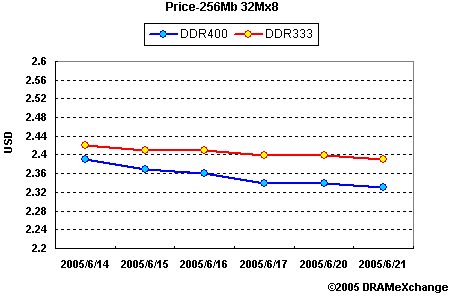
DRAM contract prices have hanged near bottom in the range of $20 to $22 for two months. Again, DRAM makers have failed to raise the prices in June as buyers still keep their inventory lean. Besides, the weak DRAM spot pricing performance in past week played a negative factor in contract pricing negotiation. Though DRAM makers have received some upside or urgent orders from buyers, the increasing volume won’t be strong enough to support the prices up. In projection of a higher demand in July, DRAM makers intend to raise the contract prices up 5% to 10% in July according to sources.
DDR2 demand to increase soon as premium disappear
As most DRAM makers aggressively to allocate more capacity to DDR2 production, DDR2 production output MoM bit growth in April and May was 14% ad 11.4% respectively and the portion of total DRAM output was up to 25.4% in May 2005 from 23.5% in April 2005. According to PC OEMs, there’s almost no premium for DDR2 512MB 400MHz over DDR 512MB 400MHz. However, there’s still 5% to 10% premium on DDR2 512MB 533MHz over DDR 512MB 400MHz. DRAM makers and OEMs buyers all believe the premium will disappear soon in the second of this year and DDR2 demand will spur accordingly. Currently, except Dell, some PC OEMs have DDR2 installed in PC system around 30%, some even have a lower portion of 10% to 20%. We estimate the average DDR2 application rate will increase to 35% to 40% in the third quarter and up to 50% to 60% in the fourth quarter.
By Judy Chen, Marketing Intelligence Team, DRAMeXchange
NAND Flash--
24% drop in contract price for June is still not low enough to cross over with spot!
This month's contract price fall on a weekly basis. For some suppliers, prices are even lowered twice at the beginning and end of each week to stimulate purchase. Contract price for 2Gb fall the heaviest this month with a 24% drop. However, current spot prices are still lower than contract prices, with 1Gb as exception. We believe the cause for current situation of spot price lower than contract price is due to following reasons. First, overall demand is poor due to seasonality reasons. Second, some of the large NAND Flash end product makers are dumping their NAND Flash inventory onto the market. Last, June is the last month for 2Q, thus, suppliers of NAND Flash, its agents, and customers have pressure to lower inventory. To maintain relationship with NAND Flash supplier, its customers purchase NAND Flash and turn around to sell in the spot market giving heavy downtrend price pressure on the spot market.
Poor demand for 4Gb and 8Gb chips
This week's demand for high density chips are not good making weekly spot price drop in the range of 3-4%. Weekly spot price low is at USD45.6 and USD25.6 for 4Gb and 8Gb, respectively. We believe next month's contract price for high density chips will fall at the same rate as this month to stimulate high density demand. Thus, spot price for high densities might still remain below contract price for another month.
Mainstream density 2Gb is the heaviest weekly spot price drop of 7%
2Gb chip dropped 7% this week to USD12.07 making it the heaviest weekly spot price of the week. However, this chip is the only one with demand and supply in the market. With demand coming from factories, 2Gb spot price is able to maintain at above USD12.
1Gb is in shortage in spot market with the least weekly spot price drop of 1%
1Gb chip stock circulating in the spot market is scarce. Thus, spot price high this week can reach USD8.9. However, deals being traded are few. We believe supply for this chip, from the largest NAND Flash supplier in the market, in the packaged form has decreased with the increased quantity in wafer form. This will in turn make the chip price go up since the customers who get wafers are not allowed to make them into products other than final goods (as in memory cards). Thus, the customers who can only use chips will be left with lesser supply in the market.
_940621b.gif)
_940621c.gif)


