By Judy Chen, Marketing Intelligence Team, DRAMeXchange
NAND Flash : Spot price plunged 6-13% for high density chips!
Spot prices have shown a significant dropping since last week. This week, most of the high density spot price lows dropped below contract price lows. In some days, the daily price dropping approached nearly USD$2.
8Gb and 2Gb spot price lows are below contract price lows by 6-10%
1Gb to 8Gb chips' spot prices all dropped at least 6% this week. Yesterdays' closing average spot price is at USD$49.8/USD$27.9/USD$13.45/USD$8.08 for 8Gb/4Gb/2Gb/1Gb, respectively. 8Gb and 2Gb chips' spot price lows are already below contract price lows in the range of 6-10% price gap. However 1Gb and 4Gb chips' spot price still have some premium over contract prices.
Demand for low density chips has started to shift from 512Mb to 1Gb
Demand coming from handsets is still the main drive force for current NAND Flash market. We have seen the mainstream for either embedded or bundled sale memory cards for new models of mobile phones which is to come out in 3Q this year to move to 128MB (1Gb). Thus, with the mainstream density moving from 64MB to 128MB for small size memory cards for mobile phones, demand for NAND Flash chip has begun to shift to 1Gb from 512Mb. This explains the current spot price for 1Gb and 512Mb; 1Gb spot price is still above USD$8, yet, 512Mb chip spot price has stopped its price surge and the average spot price remains at USD$5.86.
By Joyce Yang, Marketing Intelligence Team, DRAMeXchange
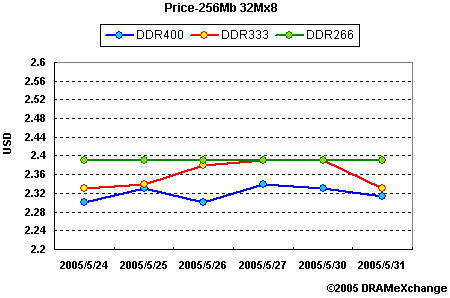
DDR 256Mb 32Mbx8 were traded up slightly
In past week, DDR 256Mb 32Mb prices have been slightly up with a contribution of restocking demand. DDR 32Mbx8 400/333/266 MHz were up from $2.30, $2.33,$2.39 on May 24 to $2.32,$2.40,$2.39 in early Asian market on May 31. eTT(UTT) chips were traded actively from $2.08 to $2.13 due to a limited supply. SDRAM 1Mx16 and 4Mx16 also have shown slight positive gain from $0.45 and $1.01 to $0.47 and $1.01 respectively.
Price v.s. Cost
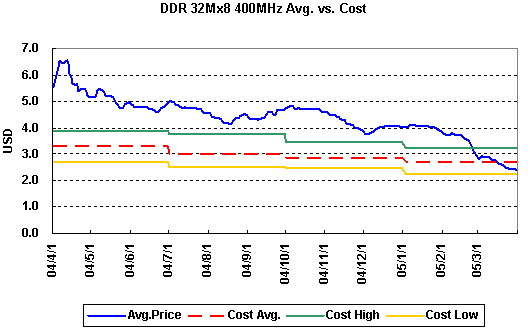
The average spot price of DDR 256Mb 32Mbx8 has plummeted over 40% since mid February
and most DRAM makers have involved with loss in April and May 2005 as the average prices dropped below $2.50. According to DRAMeXchange 'market intelligence', the average price has dropped below the cost range in 'high' at the end of February, went further below the cost range in 'average' at the end of April and reached near the cost range in 'low'. Taiwanese DRAM makers gross profit margin were at promising high in the average of 32% to 45% in the third and fourth quarter of 2004. Generally, their gross profit margin has gone down to 16% to 27% in the first quarter 2005 and have suffered loss in April and May. Therefore, some DRAM makers have adjusted their capacity allocation to other products such as Nand flash or foundry order for higher profit margin. We expect this action along with mass production on DDR2 will constrain DRAM bit supply growth in July and August.
Currently, we believe DRAM spot and contract prices will be stabilized or slightly up in June.
Some channel buyers and distributors may stay aside for further clear signals. Taipei computex show is on from May 31st to June 4th 2005 and the DRAM trading volume in spot market may be limited during the computex show period.
_20050531b.gif)
_20050531c.gif)


