Output and inventory released
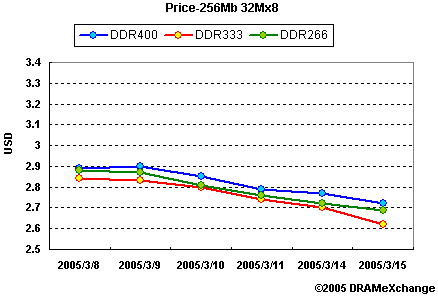
In the past two months, PC shipments have been lower than expectations so that DRAM consumption has not been strong in the contract market. DRAM suppliers didn’t release their chips to spot market but build up their inventories from 2-3 weeks to 4-5 weeks last month. As such, DRAM suppliers had more pressure to release their inventories to spot market and eventually did release their components in the second half of Feb. Last week, buyers still hesitated to purchase chips before the expected lower spot prices came out. Without buyers’ purchases, average price of 256Mb (32Mb*8) 400MHz DDR DRAM declined from US$2.90 on 7th, Mar. to US$2.77 on 14th, Mar.
More bargaining power for PC OEMs
PC OEMs seem to have good channels in the first half of March and expect to have better sales in the second half of March, but DRAM suppliers seem to be still under pressure to release their chips for the sake of this quarter-end financial results. PC OEMs believe that there is still markdown space for the second contract price of March, but DRAM suppliers intend to remain at current price level. According to our market survey to both demand and supply sides, we think PC OEMs have more bargaining power than DRAM suppliers. In the spot market, buyers will just buy chips for their orders on hand before they believe that spot price touches bottom.
NAND Flash spot market remained good
In the NAND Flash contract market, buyers continued to book more chips from DRAM suppliers so that there were insufficient chips released in the spot market. In the NAND Flash spot market, purchasing power was good but supply was tight last week. Average price of 2G, 4G and 8G NAND Flash went up to US$18.38, US$32.68, and US$62.32 on 14th, Mar from US$17.18, US$32.26, and US$59.86 on 7th, Mar. DRAM players will allocate more capacity to NAND Flash products in 2Q05. We can foresee that more NAND Flash supply will show up in 2Q05; we just wonder if demand can really consume so many chips.
_20050315b.gif)
_20050315c.gif)


