DDR 256Mb spot prices get softer and decrease 0.4% to 2.3%
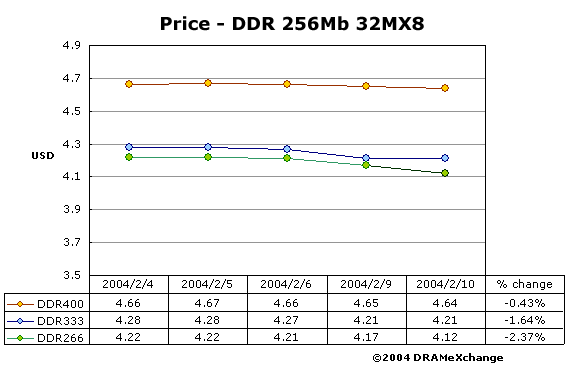
After consecutive two weeks’ strong upward trend, DDR 256Mb spot prices turn softer this past week. The spot pricing for 266MHz part was down 2.37% from $4.22 to $4.12, the 333MHz was down 1.64% from $4.28 to $4.21 and the 400MHz was down only 0.43% from $4.66 to $4.64. The 128Mb 333 MHz 16Mx8 DDR was stable at $2.50.
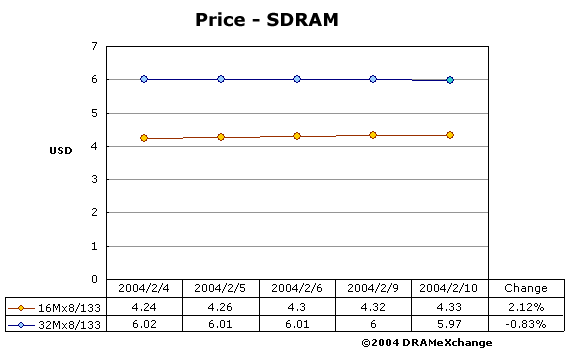
According to our check with the channels demand from varied regional market, the demand from Europe market is modest and not significant compared to other markets. The orders from USA market are most asking for DDR 32Mx8 400MHz , SDRAM 16Mx8/32Mx8 and the non-major brand modules prices increase slightly to $37.50. The buyers in China market are looking most for 266MHz and try to bid lower prices aggressively. Generally, most marketers hold cautious optimism for their inventory and are carefully watching spot pricing with the next few weeks ahead.
The DDR supply to the spot market is still limited for more capacity allocated to Flash and SDRAM for higher profit. Winbond has announced a plan to adjust its product mix and allocate more 8” fab capacity to specialty DRAM and flash by reducing the allocation portion of DRAM. Hence, its DDR production output is projected to decrease to 17% of its total output in the first quarter of 2004 from 44% in the fourth quarter of 2003. Besides, Samsung has encountered yield problem while applying new material in 12” DRAM process, therefore its DDR output decreased dramatically in January, sources said. So far, the DDR spot pricing still gets support with the limited supply, only drop less than 3% DDR 256Mb 32Mx8 266/333/400 MHz this past week after 16% to 24% up from January 2, 2004.
SDRAMs remain at high pricing with strong demand
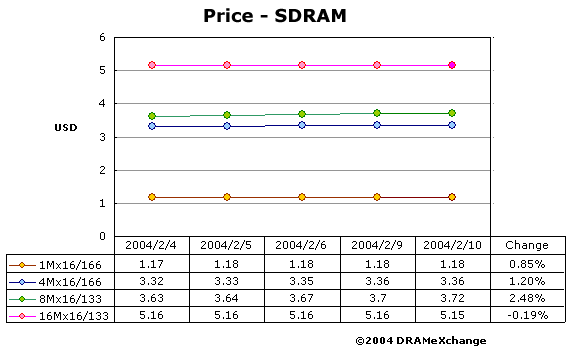
SDRAMs remains at surprising high prices with the limited supply and strong demand. Even in January, SDRAM’s output has increased around 20% according to our survey, the SDRAM pricing still keep at high level. From February 4 to 10, 2004, 4Mx16 was traded 1.20% up from $3.32 to $3.36, 8Mx16 was up 2.48% from $3.63 to $3.72. For January, SDRAM output is around 16% of total DRAM output according to our data collection.
1H February contract prices flat to up 1.5%
It’s tough for both DRAM makers and PC OEMs to negotiate the 1H February contract prices since the DRAM makers try to lift the contract prices following the strong spot pricing performance and PC OEMs are reluctant to take higher cost after passing the shopping season. The low for 1H February contract prices remain flat at $31.5 and the high increase only 1.5% from $33 to $33.5. We estimate the next run contract prices will still keep flat or up slightly since the upside is quite limited for DDR spot prices.
Many marketers bring out why the surge in DDR spot prices couldn’t boost the contract prices further higher. Normally, the spot pricing plays a leading indicator to contract pricing and should be below the contract pricing due to strict quality requirement for contract original modules. The gap of spot pricing and contract pricing will eventually get close as the market demand and supply reach equilibrium . In last August to October, the contract pricing for DDR 256Mb kept at high level above $5 while the spot pricing kept trending down to $4.30 and the gap has been widen to $1.0.
We would like to note that around that time, PC OEMs tended to increase their inventory level before the shopping season and had to suffer the increasing pricing to guarantee the components supply wouldn’t be in shortage. As for now, PC OEMs are more cautious and controlled on their procurement and inventory level for the seasonal slow demand concern. Therefore, the contract pricing upside is limited by PC OEM’s bargaining power. In the spot market, the channel distributors and traders usually increase their inventory levels or overstock for speculation and cause the prices overshooting. This phenomenon will be more significant as the spot market gets smaller in terms of trading volume.