Output decreasing effect started to kick in and will last till the end of 1Q, DDR2 1Gb spot chip price may reach US$ 1 again in 1Q
After the DDR2 667Mhz 1Gb chip price plummeted through US$ 1 cash cost in October and kept falling to the vendor’s material cost US$ 0.6, the DRAM vendors could not tolerate the loss any more and cut more and more output. According to the statistics of DRAMeXchange, the Taiwanese vendors cut almost 30% of their output in terms of 12” equivalent in 4Q, the Korean vendor Hynix terminated its 8 inch fab output and cut 20% of its 12 inch fab output. Although Samsung hasn’t decrease its output, the total output of the Korean vendors decreased 16% in 4Q. The Taiwanese vendors will elongate the Chinese New Year holidays to two weeks In January 2009 hence the 1Q output will keep decreasing. According to the estimation of DRAMeXchange, the output decreasing effect will last with the WW DRAM output cut in 1Q09. Along with the global economic downturn and the decreasing PC sales in 1Q09, the contract DRAM price may reach bottom but the upside momentum will be comparatively weak. On the spot price side, the upside momentum is higher with the decreasing output of the major vendors and Taiwanese vendors, and it may has chance to reach US$ 1. (Figure. 1)
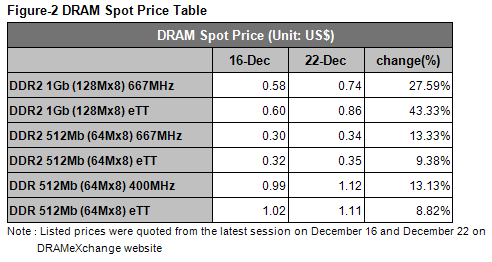
DDR2 1Gb eTT chip price fell from the high of US$ 2.15 in June to US$ 0.59 in mid December this year with the range of 73%. After the major spot vendor PSC declared that it will stop shipping after finishing its December shipment to certain major clients, the spot market supply suddenly decreased. Although the demand hasn’t increased, due to the psychological effect of future price upside anticipation, the spot chip price rallied sharply over 40% last week (12/16 to 12/22). The DDR2 1Gb eTT chip price went up from US$ 0.6 to US$ 0.86 with the range of 43% and the DDR2 667 Mhz 1Gb chip price also increased from US$ 0.58 to US$ 0.74 with the range of 28%.
Under the financial pressure, the Taiwanese DRAM vendors were the first ones being forced to reduce output. The Taiwanese DRAM vendors are the major suppliers of the spot market, and the sales portions of spot market are as followed, PSC 90%, Promos over 50% (including sales to Kingston), and Nanya 30%. The sales portions to the spot market of the major international DRAM vendors are only 5% or lower. In 1Q09, the wafer input in P1, P2, P3 of PSC will keep decreasing and the output will sharply decline, but the quantity of Elpida portion, which PSC supplies to, will remain unchanged. This will decrease the PSC own portion sharply. The PSC November output was about 100M in terms of 1Gb equivalent, after deducting the Elpida portion of 40M, its own chip production was 60M. In January 2009, the output is estimated to be 70M under the output reduction effect, after deducting the 40M Elpida portion, only 30M has left for PSC which is only 50% of 60M. The output in February and March is hoped to be less than 30M in terms of 1Gb equivalent due to the wafer in reduction in December 2008 and January 2009. Meanwhile, the Promos output reduction percentage was even higher. Nanya also decreased 30% output in November (including Inotera and its own 12 inch fab). The output reduction of the Taiwanese vendors directly impacts the spot market supply. The spot price will turn the past remaining situation of over 20% lower than the contract price around in 1Q09. The spot price may go up 20% to 30% higher than the contract price. 1Gb eTT chip supply will sharply decrease and may drive the spot price to the range of US$ 1 to US$ 1.2.
The 2H December DRAM contract price plunged over 10% under the conservative 1Q09 sales outlook of the PC OEMs and the low DRAM demand. The 1GB and 2GB memory module average price were about US$ 8 and US$ 16. The price is close to the bottom according to DRAM vendors’ opinion, and the contract price is hoped to remain stable in 1Q09 and the chances of upside will depend on how the demand turns out.
The “DRAM cold front” had driven those DRAM vendors, who never wanted to give in and cut output, to decrease output as far as 50% to 70%. Some are even thinking about adopting the “build to order” strategy to avoid oversupply. After the Korean and Taiwanese government decided to support the bail out plans, the German government officially announced to support Qimonda, the German DRAM vendor. Outsiders kept questioning about that all these bail out plans will do harm to the DRAM industry recovery, but actually, these bail out plans can only provide the short term operating capital due to the limited capital amount. Eventually the DRAM vendors still have to self rescue with output cut. The global scale output cut is expected to turn the worsening DRAM oversupply situation to equilibrium and drive the current low price to surpass the vendors’ cash cost.
Before the DDR 2 price reaches the cash cost US$ 1, the DRAM vendors will keep decreasing their output. After all, only output cut is the king, said DRAMeXchange.

NAND Flash production slowdown move will help improve the oversupply situation in 2009
Along with the spreading of global financial crisis in 4Q08, some institutes had lowered their forecast of 2009 global economic growth rate downward one after another. The view toward NAND Flash market has also turned conservative to year end holidays and the slowing 1Q09 sales expectation. This made the NAND Flash down stream product makers tend to consume their inventory in hand instead of doing new purchase, and caused the down stream purchasing demand to sharply plunge in November. The NAND Flash price continued to drop to over 30% QoQ in 4Q08 which was beyond expectation of the NAND Flash suppliers. In addition, the 2009 market shipment forecasts from some leaders of PC, Mobile phone, and consumer electronics had been lowered since early December. Therefore, major NAND Flash suppliers started to consider lowering their 2009 Capex budget in December. By means of retiring the 200 mm equipments, wafer production cut, annual equipment maintenance and suspending new capacity expansion plans, the growth of NAND Flash wafer production in 2009 can be slowed down. NAND Flash suppliers will increase the supply bit growth mainly by process technology migration.
Followings are the recent actions that NAND Flash suppliers plan to decelerate their wafer production: Samsung plans to gradually retire its 200 mm equipments of NAND Flash Fab in 2009, the 300 mm expansion schedule will be adjusted upon future market demand. The Toshiba-SanDisk camp announced that it will execute the annual maintenance for 13 days in early January, the January NAND Flash capacity of their jv. Fab will decrease about 30% MoM comparing to December. Future utilization rate will also depend upon market demand. SanDisk also announced that it planed to suspend capacity expansion for its portion of the 300 mm jv. Fab 4 till the end of 2009. Hynix had stopped its 200 mm Fab M9 & M7 NAND Flash productions in September. The future capacity expansion of 300 mm M11 has been suspended and will adjust upon market situation. IM Flash had stopped production in its 200 mm Boise Fab in November. The mass production plan of the new Singapore 300 mm NAND Flash fab will delay from 4Q09 to early 2010. DRAMeXchange estimates that the recent output reduction of NAND Flash vendors will decrease about 10% QoQ of wafer production in 1Q09.
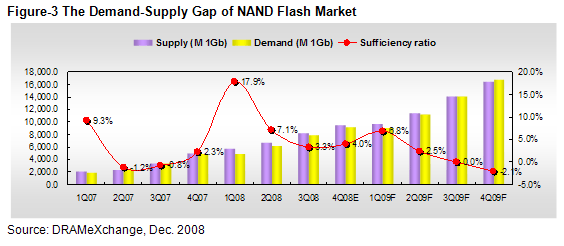
Although the sharply price decline of NAND Flash helps to raise the end application content per system, the PC, mobile phone, and consumer electronics related suppliers are comparatively conservative toward the end product shipment of 2009. We expect the 2009 NAND Flash demand bit growth to be 81% yoy, comparing to the 71% yoy of 2009 supply bit growth, which is after the wafer production slowdown, the oversupply situation will remain due to the slow season effect in 1H09 and global slump. The oversupply situation of NAND Flash market is hopefully to improve until 2H09, under the hot season effect and the influence of production slowdown. Although the electronics vendors commonly tend to be conservative toward the demand of electronic products in 2009, production reduction will help improve market sentiment. In light of the mainstream NAND Flash price has already dropped about 90% since 3Q07, we expect recent production slowdown moves of NAND Flash suppliers to help the NAND Flash price to stop sliding and stay more stable.
China will become the Netbook market hot zone
Intel Atom CPU triggered the business incentive in 2008, plus VIA started the Global Mobility Bazaa in China, these enable the China NB to catch the “Mountain Gangster” (Shan Zhai, which means the place where the mountain gangsters gather and live) wave. Even the major branding PC OEMs such as Ching Hwa Tong Fang launched their off main stream Netbook-LimeBook model. It comes with an own developed Lime OS, Freescale CPU, 256 MB or 512 MB DDR2 memory, 30GB to 100 GB HDD, and with the lowest selling price RMB$ 1,599. Ching Hwa Tong Fang is different from the major Netbook vendors, which set the new model price in the range of US$ 500 to US$ 600, and pull the price down to US$ 200.
The key reason why consumers are crazy about the “mountain gangster” device is that the price is only half or even lower than the major branding OEM models, and the quality that sacrificed was never been taken into consideration. While comparing the development of “Mountain Gangster” NB to the “Mountain Gangster” cell phones, the “Mountain Gangster” NB has fewer conditions to success. Whether it’s from the usage, product life, market scale, or design, the characteristics is very different from the cell phone.
For example, NB is mainly a tool for making a living, therefore the stability and after service are far more emphasized than cell phone. Secondly, the product life of cell phone is about 6 months to 2 years, under the low price condition, consumers keep buying new phones because of fashion and trend issues. Although the price of the “Mountain Gangster” NB is very cheap, the replacing period is not as short as six months or one year. Especially the backing up data and unstableness are something that consumers last wanted. The low repurchase rate will limit the “Mountain Gangster” NB market and lower the speed for vendors to gather gross profit. The quality issue is another thing that refrain consumers from buying the “Mountain Gangster” NB.
According to previous discussion, under reasonable purchase behavior, there are many limitations to the “Mountain Gangster” NB business opportunities. But the China consumer market has its own way and that’s why the vendors would like to give it a shot. Especially under the circumstances that top 10 NB brands account for 95% of the China NB market, non top 10 vendors see this as an opportunity for them to enter the market. In order to prevent the “Mountain Gangster” NB eroding the mainstream NB market, the top 10 vendors may accelerate their pace of Netbook product line development and reiterate the concept of low price with quality and reliability to assure their market status. CPU vendor such as Intel is willing to cooperate with its top 10 customers in product development in order to prevent VIA and AMD’s penetration in the China market. Together with these two forces, the “Mountain Gangster” NB market doesn’t have too much chance but will trigger the war in China Netbook market and made China another hot zone after Europe and the U.S.


