DRAM spot price climbs as inventory levels grow lower; Contract market the key factor for bottoming out
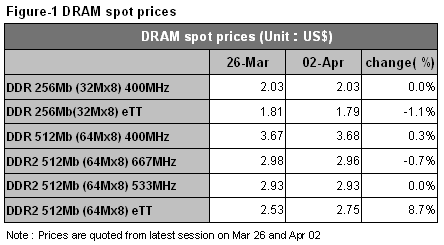
As DRAM inventory levels dropped to a more stable level, it triggered the DDR2eTT spot price to rebound, subsequently spurring other branded chip prices to increase as well. The DRAM spot prices appear to have finally stopped dropping. However, the DRAM contract price is still currently lower than the spot price. Thus, the contract market demand will be a very important factor in gauging whether or not the DRAM price has indeed hit the bottom.
The sudden increase in the DDR2eTT price, due to a growth in demand, caused retailers and module houses to acquire chips at a higher price. However, amid the price rebound, the demand did not grow in proportion, which resulted in minimal price fluctuations. For last week, the DDR2 eTT price jumped to USD2.75, while DDR2 512Mb 667MHz climbed to USD2.96. At the moment, the spot market seems to have relatively stabilized.
The plunging DRAM spot prices in March rendered many PC OEM makers and module houses to stock up on the lower-priced chips. This helped drive down the excess inventory of DRAM makers by the end of March. Prices thus began to rise, as PC OEM makers or module houses that did not have a sufficient amount of inventory needed to acquire more chips.
However, the current DDR2 512MB contract price still stands below USD25. In other words, each DRAM chip is priced at approximately USD2.5-2.7. Evidently, a gap still exists with the spot price. Therefore, until the contract price also stabilizes, the recent spot price rebound can not be viewed as a bottoming out. The primary focus should now be laid on the contract market. As April is the quarter end for some US-based PC OEM makers, there will be limited purchases from their end. However, with the contract prices growing closer to the costs of DRAM makers, the room for additional price drops should be limited.
How the growing Digital Lifestyle will bring new Flash applications
From the recent electronics shows and forums, it can evidently be seen that vendors are aggressively focusing on effectively integrating the broadband Internet & communication and relevant information technologies in building a digital lifestyle that may be realized in the not-too-distant future. With the continuing developments in the broadband digital-life services, it is set to bring the spirit & lifestyle of people into the world of the true, the good & the beautiful. From each respective exhibition, vendors are seen showcasing a vast array of products or emerging technologies. This includes the integration of fixed and wireless communications, computer Internet, TV broadcasting, digital home multimedia system, TeleHealth (better medical quality & efficiency, enhanced testing & diagnosing accuracy….), TeleEducation (widespread access to higher education, multiple education methods…..) ,and geographic information system technologies integrated with TeleMatics (car navigation, wireless multimedia service, 3D map of virtual-reality rendering…..) and TeleSecurity applications.
In addition, another usual highlight is combination of the radio frequency identification technology and smart card system in creating the E-commerce & Enterprise-Automation and E-Home & Home-Automation. This includes management of logistics & supply chain, production automation, and the intelligent automatic control system of house security, illumination, temperature, humidity & home appliances. These fields have become a major focus to electronic makers in the development of new products. Therefore, it is anticipated that medical devices, supplementary education tools, transportation vehicles, management system of logistics and supply chain, production and other business equipments will become more intelligent. The demand for high-performance micro-components & sensors and high-capacity storage devices are also expected to increase.
On a different note, we have also observed that the ongoing developments in the 3D IC/3D packaging, micro-electromechanical systems, flexible displays, and system on panel technologies will create slimmer, smaller and sleeker smart hand-held electronic devices. Vendors are also concentrating their resources in promoting anti-virus software targeted for the smart phone. With the persisting enhancements in wireless broadband connectivity and its inherent business potential, anti-virus software is expected to see increased applications in smart hand-held electronics devices. In the future, new emerging technologies, such as RFID, biometric verification and speech recognition technologies will also be added to those intelligent automatic control systems, which will help the digital lifestyle grow further in the broadband world. However, before these emerging identification technologies can be applied in new business models & database of broadband digital-life services, they must first win the confidence of the public.
In general, from the new developments in the electronics industry mentioned above, we expect that as the data transfer speed and production costs of Data Flash or Integrated Flash continue to improve, their applications will eventually expand beyond consumer electronic products, handsets and PCs. Their business potential of storage applications in the intelligent automatic control system equipped with "Smart" card/drive for medical equipment, supplementary education tools, transportation vehicles, management system of logistics & supply chain, production and business equipments, along with smart mobile electronics devices equipped with "Smart" card/drive, is likely to see more applications in the future.
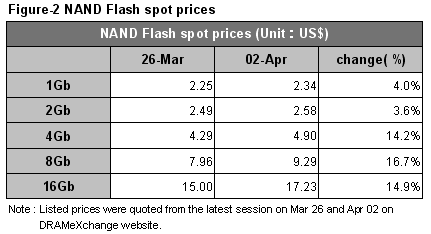
Finally, a comparison of the listed NAND Flash prices from the last session on Mar 26 and Apr 2 is shown below. Spot prices of the 1Gb chip rose from USD2.25 to USD2.34, a 4% increase. For 2Gb, they increased 3.6% to USD2.58; 4G up 14.2% to USD4.90, 8Gb up 16.7% to USD9.29 and 16Gb up 14.9% to USD17.23.