DDR2 1Gb chip spot price hit new historical low, DDR2 1GB contract price fell below the US$ 10 level
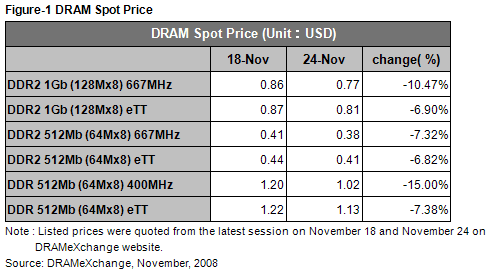
Although whether the Taiwanese government will fund the DRAM companies or not is a hot topic and under public discussion, the DRAM price eventually is determined by the market demand. With the worsening global economic downturn and frozen Christmas demand, the DDR2 spot chip price continued to hit historical low. Last week (11/18-11/24), the DDR2 1Gb eTT chip price dropped from US$ 0.87 to US$ 0.81, with a range of 6.9%, and dropped 33.6% from the beginning of the 4Q. The DDR2 667Mhz 1Gb chip price wasn’t doing any better and dropped from US$ 0.86 to US$ 0.77, with a range of 10.5%, and dropped 36.8% from the beginning of 4Q. In the past, the original chips traded in the spot market were under strict testing process and enjoyed higher price comparing to the eTT chips, but now the price is lower than the eTT. It obviously showed that the DRAM vendors are dealing with sever inventory pressure and the oversupply situation still remains.
In the contract market, the 2H November contract price fell below US$10 and hit historical low, the average price of DDR2 667Mhz 1GB and 2GB modules were about US$ 9.5 and US$ 20 which dropped about 10%. From the beginning of 4Q to date, the price has dropped 30% and 26% respectively. While the PC market stepped into slow season from November conventionally and the total market demand declined sharply, the contract price may keep plunging but with limited range. What’s more need to pay attention to is that along with the increasing shipment of Netbook, which might account for 50% and 30% of the 2009 NB shipment of Asus and Acer, the increasing of DRAM average content per box will be suppressed. The worsening environment and the Netbook issue mentioned above will delay the recovering of contract price.
With the worsening DRAM market situation and the sever oversupply issue, the DRAM vendors are facing declining revenue and cash outflow. Whether funding privately, from technology parent, or even government, for DRAM vendors, the core competitiveness is still the key to survive. Even without the DRAM core process technology developing ability which Samsung, Micron, and Elpida have, the mass production and cost down skills still make the Taiwanese DRAM vendors the best allies. For example, the technology alliance of Elpida and PSC or Micron, Nanya, and Inotera, mainly built on the manufacturing ability of the Taiwanese DRAM makers. The future DRAM market will be like a tripod, the technology will be led by the American, Japan, and Korea makers, and manufacturing will be done by the Taiwan vendors. The cooperation between the technology parents and the manufactures will be even closer. The Taiwanese vendors will play the key role of helping the technology parent vendors to gain market share.
2009 will be the promotion year of 3-bit/cell MLC NAND Flash; the NAND Flash Contract Price of 2H November Remained Unchanged
Currently there are two orientations of cost down with the NAND Flash vendors’ technology R&D. First orientation is the shrinking of process technology, and the second is adopting the design of multi-bit per cell architecture. In the past, NAND Flash suppliers’ cost-down efforts were mainly focusing on the shrinking of process technology. The process migrating speed of NAND Flash was generally one generation per year and was faster than the Moore’s law. Nowadays, the process technology has come from 90nm → 6xnm → 5xnm → 4xnm, and about to step into the 3xnm process technology stage.
With the 56nm 3-bit/cell MLC NAND Flash mass production of Toshiba/SanDisk in 2Q08, the NAND Flash makers have started to develop the 3-bit/cell MLC products. Generally speaking, the die size of a 3-bit/cell MLC chip would be over 20-30% smaller when comparing to 2-bit/cell MLC based on same process technology. Theoretically, the unit production cost of 3-bit/cell MLC will be lower than the 2-bit/cell MLC. Due to the higher complexity of 3-bit/cell MLC design, the yield rate, performance and reliability parameters will show less well than the 2-bit/cell MLC.
So far, SanDisk is the most enthusiastic vendor of promoting 3-bit/cell MLC NAND Flash products. After Toshiba/SanDisk alliance launched the 56nm 3-bit/cell 16Gb MLC, it plans to implement the 43nm 3-bit/cell MLC product mass production in 1Q09 and the 3xnm 3-bit/cell MLC mass production in 1Q10. It’s expected that SanDisk will keep playing the role of 3-bit/cell MLC market promoter in 2009. Although there is still no concrete schedule of other NAND Flash makers, they all claimed they will have 3-bit/cell MLC product in 2009. For example, Samsung plans to manufacture the 42nm 3-bit/cell MLC in 1H09, Intel plans to produce the 34nm 3-bit/cell MLC around mid-2009, and Hynix plans to produce the 41nm 3-bit/cell MLC around mid-2009.
Although the data writing speed and endurance of 3-bit/cell MLC decrease with the node technology shrinking, the chip unit cost is still lower than the 2-bit/cell MLC based on the same process technology with the same capacity. Therefore, the Toshiba/SanDisk alliance will first allocate the 56nm 3-bit/cell MLC NAND Flash in the products which require less reliability and lower performance demand, such as low-cost UFD and memory card market, to test the market response. It will adjust the 3-bit/cell MLC portion with the degree of market acceptance. Currently, the NAND Flash makers have developed different technology solution alternatives to improve the endurance and data writing speed of the 3-bit/cell MLC. They hope to broaden the application to PC storage market, which requires higher reliability and performance, such as low cost PC and SSD. Since the 4xnm & 3xnm 3-bit/cell MLC products of most NAND Flash vendors are in the process of developing and improving period, related product parameters are still under adjustment. While taking the time of the 3-bit/cell MLC yield rate and performance adjusting and the schedule of NAND Flash controller supporting into consideration, we expect the 3-bit/cell MLC will be more popular in the low-price memory card and UFD market in 2H09. With the continuing improvement of endurance and performance of 3-bit/cell MLC, it is possible to be widely adopted in the low-cost market segments of consumer electronics, mobile phone, and PC applications.
2HNov. NAND Flash contract price review
NAND Flash contract price of 2H November, 2008 remained stable. As upstream suppliers had cut the price earlier in 1H November to help downstream makers promote year-end holiday demand, 1H and 2H NAND Flash contract price weren’t adjusted much. Downstream clients have been comparatively reserved toward the market, so they are more prudent with restocking. Further purchasing would depend on market sales condition during the year-end sales peak. Due to the great accumulation of NAND Flash price drop and downstream makers’ low inventory policy, we expect the price to remain flat or slightly fall in the short term.
The restricted All in one PC Atom platform
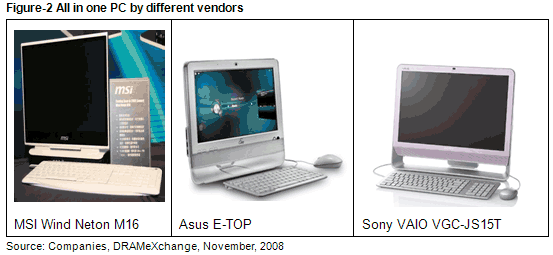
Intel Atom series CPU is built for power saving compact size PC. After the Netbook launched, the Nettop products stepped into the market in 2H November, vendors including Asus and MSI. The Asus E-TOP equipped with 15.6 inch monitor, 1.6 GHz Intel Atom CPU, 1GB memory, 160GB HDD, one web cam, and Windows XP. Its specification is closed to EeePC and with the suggested retail price of NT$ 18,900.
MSI will launch its Wind Neton M19 and M16. The M19 comes with a 18.5 inch monitor and M16 comes with a 15.6 inch. The basic version of M16 adopts Atom processor, and the retail price starts from US$ 399. These products will be first launched in 1Q09.
The all in one concept is not new to the PC industry, vendors like Apple and Sony both have products in the market for a while, adopted the mainstream CPU, and targeted at the high price segment. For example, the new Sony VAIO VGC-JS15T is equipped with the Intel Duo Core desk top processor E7200 and 1680 x 1050 high resolution 20.1 inch monitor, and emphasizes on the multi media entertainment functions. The new Sony VAIO VGC-JS15T suggested retail price is NT$ 44,800.
Before the Atom platform, the market share of all in one PC was limited. The high price, un-upgradeable specs, and inconsistency of the monitor life time all quenched the consumers’ purchasing desire. The launch of the Atom platform created a way for the all in one PC to penetrate into the market and gave hope to the market share increase.
Comparing the performance/cost ratio of the current entry level desktops and take the substitution of the Netbook into account, the future of all in one PC seems limited. Take the Asus Eee PC as an example, with similar specifications, it costs about NT$ 20,000 to NT$ 23,000 if the additional 19 inch monitor is purchased, which is closed to the price of ETOP and with better mobility. If we put the monitor with an entry level desktop, the total price will be less than NT$ 15,000. Therefore, difference between the positioning of Nettop and desktop is about the total cost of the monitor and computer, and about the cost and mobility while comparing with Nebook. We do see that Nettop is under more restrictions than Netbook.

The memory market watcher
DRAMeXchange is a global primary provider of future intelligences, in-depth analysis reports and advisory services on DRAM and Flash memory industry with coverage including current business, spot trading prices, and market trends, capital spending and wafer capacity trends, the impact of DRAM/flash memory products on the market, and other relevant PC industry information.
© DRAMeXchange ® Tech.Inc. All rights reserved.