DRAM Makers’critical decision:“reduce or retire”
Because the enormous capital expenditure of DRAM manufacturing and sharp equipment depreciation occupying upward of 40%~50% of cost, production capability must be in full utilization to drive down the average bit cost and to recover equipment investment. Thus, when supply and demand are unbalanced, the self regulated reduction in supply that is common to other industry is seldom seen in the DRAM industry. DRAM manufacturers with capital may even expand production capacity despite market downturn, thus they may increase their market share after their weaker competitors withdraw from the industry.
The industry wide recession that has continued for nearly two years is primarily due to the high exit barrier to withdraw from DRAM industry. After several industry wide consolidations and the huge capital investment in 12” facilities, with the exception of Samsung who can fall back on its TFT LCD, tel-com, or handsets business units, all other DRAM manufacturers - Hynix Micron, Qimonda, Elpida, Powerchip, ProMOS, and Nanya - are pure DRAM/NAND Flash manufacturers. Unlike previous companies that exited the DRAM business who can exit by simply selling its DRAM business and stop its financial losses, in the current recession, for these DRAM manufacturers, except Samsung, to exit will mean an end for these companies. Thus, unless these DRAM manufacturers face severe cash flow issues in addition to a market price that is below their manufacturing cost with no hope of seeing a price recovery in the short term, it will be unlikely to see any large scale production cutbacks.
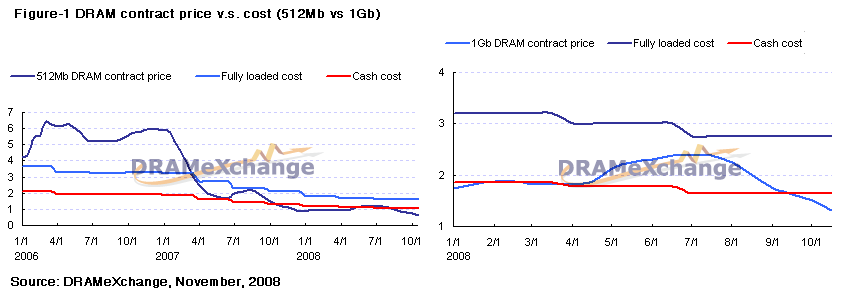
According to DRAMeXchange research, the DRAM vendors’ cash cost of the current main stream 70 nm technology is US$1.3 to US$1.5, and lower to US$1.0 to US$1.2 with the migration to the improved version of 6x nm process, which vendors mostly started in 1H08. However in September and October the DRAM DDR2 price plunged 20%, both October contract and spot price reached the new low of US$1.3 and US$1.0. Under the global economic recession, the demand is hard to recover in the short term and the DRAM price is difficult to have quick rebound. With the continuous loss, the DRAM vendors are tight on cash. Under the financial crisis and global economic recession, the banks have tightened their loans and the liquidity risk has risen. The difficulty of fund raising from capital market is much higher. Therefore, DRAMeXchange believe DRAM industry has entered the key adjusting stage of “reduce or retire”. The big scale reduction is now in progress and even some DRAM vendors will be out of the DRAM market in 2009. This adjusting wave will go on until the demand and supply come to balance.
Total 12" Wafers Down by 6% by First Wave Cutback
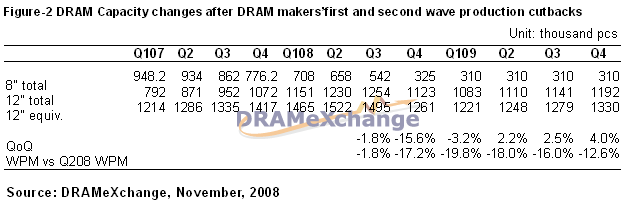
With a poor sale in September, DRAM price quickly fell to little more than cash cost. In early September, Powerchip its decision to cut DRAM production by 10%~15% (13k~19k wafers, or 1.5%~2% of global capacity) and request that other DRAM manufacturers to tackle the severe oversupply problem in DRAM market. Elpida followed several days later by announcing production reduction of 10% (10k wafers, or 1% of global capacity) at its Hiroshima facility.
By 22nd of September, the world's second largest DRAM manufacturer – Hynix also annoucned in cutting back production, halting nearly all of its 8” facilities, including its facility at Oregon in USA, Wuxi Suzhou in China and its largest 8” facility in Korea, leaving only a single 8” facility with 100k wafer/month capacity for DRAM, NAND Flash and CMOS Imaging Sensor. DRAMeXchange estimates this reduction lowers the total production volume of Hynix by 15%~20%. Based on its estimated market share of 18%~20%, this cut back will reduce global DRAM production by 3%~3.5%.
Total 12" Wafers Down further 10% by 2nd Wave Cutback
Inotera, after Micron has confirmed its acquisition of Inotera’s shares from Qimonda, announced it will reduce production by 20% starting November in order to prepare for the technology migration. Nanya will also suspend its Fab3 Phase2 expansion plan and, instead migrate the 30K capacity Fab3 Phase1 to Micron process; it expects to reduce production gradually beginning this November, shut down Fab3 Phase1 completely in January next year, and begin migration to Micron process in February next year. ProMOS has announced it will stop its 8” production facility. Powerchip may reduce another 20K production in November down to 90K. DRAMeXchange estimates total reduction for November, based on announcements in October, to be roughly 125K, or 10% of total 12” wafers.
Third Wave in January’09 to cut 6% more
Although it has not yet announced in public, but it’s said ProMOS confirmed that it will have a one month shutdown next January for annual maintenance. Nanya also expects to stop production at its 12” facility in January in order to prepare migrating to Micron process. Powerchip also may have 2-week annual maintenance in January’09. Thus, compared to November, we expect capacity to reduce by up to 70K 12” wafers in December, another 6% down on 12” wafer starts.
The output reductions mentioned above all are just some short term reactions of the DRAM vendors while facing the situation of prices falling below the cash cost this time. The ramp up volume of DRAM will hit the bottom in 1Q09. According to the DRAMeXchange research result, while taking the 2Q08 average monthly ramp up volume as the comparing basis, the 3Q08 average ramp up volume (in 12" equivalent) only slightly decreased 1.8%. Comparing 4Q08 number to the peak of 2Q08, the average ramp up volume decreased about 17%, and 1Q09 will decrease about 20%.
DRAM Supply-Demand and price trend analysis in 4Q08 and 2009
In 4Q08, the PC OEMs and channel players are all urged to digest their inventory in hand. With the sharply shrinking of market demand, the DRAM vendors are facing incredibly increasing sales pressure and rising inventory. Hence, before January 2009, we can barely see DRAM price rebound strongly while vendors are under great inventory pressure. With the continuous output reduction started in September, the amount of reduction will reach the peak in January 2009. We expect the over supply situation will be eased starting from the end of 1Q09. Therefore, the DRAM price may have a chance to rebound at the end of 2Q09 or in 3Q09 with the rising demand of PC OEMs.
Due to the 20% price drop in September and October, the DRAM prices are mostly now under the cash cost of vendors. Plus DRAM vendors have been suffering from loss for one and a half year, the operation of DRAM vendors is now in difficulty. While the average price may fall 20 to 30% in 4Q08, if the low price lasts to 1Q09, at least two DRAM vendors are very possible to be driven out of the market. No matter reduction or getting out of the market, DRAM industry has entered the final death match. The capacity of DRAM must adjust until the equilibrium of supply and demand has been reached. DRAMeXchange expects that the DRAM average price will go back to US$1.5 to US$2.0/ 1 Gb early as 2Q09 or late as 2H09.However,if the governments of Germany, Korea, Japan and Taiwan offer relief funds to DRAM companies to survive through the downturn, the downturn could be extended to 2010.
Over-Supply in NAND Flash Market is likely to improve in 2H09; 1H Nov. Contract Price of Mainstream MLC NAND Flash Declined Between 0-20%
Starting from 3Q07, the global financial plague derived from US sub-prime mortgage loan has infected the world real GDP growth gradually. The traditional NAND Flash hot season demand pattern in 2H08 is not as strong as before and the seasonal growth is weaker than the past few years. The global stock markets have dropped 30 to 70% in the past twelve months, and the real estate market is still under correction. With the shrinking of wealth effect, the demand of the consumer electronics has weakened, and the commercial market has also been conservative about the future and cutting the budget on electronic equipment expenditure.
In 2009, we expect that in both consumer or commercial markets, no matter in developed or emerging countries, the overall demand growth will be lower than 2008. Slow season effect will also continue in 1H09. The 1H09 oversupply situation will be worse than 2H09. In 2009, most NAND Flash vendors will adopt process technology upgrade to increase output and the cost will also go down in 2H09. The vendors will promote more high capacity products with lower cost, such as smart phones, MP3, low-cost PCs, MID, SSD, UFD etc. This will drive the demand bit growth and gradually shrink the over supply gap in 2H09. In 2H09, if the NAND Flash vendors can continuously adjust their output growth, we may see price rebound under hot season effect.
We expect the 2009 annual NAND Flash demand bit growth will fall to 93.1% from 125.5% in 2008. The 2009 NAND Flash supply bit growth will fall from 133.9% in 2008 to 89.5%. The over supply situation will continue in 2009.
1H Nov. NAND Flash contract price review
Contract price of mainstream MLC NAND Flash in 1H November dropped between 0 to 20% reflecting weak demand of the coming Christmas and New Year holiday. Some upstream NAND Flash suppliers have also adjusted the price to help downstream clients promote and stimulate the coming hot season demand expected later. SLC NAND Flash has shown more stabilized due to less supply in the market. 4Q peak season demand growth may not be as strong as the past few years. In light of that the main MLC NAND Flash had dropped over 80% in the past year, the overall price is expected to indicate mild decline in the short term.
PC future became unclear
WW PC shipment target wasn’t reached due to weak buying. The total shipment of MB and NB was 73.4M in 3Q08, and the quarterly growth rate was 14.6% lower than expected level 20%. The MB quarterly growth rate was only 11.7%, shipment 40.7M, and NB was 18.5%, 32.6M, lower than expected in the beginning of 3Q.
According to past history, PC shipment in 3Q was usually 20% higher than in 2Q. This year, sub-prime crisis, inflation, and rising unemployment rate, have weaken the consumer’s buying and blow away vendor’s hope of recovering the yearly sales target by 2H08 hot season. Furthermore, even lower the growth rate. The MB growth rate in 3Q08 was 11.7%, and the shipment was 40.7M. These only reached about 50% of the historical level. And NB shipment reached 32.6M with a growth rate of 18.5% and was lower than expected earlier this quarter.
With the newly released 4Q shipment targets of major ODMs, the PC future became unclear. The original forecast of NB QoQ growth rate was 15% to 20% and had been revised down to 5% to 10%. ODMs are still optimistic about the shipment in November and claim it will hold stable as October numbers. But the Thanks Giving end market sales will decide December shipment.
While companies are laying off employees all over the world, vendors are quite conservative and expect the shipment to shrink at the year end. 4Q NB quarterly growth rate might fall between 4 to 7% with the shipment of 34.2 M., which is far lower than the past years’ 15 to 20%, and yearly shipment is 120M. The estimation of Q4 MB is 38 to 40M, with a growth rate between -7~-2%, and yearly shipment is 156.2 M with a worse than 5% yearly growth.
It is still hard for us to take the outlook of 2009 optimistically. PC Vendors try hard to maintain their company growth level as the industry is. On the NB side, it can still retain its annual growth rate by replacing MB and stayed 10% to15%. Besides facing replacing threat, MB is also lack of technology drive. AMD and Intel are both integrating the graphic processor into CPU, and will launch in Q409 or2010. This will defer the upgrade demand for MB to the end of 2009. Therefore we expect MB market scale will keep shrinking with a decline of 5 to10%. WW PC shipment growth rate (Netbook not included) is 0.3% with the scale of 277M.

The memory market watcher
DRAMeXchange is a global primary provider of future intelligences, in-depth analysis reports and advisory services on DRAM and Flash memory industry with coverage including current business, spot trading prices, and market trends, capital spending and wafer capacity trends, the impact of DRAM/flash memory products on the market, and other relevant PC industry information.
© DRAMeXchange ® Tech.Inc. All rights reserved.