Further drop of DRAM contract price likely in 2H August
DRAN spot price failed to rebound after 1Gb DDR2 eTT dropped below US$1.80 – a benchmark for a price bottom, on August 7.
In the week August 12-18, price of 1Gb eTT DDR2 has dropped by 1.7% from NT$1.79 to US$1.76, whereas price of 512Mb DDR2 eTT has also felt by 3.7% from US$0.81 to US$0.78. Price drop was relatively mild in the branded segment. Price of branded 1Gb DDR2 667 was flat at US$1.86 and price of 512Mb DDR2 667 was down 2.4% from US$0.85 to US$0.83.
Spot price has steadily declined since the Beijing Olympics inaugurated as back-to-school demand did not occur and China curbs smuggling during the games. Inventory in the spot market stayed high without any channel to ease. Industry participants said any demand pickup in China over September may be offset by weak season in Europe. As distributors still owns over one month worth of inventory, spot price may continue to be weak for the rest of the year.
DRAM contract price is expected to continue declining by another 5% HoH in 2H August, following the same-rate of drop in 1H August. By 2009, prices of 1GB and 2GB DDR2 667 may again correct to the price trough as seen in early FY08, i.e. 1GB at US$16 and 2GB at US$32.
Weak spot pricing is hindering any potential price upside at contract market. DRAMeXchange records that price premium of contract price has enlarged to 21% at the two market places as of August 18 (spot US$1.86 vs. contract US$2.25), up from 13% as recorded in late April (spot US$1.88 vs. contract US$2.16). Also, inventory issue among OEMs and an unclear demand visibility for Christmas, are also factors that may drive a downward price trend.

Low Cost PC with SSD Shipment and NAND Flash Density Doubled in the Year of 2009
Low Cost PC commonly refers to NB with a screen size under 10" and priced at the range between $299 to $499. Low Cost PC is primarily designed for internet access and document processing. It is a product positioned between a high end smart phone and traditional NB. Screen sizes of Low Cost PC currently in the market are between 7" to 8.9". Low Cost PC originated from the OLPC (One Laptop Per Child) movement in 2005, but the actual products were not launched until 4Q07, and this has created a new market demand in the PC industry.
Take the Asus Eee Pc for example. The product is clearly defined as the second home PC for consumers in developed countries. Regardless of the limitation imposed by the smaller screen size, Eee PC's shipment volume in Europe and N.A. has proven the evident demand for Low Cost PCs. It provides an alternative to those who were forced to buy a DT PC previously because of price reasons. Currently, Low Price PC is sold primarily through retail channels. Its target market is focused on regular consumer and educational institutions.
Asus Eee PC has revised the concept of OLPC and has become the representative in the Low Cost PC market because it focuses on the concept of OLPC and fixed the issue of over-simplification in the prior Classmate PC. After a well-received launch in 4Q07, Asus followed up with the second generation Eee PC 900 in April of 2008 offering both Window and Linux versions. The Eee PC 900 is basically an upgraded 701 – the previous generation Eee PC – featuring an 8.9" screen and a bigger SSD as new selling points.
Eee PC, which used SLC for storage in the previous 701 model, now uses MLC for storage in its new 901 model for further cost reduction. Although MLC is slower than SLC during write cycle, Asus had to switch to MLC given the cost pressure. In order to raise memory access efficiency, Asus employs a Controller IC to control the built in MLC board inside the Eee PC. To balance efficiency and cost, the future trend for Low Cost PC storage application is leaning towards card slot type of approach in which a Low Price PC is equipped, initially, with only enough built-in memory to satisfy the basic needs and with reserved card slots to be used for future memory expansion. With this approach, Low Price NB makers can meet the low cost requirement of Low Price PC, while providing room for new future applications and conveniences. Such approach can also extend how SSD is applied as well.
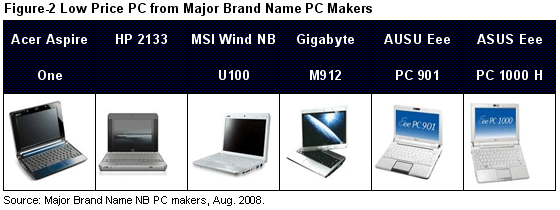
Focusing on the Low Priced NB niche, many brand name NB makers have launched different products. Besides EeePC from Asus, Acer introduced the Aspire One with 8GB SSD and 80GB HDD for storage. HP introduced the 2133 with 4GB SSD (see figure 1). Models from other NB makers such as Everex, VIA, DELL, MSI, GigaByte, etc mainly used Hard Disk Drive (HDD) for storage file.
According to DRAMeXchange estimates, affected by the shortage of Intel Atom processor, the total shipment of Low Price PC will reach 8M in 2008 with an average memory density of 8.3GB. Total shipment should reach 15M with the average memory density exceeding 16GB in 2009, and then increase steadily over the years. Overall, given the continued fall in NAND Flash price, the number of Low Price NB that uses NAND Flash as storage will continue to rise. In addition to utilizing on-board MLC SSD, as the SSD market will matures gradually after 2010, external storage device may also become a popular choice and trend for Low Price PC.
DDR3 transition to take faster pace in NB segment
Following the launch of Intel P4X series chipset during late 2Q, more attention has been drawn to DDR3. Yet, a noticeable price premium (~3x) between the two generation of memory has somehow frozen the transition.
In the desktop segment, the best-selling 945GC chipset in 1H08 still only supports DDR2, whereas for the second best-selling G3X chipset, it supports both DDR2 and DDR3. Since PC vendors are still designing their products to support DDR2, therefore, the Intel P45 is re-modeled to also support DDR2 in order to gain wide acceptance among customers.
It is expected that PC vendors will gear up on rolling out more model supporting DDR3 in 2H08 because: 1, standards of DDR3-compliant chipsets have already well established, such as strong feedback of P4X series at channels implies a stronger sales onwards; 2, memory oversupply will prompt memory makers to push PC vendors launching DDR3 products to reduce the loss.
The role that memory makers play in memory standard transition is to narrow down price premium between DDR3 and DDR2. Once the premium is lower, stronger incentive will be spurred among PC vendors. The easiest way to achieve this goal is to boost their production volume of DDR3. Some memory makers have already inked contracts with OEMs. Lower price is offered on an agreed volume of procurement. Not only sales, but also profitability is also guaranteed under these contracts.
Transition to DDR3 at notebook is likely to lead desktop, given that the top-ten vendors have grabbed over 80% share in the market. The oligopoly nature in the notebook industry means that the top vendors hold a stronger stance over price bargaining and new standard migration. In contrast to the notebook market, 45% of demand at the desktop market still comes from channels.

The memory market watcher
DRAMeXchange is a global primary provider of future intelligences, in-depth analysis reports and advisory services on DRAM and Flash memory industry with coverage including current business, spot trading prices, and market trends, capital spending and wafer capacity trends, the impact of DRAM/flash memory products on the market, and other relevant PC industry information.
© DRAMeXchange ® Tech.Inc. All rights reserved.